


D-Wave Quantum Shares Crashed in January. Is it Time to Buy?



Key Points
- D-Wave Quantum made a defining acquisition last month.
- The company now plans to lead in quantum annealing as well as gate-model systems.
- The valuation is high, and only risk-tolerant investors should own the stock at this stage.
D-Wave Quantum (NYSE: QBTS) wants to lead the development of quantum computing with a unique, dual-platform approach. The month of January included several steps to accomplish that goal.
Yet rather than sending shares higher, D-Wave stock lost 18.9% last month, according to data provided by S&P Global Market Intelligence. That makes it a good time to take another look at the investing thesis.
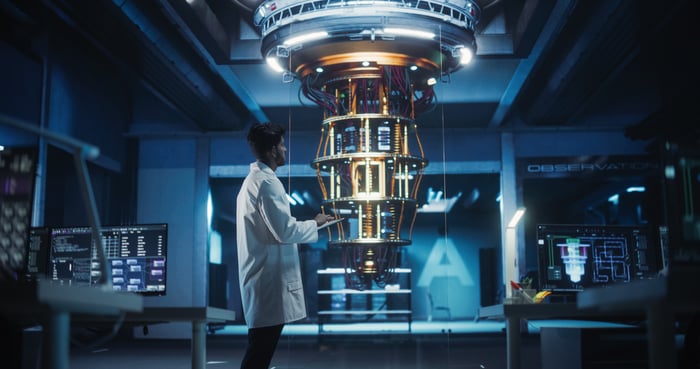
Image source: Getty Images.
Game-changing potential
Quantum computing could be a powerful game changer in many areas. It possesses enormous, transformative potential across industries such as pharmaceuticals, materials science, finance, and cybersecurity by tackling problems that classical computers cannot solve. 2025 was a somewhat breakthrough year as quantum sensing technology advanced beyond foundational research. The emphasis has shifted to production and deployment with quantum computing processing.
Companies are taking varied approaches, leaving investors to decide which, if any, quantum computing stocks to include in their portfolios. D-Wave was primarily known for its leading quantum annealing system, which is already commercially available. It's an energy-efficient system designed to help enterprises speed up decision-making, optimize operations, and respond to disruptions.
Last month, however, the company completed what could be a somewhat transformational acquisition. D-Wave brought Quantum Circuits Inc. (QCI) into its fold. That company creates full-stack superconducting gate-model quantum computing systems engineered for commercial scalability. The combination gives D-Wave a balance between its commercial annealing quantum systems and a path to develop gate-model quantum computers at scale for general-purpose, fault-tolerant computing.
Investors should keep eyes wide open
D-Wave didn't break the bank with the acquisition. The price to acquire QCI was $550 million, consisting of a combination of $300 million in D-Wave stock and $250 million in cash. That may seem like a big purchase considering D-Wave only generated about $22 million in revenue over the first nine months of 2025. But that revenue more than tripled compared to the prior year period, and D-Wave held a cash balance of $836.2 million as of Sept. 30, 2025.
Still, there's no guarantee the company will achieve enough success to justify its valuation of over $7 billion, let alone grow from there. Only highly risk-tolerant investors should own the stock at this early stage. Shares are going to be volatile, as evidenced by the 19% drop in January.
It's possible, if not likely, that investors will revalue the company if sales of D-Wave's quantum annealing system don't grow quickly enough, or if development of its gate-model system doesn't advance meaningfully this year. Investors should just be aware of those possibilities if wanting to speculate in the quantum annealing space.
Recommended Articles







Comments (0)
Click the $ button, enter the symbol, and select to link a stock, ETF, or other ticker.