Advanced Micro Devices (AMD) Stock Just Plunged. Buy the Dip, or Run for the Hills?

Key Points
AMD is trying to catch up to Nvidia in the market for artificial intelligence (AI) chips for the data center.
However, there are concerns about the massive deal it signed with ChatGPT creator OpenAI last year.
AMD stock plunged 15% after reporting its latest quarterly earning, but it's still relatively expensive.
Advanced Micro Devices (NASDAQ: AMD) is one of the world's top semiconductor suppliers. Its chips can be found in popular consumer products like Microsoft's Xbox and Sony's PlayStation 5, but investors are more focused on the company's data center business right now, where it sells graphics processing units (GPUs) for artificial intelligence (AI) development.
AMD will launch some of its most powerful AI chips ever during 2026, as it attempts to catch up to its fierce rival, Nvidia, in this lucrative market. However, the path to success is proving to be very bumpy. AMD reported its operating results for the fourth quarter of 2025 (ended Dec. 27) on Feb. 3, and its stock tumbled by 15% the following trading day.
Will AI create the world's first trillionaire? Our team just released a report on the one little-known company, called an "Indispensable Monopoly" providing the critical technology Nvidia and Intel both need. Continue »
Despite strong revenue and earnings growth for the period, Wall Street is now concerned about AMD's reliance on one particular AI customer to fuel its future GPU sales. Let's explore this potential challenge to determine whether or not investors should use the recent dip in AMD stock as a buying opportunity.
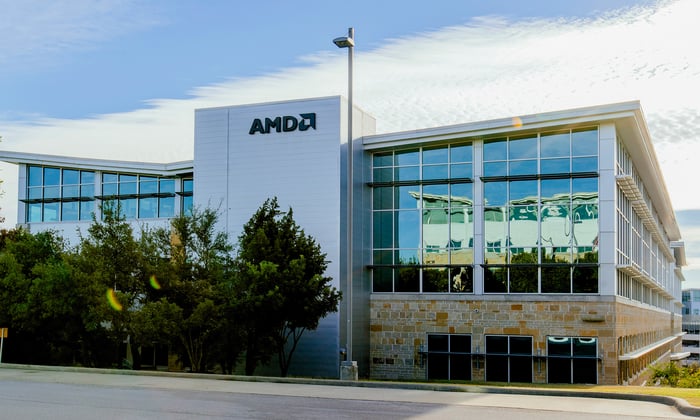
Image source: Advanced Micro Devices.
AMD might have an OpenAI problem
ChatGPT creator OpenAI is currently the world's largest AI start-up with an estimated valuation of over $500 billion in the private market. But there have been concerns about the defensibility of the company's business model, given the extremely competitive landscape for AI chatbots and coding assistants. In fact, last weekend, The Wall Street Journal reported that chip giant Nvidia is no longer planning to go through with a previously announced $100 billion investment in OpenAI.
This creates some serious issues, because OpenAI has committed to renting $281 billion worth of data center capacity from Microsoft's Azure cloud division, and a further $300 billion from Oracle Cloud Infrastructure. The start-up has also committed to buying up to 6 gigawatts worth of GPU compute capacity directly from AMD by 2030.
OpenAI currently has annualized revenue of around $20 billion, so it isn't generating anywhere near enough cash to fulfill all of these obligations. Therefore, its only option is to raise more money from investors, which will be tricky if major supporters like Nvidia are growing nervous.
This was a major topic of discussion during AMD's conference call with investors on Feb. 3. Wall Street analysts asked AMD CEO Lisa Su several questions about the status of the OpenAI deal, and she calmed some nerves by saying the start-up will receive the first batch of the latest MI450 GPUs in the second half of 2026 as planned.
MI450 GPUs are expected to deliver 36 times more performance than AMD's previous generation of GPUs when configured in the company's new Helios data center rack, which includes specialized hardware and software systems designed to extract maximum processing speeds for AI workloads.
However, there is no telling whether OpenAI will fulfill the rest of its obligations to AMD after the first round of shipments. Six gigawatts of compute capacity would include between 3 million and 6 million GPUs, worth around $90 billion (according to an estimate from Substack newsletter More Than Moore).
AMD's data center business is still growing quickly
AMD generated $34.6 billion in total revenue during 2025. The data center segment alone accounted for a record $16.6 billion of that total, growing by 32% compared to the previous year. So, the good news is that there is clear demand for AMD's AI GPUs from several customers other than OpenAI.
In fact, Su just told investors that AMD's data center revenue could grow by a whopping 60% annually over the next three to five years, with AI hardware sales alone bringing in tens of billions of dollars per year from 2027 onward. Of course, the OpenAI deal is baked into Su's forecast, so data center growth might be less impressive if the start-up doesn't meet its obligations.
Should you buy the dip on AMD stock?
AMD generated non-GAAP (adjusted) earnings of $4.17 per share during 2025, placing its stock at a price-to-earnings (P/E) ratio of 49.9. That means it's slightly more expensive than Nvidia stock, which trades at a P/E ratio of 43.5 based on its trailing-12-month adjusted earnings of $4.05.
Therefore, on the one hand, AMD stock still isn't cheap despite its recent correction. Nvidia is the leader in the AI hardware market, generating more data center revenue and faster growth than AMD, so AMD's premium valuation doesn't make much sense from that perspective. On the other hand, if Su is right and AMD's data center business produces a massive growth acceleration over the next few years, then its stock might be attractive at the current level for long-term investors.
With all of that said, patience might be the name of the game right now given the jitters in the AI space. I think AMD stock is vulnerable to further downside in the short term because of its relatively high valuation, so investors might get a better buying opportunity in the coming months.
Should you buy stock in Advanced Micro Devices right now?
Before you buy stock in Advanced Micro Devices, consider this:
The Motley Fool Stock Advisor analyst team just identified what they believe are the 10 best stocks for investors to buy now… and Advanced Micro Devices wasn’t one of them. The 10 stocks that made the cut could produce monster returns in the coming years.
Consider when Netflix made this list on December 17, 2004... if you invested $1,000 at the time of our recommendation, you’d have $443,299!* Or when Nvidia made this list on April 15, 2005... if you invested $1,000 at the time of our recommendation, you’d have $1,136,601!*
Now, it’s worth noting Stock Advisor’s total average return is 914% — a market-crushing outperformance compared to 195% for the S&P 500. Don't miss the latest top 10 list, available with Stock Advisor, and join an investing community built by individual investors for individual investors.
*Stock Advisor returns as of February 8, 2026.
Anthony Di Pizio has no position in any of the stocks mentioned. The Motley Fool has positions in and recommends Advanced Micro Devices, Microsoft, Nvidia, and Oracle. The Motley Fool has a disclosure policy.
Related Articles
Amazon Stock Predictions for 2026 to 2030: Will They Exceed Expectations and Achieve Major Long-Term Goals?
TradingKey - As we head into 2026, many investors are questioning where Amazon (AMZN) fits into the technology world.
A Crash After a Surge: Why Silver Lost 40% in a Week?
TradingKey - Spot silver (XAGUSD) prices continue to decline. Silver plunged 20% on Thursday, breaking below $71 per ounce, with the sell-off intensifying on Friday as prices fell further below $64. Compared to the all-time high set on January 29, silver prices have retraced more than 40%, wiping out nearly all gains accumulated over the previous month.
Is Bitcoin’s Four-Year Cycle Dead in 2026?
Is the Bitcoin 4-year cycle dead? After 2025 broke historical records with a red post-halving year, institutional analysts explore if the Bitcoin price has decoupled from the halving countdown. Analyze the impact of spot ETFs, global liquidity, and the roadmap to the 2028 halving in this 2026 market
Why Ripple ETFs are Winning the Capital War Against Bitcoin
While Bitcoin and Ethereum ETFs face massive outflows, XRP ETFs have defied market trends with a historic 30-day inflow streak reaching $1.37 billion. Explore why institutional "smart money" is rotating into Ripple, the structural impact of the "Liquidity Lock," and why analysts set a 2026 price tar