


Pre-Bell | Stock Futures Muted; Nvidia-Linked Shares Rally With Aeva up 26%; Zeta Rockets 10% on OpenAI Collaboration; Novo Jumps Another 4%



01 Stock Market
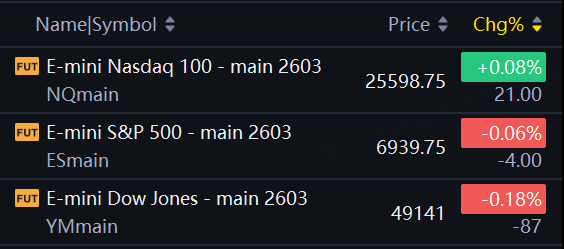
As of Jan 6, U.S. stock index futures are mixed, with Dow futures softer, S&P 500 futures flat, and Nasdaq 100 futures slightly higher. E-mini Dow futures slipped 0.18%, while E-mini S&P 500 futures edged down 0.06%. E-mini Nasdaq 100 futures rose 0.08%, suggesting megacap tech could open on a firmer footing as investors digest high-profile product news from the CES technology showcase.
Notable Stock Movers: semiconductor and AI-adjacent names outperformed, while select megacaps and EVs eased. NVIDIA (NVDA) up 0.60% at $189.25; Advanced Micro Devices (AMD) up 0.68% at $222.59; Micron (MU) up 1.36% at $316.38; Intel (INTC) up 1.22% at $39.85; Taiwan Semiconductor (TSM) up 1.91% at $328.40. EV-related trading was mixed: Tesla (TSLA) down 0.40% at $449.88; Apple (AAPL) down 0.25% at $266.59. Lidar and autonomy names gained: Aeva (AEVA) up 25.9% at $16.48; Hesai (HSAI) up 5.57% at $25.60. Precious-metals proxies advanced: iShares Silver Trust (SLV) up 2.75% at $70.98; ProShares Ultra Silver (AGQ) up 5.44% at $190.00.
Semiconductor strength coincides with fresh AI chip and platform announcements from industry leaders at CES, while autonomy hardware names reacted to ecosystem partnerships. Obesity drug dynamics supported select pharma-linked ADRs pre-bell, with Novo Nordisk (NVO) up 3.86% at $57.24, and nuclear-themed stocks were bid after supportive policy headlines, including NuScale (SMR) up 3.09% at $19.36. Elsewhere, Alibaba (BABA) down 0.92% at $154.82 and Amazon (AMZN) down 0.08% at $232.88 traded slightly lower ahead of the bell.
02 Other Markets
10-year U.S. Treasury yield rose 0.43%, to 4.18%.
U.S. Dollar Index rose 0.0905% to 98.44.
WTI crude oil futures rose 0.50% to 58.61 USD/barrel; COMEX gold futures rose 0.50% to 4473.70 USD/ounce.
03 Key News
AMD unveiled higher-performing AI chips and new PC processors, signaling a broader AI hardware push. At a CES keynote, the company presented MI455 data center accelerators and the MI440X for enterprise on‑premise systems, alongside Ryzen AI 400 Series and Ryzen AI Max+ chips for AI PCs. Management also previewed the MI500 platform, highlighting major performance gains to compete more directly in high-intensity AI workloads.
NVIDIA announced its Vera Rubin AI computing platform is in full production, expanding capacity for training and inference. The six‑chip “platform” includes a new CPU, a Rubin GPU tuned for inference, and Spectrum-6 Ethernet switching to enable large‑scale “AI factory” deployments. Co‑designed CPU/GPU components aim to reduce latency and improve performance per watt, with shipments expected to begin later in the year.
NVIDIA selected Hesai as a LiDAR partner for the DRIVE AGX Hyperion 10 platform, deepening its autonomous driving ecosystem. The partnership integrates Hesai’s sensors into NVIDIA’s reference architecture for autonomous vehicles, increasing supplier visibility and potential program design‑ins. The tie‑up underscores NVIDIA’s strategy to align best‑in‑class component suppliers with its end‑to‑end AV stack.
Tesla introduced a 5‑year interest‑free loan program for Model 3/Y purchases in China to stimulate demand. The financing offer broadens affordability and could support near‑term delivery volumes in a key market. Investors will monitor the trade‑off between incremental unit growth and potential pressure on per‑vehicle profitability.
Eli Lilly cut prices for Mounjaro in China, escalating competition with Novo Nordisk and local rivals. The reductions cover multiple dosage levels and follow recent moves by competitors, aligning with broadening insurance reimbursement for diabetes indications. Lower prices could accelerate volume adoption while pressuring margins across the GLP‑1 weight‑loss and diabetes segment.
The U.S. Department of Energy awarded substantial contracts to domestic nuclear fuel producers to rebuild supply chains. Funding supports purchases of low‑enriched uranium and high‑assay low‑enriched uranium, helping reduce reliance on Russian supply and enabling future small modular reactor deployment. Additional support was allocated to next‑generation enrichment technology, benefiting companies positioned along the nuclear fuel cycle.
Zeta Global integrated OpenAI models into its Athena AI agent to enhance marketing automation capabilities. The upgrade brings voice‑activated responses and an adaptive interface within the Zeta Marketing Platform, aiming to streamline campaign execution for enterprise clients. The move could deepen customer engagement and expand AI‑driven features across Zeta’s product suite.
Datavault AI entered a Master Purchase Order Agreement with AP Global Holdings, expanding its commercial pipeline. The agreement is expected to support new deployments for data monetization solutions and could bolster near‑term bookings. Shares exhibited heightened volatility in pre‑market trading as investors assessed revenue visibility from the pact.
Intel introduced Panther Lake chips, with orders opening, to compete in the next wave of AI‑enabled PCs. The launch complements increasing PC‑side AI compute demand and responds to rival announcements at CES. Management framed the rollout as part of a broader roadmap to embed AI acceleration at the edge and in consumer devices.
NVIDIA outlined plans to test Level 4 robotaxi services with partners and launched a new AI toolkit for robotics and autonomous vehicles. Management framed this as a step toward “physical AI,” where machines can reason and act in real‑world environments. The initiative expands NVIDIA’s addressable market from data centers to autonomy across mobility and industrial applications.
Sources: Reuters, Dow Jones, Tiger Newspress, public market data
Disclaimer: For informational purposes only; not investment advice.
Recommended Articles





Comments (0)
Click the $ button, enter the symbol, and select to link a stock, ETF, or other ticker.