


FOMO Versus Bubble Fears Signal Heightened Stock Volatility in 2026



The US stock market is expected to remain volatile in 2026 as investors grapple with the dual pressures of fearing they might miss out on the AI-driven rally and worrying that the sector could be an impending bubble.
Sharp sell-offs followed by rapid recoveries have characterized markets over the past 18 months, a pattern likely to persist into 2026. Some strategists predict AI stocks will follow the historical boom-bust trajectory of past technological revolutions.
Tech giants leading the AI investment surge wield disproportionate market influence. While their outperformance relative to the broader S&P 500 has helped suppress overall volatility in 2025 (as tech gains offset declines elsewhere), investors remain wary of potential stumbles in semiconductor stocks triggering market-wide turbulence. Such a scenario could cause volatility indicators like the Cboe Volatility Index (VIX) to spike dramatically.
"2025 has been marked by sector rotation and narrow market leadership rather than broad risk-on/risk-off sentiment," noted a derivatives strategist at UBS. "This pushed implied correlations to record lows, leaving the VIX vulnerable to sharp spikes whenever macroeconomic factors regain dominance."
Recent surveys show fund managers view bubble risks as their primary concern following the market's steep rally. However, the equally classic fear of missing out on further gains continues to complicate investment decisions, potentially punishing those who exit positions prematurely.
Strategists anticipate elevated equity volatility in 2026, as asset bubbles typically grow more unstable during expansion phases. Investors should prepare for periodic 10%+ pullbacks followed by rapid recoveries as traders realize the bubble hasn't burst.
UBS strategists suggest positioning for either AI boom continuation or collapse by owning volatility contracts on the tech-heavy Nasdaq 100. Their US equity derivatives head noted such volatility plays perform well in both scenarios and can be structured as directionally neutral through straddles or OTC swaps.
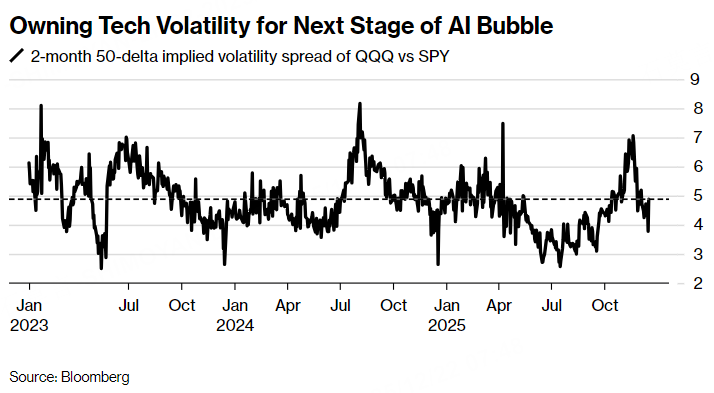
"Buying Nasdaq 100 volatility while selling S&P 500 volatility represents our highest-conviction trade for 2026," the UBS executive stated.
JPMorgan analysts expect volatility to oscillate between technical/fundamental factors suppressing it and macroeconomic forces pushing it above average. While projecting a median VIX of 16-17 for 2026, they anticipate periodic risk-off surges.
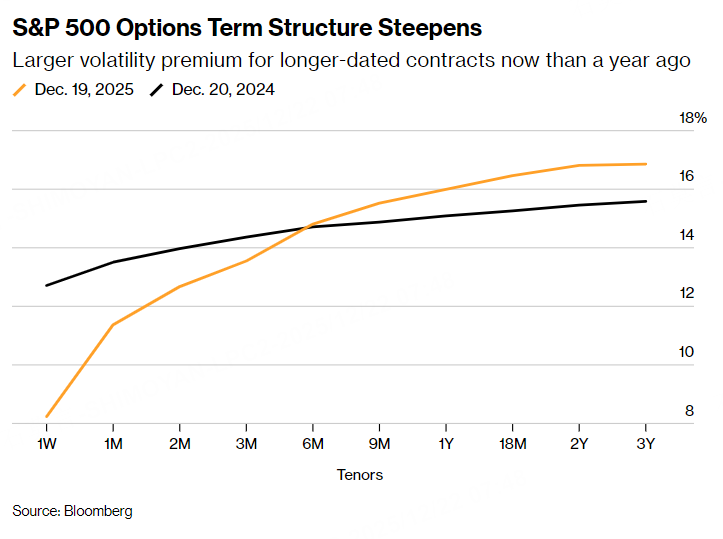
A Citi structuring head highlighted another technical factor: investment flow imbalances likely to steepen the volatility curve in 2026. "Retail and institutional supply dominates the short end, while hedging flows support the long end, creating a steep term structure," he explained.
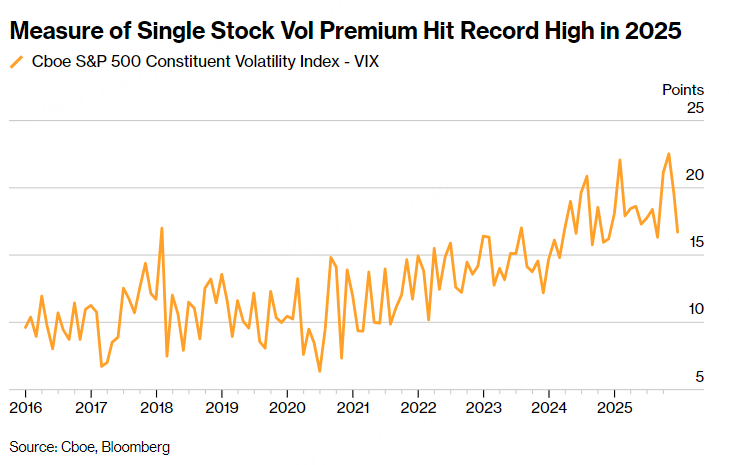
The dispersion trade (betting on higher single-stock volatility versus index moves) should see strong early-year demand, though some funds are now taking contrarian positions. "Dispersion has become an overcrowded tourist trade—we're running the reverse position," noted a volatility fund CIO.
As dispersion strategies mature, firms must innovate to extract returns. "The easy alpha's gone—now it's about better implementation, stock selection, and tactical timing," commented a hedge fund investment chief.
Capital inflows should maintain single-stock volatility premiums, particularly as January expiration cycles prompt hedge funds to rebuild custom basket positions.
Timing volatility shifts remains the critical challenge. Société Générale's regime-switching model—which uses yield curve signals to toggle between long/short volatility positions—currently forecasts higher 2026 volatility, anticipating a new AI-driven corporate releveraging cycle.
Bloomberg Intelligence's derivatives strategist concluded: "The interplay of FOMO, conflicting AI narratives, and policy uncertainty creates ideal conditions for volatility trading in 2026, making tail risk hedging essential."
Recommended Articles






Comments (0)
Click the $ button, enter the symbol, and select to link a stock, ETF, or other ticker.