


Magnificent 7 Is Passe. These AI Stocks Can Replace It



The Magnificent Seven, the most powerful stock portfolio on Wall Street, is looking a tad dated. Make way for the Eight Giants. Or maybe the Golden Dozen. Or the TenAI of GenAI.
It’s been nearly three years since OpenAI’s ChatGPT put artificial intelligence at the center of the global economy, and during that time, one trade has dominated the U.S. stock market: buying the Mag Seven. Comprised of NVIDIA Corp., Microsoft Corp., Apple Inc., Alphabet Inc., Amazon.com Inc., Meta Platforms, Inc. Inc. and Tesla Motors Inc., this septet was seen as best positioned to deliver huge returns to investors during the biggest technological shift since the internet.
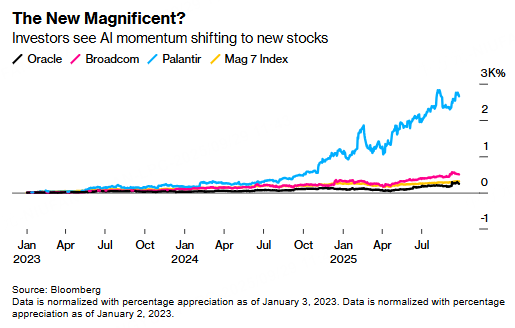
Although this has largely come to an end, an interesting thing happened in the process of moving towards global dominance. Artificial intelligence trading has expanded in unexpected ways and surpassed several of the most popular large technology companies in the market. So investment strategies based on the Magnificent Seven — which is responsible for more than half the S&P 500 Index’s 70%-plus rise since the start of 2023 — are missing some of the firms that are also expected to thrive in an AI future, like Broadcom Inc., Oracle Corp. and Palantir Technologies Inc. Inc.
“Just because the Mag Seven won past tech cycles like mobile, the internet and e-commerce, that doesn’t mean they’ll win here,” said Chris Smith, who oversees $2.4 billion as the portfolio manager of Artisan Partners’ Antero Peak Group. “The next winners will be the ones that address large and unconstrained markets through AI, becoming bigger companies in the future than the Mag Seven are today.”
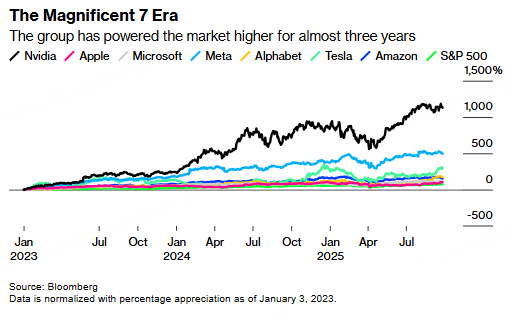
This does not mean that the original seven are going away. Data from Bloomberg Intelligence shows that the Mag Seven accounts for nearly 35% of the S&P 500 index, and its earnings are expected to climb more than 15% in 2026 on the back of 13% revenue growth. Other constituent companies in the S&P 500 index that do not include the Mag Seven are expected to see their profits increase by 13% and their revenues rise by 5.5% next year.
But there’s a divergence within the group’s stock-market performance. Nvidia, Alphabet, Meta and Microsoft are considered to be in a favorable position in the field of artificial intelligence, and their share prices have risen by 21% to 33% this year. On the other hand, the prospects for Apple, Amazon and Tesla are not so clear; they are lagging far behind.
“It is hard to see the current Mag Seven as the best representation of AI,” Smith said.
So Wall Street has been proposing variations to the theme to capture the real winners. Some have trimmed it to a “Fab Four” of Nvidia, Microsoft, Meta and Amazon. Jonathan Golub, chief equity strategist at Seaport Research, proposes removing Tesla to create the “Big Six.” Others like Ben Reitzes of Melius Research prefer an “Elite 8” of the Mag Seven plus chipmaker Broadcom, which is now the seventh-largest company in the US by market capitalization.
But none of these covers all artificial intelligence transactions. For instance, with the take-off of its cloud computing business related to artificial intelligence, Oracle's share price has risen by more than 75% this year. So far, Palantir is the best-performing company in the Nasdaq 100 Index, which is dominated by technology stocks. Due to the strong demand for its artificial intelligence software, the company soared by 135% in 2025.
“A company can become too big to ignore,” said Jurrien Timmer, who helps oversee $16.4 trillion in assets under administration as director of global macro at Fidelity Investments. “It could be that as the AI story evolves new winners take the place of the old winners, even if the previous ones continue to do fine.”
On Wall Street, the concept of the "Magnificent Seven" is nothing new. They like to create collections of popular stocks in order to simplify the market for investors, from the "Nifty Fifty" in the 1960s. From the "Four Horsemen" of Nasdaq in the dot-com era to the FAANGs that dominated the era between smartphones and artificial intelligence at the beginning of this century. But just as these groups dominated their times, they eventually ceded the leadership to new names, and this seems destined to happen to artificial intelligence.
In a sign of how Wall Street is looking beyond the Mag Seven, Cboe Global Markets Inc. is launching futures and options based on what it is calling the Cboe Magnificent 10 Index, which includes the original seven along with Broadcom, Palantir and Advanced Micro Devices Inc., Nvidia’s much-smaller rival in processing chips.
That index shows how subjective this exercise can be. Cboe’s announcement came on Sept. 10, just as Oracle was having its biggest one-day gain since 1992 following a robust forecast that cemented its status as a major AI winner. Oracle’s stock is beating most of the Mag Seven since the start of 2023. But it still didn’t make the cut for the Magnificent 10.
“We do need to expand the conversation beyond just the Mag Seven,” said Nick Schommer, a portfolio manager who manages approximately $34.7 billion across investment strategies, including the Janus Henderson Transformational Growth ETF. “Oracle is definitely a part of it now, and so is Broadcom.”
Cboe declined to make someone available to discuss index’s methodology, but said in its press release announcing the Mag 10 that the components were selected “based on liquidity, market value, trading volume and leadership in areas like artificial intelligence and digital transformation.”
Next Generation Leaders
Wall Street professionals have nominated many candidates for the next generation of leaders, but some companies are mentioned particularly frequently in interviews. Taiwan Semiconductor Manufacturing, along with Oracle and Broadcom, is regarded as a key component of the artificial intelligence ecosystem. While leading enterprises in the traditional software industry, such as Salesforce.com Inc. and Adobe Inc. are striving to overcome the perception that they are lagging behind, Palantir is regarded as one of the few winners in artificial intelligence software.
As for which stocks are no longer magnificent, Apple and Tesla are mentioned most frequently. Apple has not achieved the same level of growth as other tech giants and is regarded as lagging far behind in artificial intelligence. Meanwhile, with sales drying up and the emergence of competitors, Tesla's electric vehicle business is under tremendous pressure.
But these two companies still have a large number of stock market fans betting that they will come to the rescue when the time is right. For Apple, it is betting that the iPhone will become the device through which millions of consumers access artificial intelligence. Tesla investors hope that the self-driving and humanoid robots promoted by CEO Elon Musk will bring about future growth, all of which require artificial intelligence.
There’s also a lengthening list of industries benefiting from AI, including power generators and other elements of the AI infrastructure build out, like communications equipment company Arista Networks Inc., memory chipmaker Micron Technology, and storage companies such as Western Digital Corp., Seagate Technology PLC Holdings Plc and SanDisk Corp.
Another challenge in pegging the AI trade is several key companies are private. OpenAI is likely to be on any list of winners in artificial intelligence, but most investors have no access to it, although it is reported that it is negotiating to sell its shares at a valuation of about $500 billion. Anthropic and SpaceX have not gone public either.
With the explosive growth of artificial intelligence, the beneficiaries may shift from companies that drive the rise to those that provide AI-specific services and products, and eventually to enterprises that leverage AI to enhance efficiency and growth. This transformation may determine the ultimate winner of artificial intelligence - no matter how Wall Street ultimately decides to call them.
“As that evolution happens, the leaders of the AI boom may become expensive, their growth and cash flow could stop looking as good, and the trade will start to fray at the edges,” Fidelity’s Timmer said. “The problem with a concentrated market is that we could have a disruptive change as leadership falls out of favor. We’re not currently at valuation levels that make me scratch my head, but right now we can’t say if the Mag Seven era will end with a benign rotation or a crash.”
Recommended Articles




Comments (0)
Click the $ button, enter the symbol, and select to link a stock, ETF, or other ticker.