Why Did Warren Buffett Just Sell Investments He's Recommended Millions of Others Buy?

Warren Buffett wrote to Berkshire Hathaway shareholders in 2014 that most investors shouldn't try to pick individual stocks to buy because they couldn't "predict their future earnings power." Instead, he recommended that the typical investor buy a "low-cost S&P 500 index fund."
Berkshire's portfolio included two low-cost S&P 500 index exchange-traded funds (ETFs) for several years: the SPDR S&P 500 ETF Trust (NYSEMKT: SPY) and the Vanguard S&P 500 ETF (NYSEMKT: VOO). But the conglomerate doesn't own the ETFs anymore. Buffett exited Berkshire's positions in both S&P 500 funds in the fourth quarter of 2024.
Where to invest $1,000 right now? Our analyst team just revealed what they believe are the 10 best stocks to buy right now. Learn More »
Why did Buffett sell investments he's recommended millions of others buy? He hasn't explained the decision publicly, but several possible reasons exist.
Image source: The Motley Fool.
Unlikely reasons
Let's start with possible reasons behind Buffett's sales of the SPDR S&P 500 ETF Trust and Vanguard S&P 500 ETF that are unlikely. Perhaps the easiest one to scratch off the list is that Berkshire needed to raise cash. Although that's sometimes a reason to sell stocks and ETFs, it doesn't hold water in this case. Berkshire ended the third quarter of 2024 with over $325 billion in cash, cash equivalents, and short-term investments in U.S. Treasury bills. Selling the two S&P 500 ETFs wouldn't add much to this total.
Could Buffett have sold these funds because he expects a stock market crash? I seriously doubt it. For one thing, the legendary investor wrote in a 2008 New York Times op-ed, "Let me be clear on one point: I can't predict the short-term movements of the stock market. I haven't the faintest idea as to whether stocks will be higher or lower a month or a year from now."
Buffett has never changed his stance on his lack of ability to forecast what the stock market will do over the near term. In his 2022 letter to Berkshire Hathaway shareholders, he wrote that he believed "that near-term economic and market forecasts are worse than useless."
We could be on to something with valuation, though. Buffett is a value investor, and the S&P 500 isn't cheap right now. In fact, the S&P 500 Shiller CAPE ratio, one of the best valuation metrics for the widely followed index, is near its second-highest level in history.
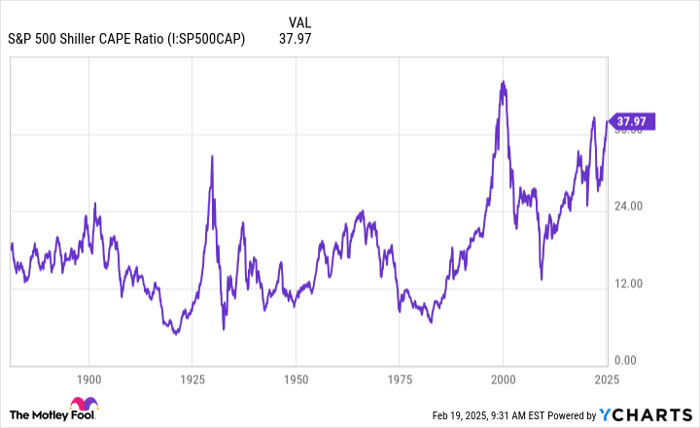
S&P 500 Shiller CAPE Ratio data by YCharts
However, there's a simple reason to believe that Buffett didn't sell the two S&P 500 ETFs because of concerns about valuation: Berkshire owns other individual stocks that trade at even higher earnings multiples than the S&P 500, including its largest holding -- Apple. If Buffett was truly worried about valuation, he would have sold those stocks too.
Most likely reason
So why did Buffett sell the SPDR S&P 500 ETF Trust and Vanguard S&P 500 ETF? We don't know for sure. But the most likely reason is that he and his investment managers were doing a little clean-up of Berkshire's portfolio.
These two S&P 500 index funds were very small positions for Berkshire. The conglomerate owned 43,000 shares of the Vanguard S&P 500 ETF worth roughly $22.7 million at the end of the third quarter of 2024. Its stake in the SPDR S&P 500 ETF Trust was even smaller -- 39,400 shares valued at $22.6 million at the end of Q3. Most of Berkshire's holdings are valued in the hundreds of millions or billions of dollars.
Buffett and his two investment managers, Todd Combs and Ted Weschler, have exited small positions in the past as part of similar portfolio clean-ups. The rationale behind these moves is that it doesn't make sense to have money tied up in holdings that aren't significant enough to move the needle much.
Is Buffett's original advice still sound?
Has Buffett changed his mind about the wisdom of investing in low-cost S&P 500 index funds? I don't think so.
As Buffett wrote in his 2013 letter to Berkshire Hathaway shareholders, "In aggregate, American business has done wonderfully over time and will continue to do so (though, most assuredly, in unpredictable fits and starts." Buying S&P 500 ETFs provides an easy way to invest in American business in aggregate.
Buffett acknowledged, though, that investing heavily "at a time of extreme exuberance" could result in paper losses. His solution was to "accumulate shares over a long period and never sell when the news is bad and stocks are well off their highs." He added, "Following these rules, the 'know-nothing' investor who both diversifies and keeps his costs minimal is virtually certain to get satisfactory results."
That's still sound advice more than a decade later.
Don’t miss this second chance at a potentially lucrative opportunity
Ever feel like you missed the boat in buying the most successful stocks? Then you’ll want to hear this.
On rare occasions, our expert team of analysts issues a “Double Down” stock recommendation for companies that they think are about to pop. If you’re worried you’ve already missed your chance to invest, now is the best time to buy before it’s too late. And the numbers speak for themselves:
- Nvidia: if you invested $1,000 when we doubled down in 2009, you’d have $361,026!*
- Apple: if you invested $1,000 when we doubled down in 2008, you’d have $46,425!*
- Netflix: if you invested $1,000 when we doubled down in 2004, you’d have $562,659!*
Right now, we’re issuing “Double Down” alerts for three incredible companies, and there may not be another chance like this anytime soon.
*Stock Advisor returns as of February 3, 2025
Keith Speights has positions in Apple, Berkshire Hathaway, and Vanguard S&P 500 ETF. The Motley Fool has positions in and recommends Apple, Berkshire Hathaway, and Vanguard S&P 500 ETF. The Motley Fool has a disclosure policy.
Related Articles
National Debt Bomb Ignited? Musk Warns U.S. Will Be 1000% Bankrupt Without AI
TradingKey - Tesla (TSLA) CEO Elon Musk recently issued another warning regarding the rapidly ballooning U.S. national debt. He stated clearly that without artificial intelligence and robotics, the United States will inevitably head toward fiscal bankruptcy.
Why Sanae Takaichi Winning Japan’s Diet Election Led to a Surge in Japanese Stock Indices?
TradingKey - Reports indicate that the ruling coalition led by Japanese Prime Minister Sanae Takaichi has secured a single-party majority in the parliamentary elections held on Sunday (February 8). Following the news, the yen weakened slightly, while the Nikkei Index surpassed 57,000 for the first t
A Crash After a Surge: Why Silver Lost 40% in a Week?
TradingKey - Spot silver (XAGUSD) prices continue to decline. Silver plunged 20% on Thursday, breaking below $71 per ounce, with the sell-off intensifying on Friday as prices fell further below $64. Compared to the all-time high set on January 29, silver prices have retraced more than 40%, wiping out nearly all gains accumulated over the previous month.
Is Bitcoin’s Four-Year Cycle Dead in 2026?
Is the Bitcoin 4-year cycle dead? After 2025 broke historical records with a red post-halving year, institutional analysts explore if the Bitcoin price has decoupled from the halving countdown. Analyze the impact of spot ETFs, global liquidity, and the roadmap to the 2028 halving in this 2026 market