Stock-Split Watch: Is Meta Platforms Next?

Meta Platforms (NASDAQ: META) isn't a cheap stock anymore, at least on a dollars-per-share basis. Its stock price has reached over $700 per share, a range that many investors begin wondering if a stock split is imminent. Meta has never split its stock before, so this is a bit of uncharted territory for the company.
Is Meta due for a stock split soon? After all, it's near a range where many of its big tech peers have enacted stock splits.
Where to invest $1,000 right now? Our analyst team just revealed what they believe are the 10 best stocks to buy right now. Learn More »
There is no historical precedent for a Meta Platforms stock split
With the success of big tech stocks over the past decade, many of them have undergone stock splits. Apple underwent one in 2020 when it split its stock 4-for-1. At that time, Apple was trading over $500 per share, which was not far from where Meta is now. Nvidia has undergone two stock splits in its meteoric rise: one in 2021 and another in 2024. The 2024 one occurred when the stock was trading around $1,200 per share, while the 2021 split occurred when the stock was trading just shy of $800.
So, there's historical precedent for a company like Meta to split its stock around these price points, but why does it matter?
Investors get excited for stock splits because they perceive the stock to suddenly be cheaper. This is rooted in psychological thinking, even though not much has changed with the stock.
Most stock splits are purely cosmetic, although they do have some benefits. They are:
- Stock splits allow companies to give stock grants to employees more easily.
- Stock splits allow investors without access to fractional shares to purchase the stock more easily.
- Stock splits open up more option strategies to investors.
I'd argue that only the first point truly matters to the company, so it's clear that stock splits are mostly cosmetic. However, I think that finding companies splitting their stock is a smart idea, as companies only split their stock for one reason: The stock price has risen a lot.
Finding companies with rising stock prices is smart, as it indicates that the business is doing well. While some may shy away from buying a stock that has risen so much, I believe it indicates a high-quality company -- something Meta clearly is.
Meta Platforms has become even more dominant over the past few years
Meta Platforms is the parent company of social media sites Facebook, Threads, Instagram, and WhatsApp. These dominant platforms generate a ton of advertising revenue, which has turned Meta into an absolute financial powerhouse. In Q4 alone, Meta's Family of Apps generated $47.3 billion in revenue and converted $28.3 billion of that into operating income. That's a 61% operating margin, which is nearly unheard of from any company in any industry.
While Meta has started to pay dividends and repurchase shares, it's using much of that cash flow to expand its artificial intelligence (AI) offering. In 2025, Meta expects to spend between $60 billion and $65 billion on capital expenditures, mostly centered around its AI investments. That's a lot of money, but it's clear that there's a huge market opportunity there.
Meta CEO Mark Zuckerberg believes that 2025 will be the year when an AI agent can create a good mid-level engineer. This would be a massive breakthrough and would multiply the company's engineering power, boosting its resources.
Right now, AI isn't a profit center for Meta; it's a cost. However, there are a few avenues where it could help Meta generate revenue, but those days are still a bit in the future. As a result, we should value the company on its current business.
Meta Platforms trades for 30 times trailing earnings and 28 times forward earnings, indicating that Wall Street isn't as bullish on its 2025 prospects.
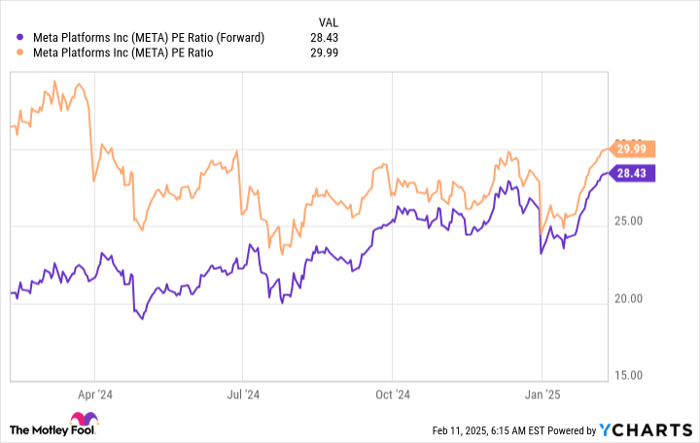
META PE Ratio (Forward) data by YCharts
This can be traced back to Meta's massive expenditure plan for 2025, but I still think it is a reasonable price to pay for a company with Meta's dominance in both the social media field and the generative AI sector.
While I'm not sure if Meta Platforms will undergo a stock split anytime soon, I don't think it matters, as the stock looks like a great buy now and doesn't need the catalyst of a stock split to send it higher.
Don’t miss this second chance at a potentially lucrative opportunity
Ever feel like you missed the boat in buying the most successful stocks? Then you’ll want to hear this.
On rare occasions, our expert team of analysts issues a “Double Down” stock recommendation for companies that they think are about to pop. If you’re worried you’ve already missed your chance to invest, now is the best time to buy before it’s too late. And the numbers speak for themselves:
- Nvidia: if you invested $1,000 when we doubled down in 2009, you’d have $340,048!*
- Apple: if you invested $1,000 when we doubled down in 2008, you’d have $44,908!*
- Netflix: if you invested $1,000 when we doubled down in 2004, you’d have $554,019!*
Right now, we’re issuing “Double Down” alerts for three incredible companies, and there may not be another chance like this anytime soon.
*Stock Advisor returns as of February 3, 2025
Randi Zuckerberg, a former director of market development and spokeswoman for Facebook and sister to Meta Platforms CEO Mark Zuckerberg, is a member of The Motley Fool's board of directors. Keithen Drury has positions in Nvidia. The Motley Fool has positions in and recommends Apple, Meta Platforms, and Nvidia. The Motley Fool has a disclosure policy.
Related Articles
National Debt Bomb Ignited? Musk Warns US Will Be 1000% Bankrupt Without AI
TradingKey - Tesla (TSLA) CEO Elon Musk recently issued another warning regarding the rapidly ballooning U.S. national debt. He stated clearly that without artificial intelligence and robotics, the United States will inevitably head toward fiscal bankruptcy.
Why Sanae Takaichi Winning Japan’s Diet Election Led to a Surge in Japanese Stock Indices?
TradingKey - Reports indicate that the ruling coalition led by Japanese Prime Minister Sanae Takaichi has secured a single-party majority in the parliamentary elections held on Sunday (February 8). Following the news, the yen weakened slightly, while the Nikkei Index surpassed 57,000 for the first t
A Crash After a Surge: Why Silver Lost 40% in a Week?
TradingKey - Spot silver (XAGUSD) prices continue to decline. Silver plunged 20% on Thursday, breaking below $71 per ounce, with the sell-off intensifying on Friday as prices fell further below $64. Compared to the all-time high set on January 29, silver prices have retraced more than 40%, wiping out nearly all gains accumulated over the previous month.
Is Bitcoin’s Four-Year Cycle Dead in 2026?
Is the Bitcoin 4-year cycle dead? After 2025 broke historical records with a red post-halving year, institutional analysts explore if the Bitcoin price has decoupled from the halving countdown. Analyze the impact of spot ETFs, global liquidity, and the roadmap to the 2028 halving in this 2026 market