



Nvidia Stock Investors Just Got Good News From Meta Platforms and Microsoft

China's DeepSeek recently published a research paper that shocked Wall Street. The startup company claims it spent less than $6 million to train an artificial intelligence (AI) model whose performance matches or nearly matches that of leading U.S. models. Comparatively, OpenAI spent more than $100 million on its GPT-4 model.
Nvidia (NASDAQ: NVDA) stock declined sharply on the news. Its market value fell nearly $600 billion in a single day, the largest daily loss by any listed company in history. The logic behind the crash is straightforward: If DeepSeek built a good AI model for less money, U.S. companies can use the same training methods to achieve similar efficiencies.
Where to invest $1,000 right now? Our analyst team just revealed what they believe are the 10 best stocks to buy right now. See the 10 stocks »
Consequently, investors are worried U.S. companies would spend less than anticipated on Nvidia GPUs, which are usually the most expensive line item in AI infrastructure budgets. But the market may have overreacted. Nvidia shareholders just got good news from Meta Platforms (NASDAQ: META) and Microsoft (NASDAQ: MSFT), two of its largest customers.
Read on to learn more.
Good news from Meta Platforms: CEO Mark Zuckerberg views heavy investments in AI as a strategic advantage
Meta Platforms CFO Susa Li told analysts on the fourth-quarter earnings call that capital expenditures would increase as much as 66% to $65 billion in 2025 to support its generative AI efforts and core business. That represents a material acceleration from the 39% increase in capital expenditures last year.
CEO Mark Zuckerberg also provided context, telling analysts Meta's ability to spend heavily on AI is going to be a "strategic advantage" over time. He also said more efficient training methods do not necessarily reduce the need for AI chips. Instead, he sees recent breakthroughs as an opportunity to apply more computing power to inference workloads to "generate a higher level of intelligence and a higher quality of service."
Good news from Microsoft: CEO Satya Nadella says demand will increase exponentially as AI becomes more affordable
Not to be outdone by DeepSeek, Microsoft CEO Satya Nadella said on the latest earnings call: "We ourselves have been seeing significant efficiency gains in both training and inference for years now. On inference, we have typically seen more than 2x price-performance gain for every hardware generation and more than 10x for every model generation due to software optimizations."
However, Nadella thinks the consequences will be favorable for Nvidia. "As AI becomes more efficient and accessible, we will see exponentially more demand," he told analysts on the call. Nadella also posted on X: "Jevons paradox strikes again! As AI gets more efficient and accessible, we will see its use skyrocket."
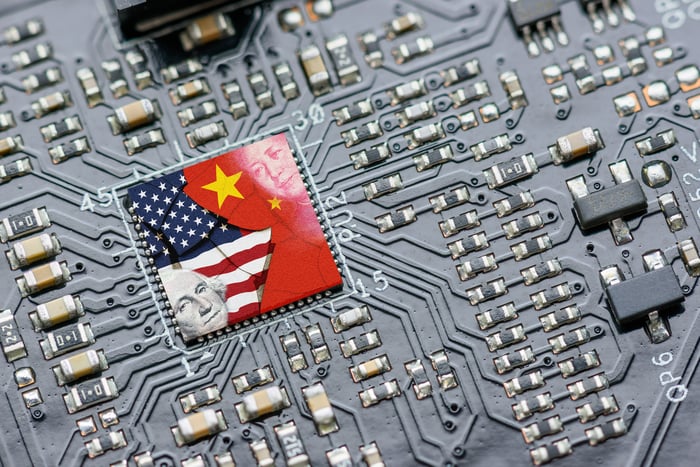
Image source: Getty Images.
What the Jevons paradox means for Nvidia
In the 1860s, economist William Stanley Jevons argued that the technological advancements that made coal a more efficient energy source paradoxically created more demand for coal. Put differently, Jevons believed the cost reductions arising from the greater price performance of coal were more than offset by the resultant increase in spending.
When applied to Nvidia, the Jevons paradox means more efficient AI training methods will ultimately drive more demand for AI software and services. In turn, the cost savings arising from improved price performance of GPUs may be more than offset by the resultant increase in demand for those AI processors.
Indeed, since DeepSeek published its report, Morgan Stanley analysts have upwardly revised their capital expenditure estimates, such that AI infrastructure spending among the four biggest hyperscalers -- Amazon, Alphabet, Meta, and Microsoft -- is projected to increase 32% to $317 billion in 2025, up from 28%. And that figure could increase further after Amazon and Alphabet report financial results this week.
Importantly, other Wall Street analysts seem to be thinking along similar lines. Despite the DeepSeek news, Nvidia still has a median target price of $175 per share among the 67 analysts who follow the company. That implies 45% upside from its current share price of $120.
Don’t miss this second chance at a potentially lucrative opportunity
Ever feel like you missed the boat in buying the most successful stocks? Then you’ll want to hear this.
On rare occasions, our expert team of analysts issues a “Double Down” stock recommendation for companies that they think are about to pop. If you’re worried you’ve already missed your chance to invest, now is the best time to buy before it’s too late. And the numbers speak for themselves:
- Nvidia: if you invested $1,000 when we doubled down in 2009, you’d have $311,343!*
- Apple: if you invested $1,000 when we doubled down in 2008, you’d have $44,694!*
- Netflix: if you invested $1,000 when we doubled down in 2004, you’d have $526,758!*
Right now, we’re issuing “Double Down” alerts for three incredible companies, and there may not be another chance like this anytime soon.
*Stock Advisor returns as of January 27, 2025
Randi Zuckerberg, a former director of market development and spokeswoman for Facebook and sister to Meta Platforms CEO Mark Zuckerberg, is a member of The Motley Fool's board of directors. John Mackey, former CEO of Whole Foods Market, an Amazon subsidiary, is a member of The Motley Fool's board of directors. Suzanne Frey, an executive at Alphabet, is a member of The Motley Fool's board of directors. Trevor Jennewine has positions in Amazon and Nvidia. The Motley Fool has positions in and recommends Alphabet, Amazon, Meta Platforms, Microsoft, and Nvidia. The Motley Fool recommends the following options: long January 2026 $395 calls on Microsoft and short January 2026 $405 calls on Microsoft. The Motley Fool has a disclosure policy.
Related Articles
National Debt Bomb Ignited? Musk Warns U.S. Will Be 1000% Bankrupt Without AI
TradingKey - Tesla (TSLA) CEO Elon Musk recently issued another warning regarding the rapidly ballooning U.S. national debt. He stated clearly that without artificial intelligence and robotics, the United States will inevitably head toward fiscal bankruptcy.
Tesla Stock Outlook: Competing With Rivian, Robotaxi Potential, and 2026 Prospects
There is much conversation about the prospect of investing in Tesla (TSLA) as we move closer to 2026. The volatility of its share price in 2025 is leading many investors to consider if they should purchase shares of Tesla given the alternatives available in terms of electric vehicles (Rivian, etc.).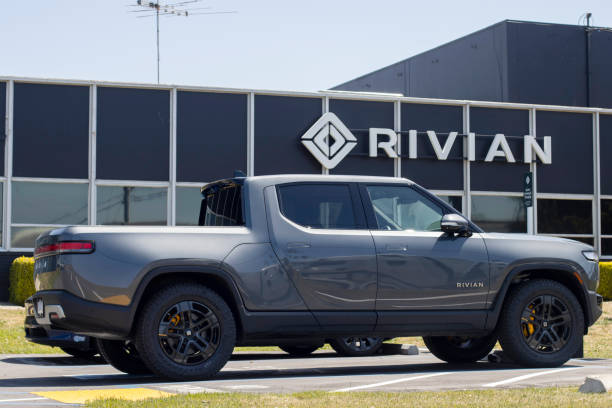
Why Sanae Takaichi Winning Japan’s Diet Election Led to a Surge in Japanese Stock Indices?
TradingKey - Reports indicate that the ruling coalition led by Japanese Prime Minister Sanae Takaichi has secured a single-party majority in the parliamentary elections held on Sunday (February 8). Following the news, the yen weakened slightly, while the Nikkei Index surpassed 57,000 for the first t
A Crash After a Surge: Why Silver Lost 40% in a Week?
TradingKey - Spot silver (XAGUSD) prices continue to decline. Silver plunged 20% on Thursday, breaking below $71 per ounce, with the sell-off intensifying on Friday as prices fell further below $64. Compared to the all-time high set on January 29, silver prices have retraced more than 40%, wiping out nearly all gains accumulated over the previous month.

