Warren Buffett Has $74 Billion of Berkshire Hathaway's $301 Billion Portfolio Tied Up in 2 Leading Artificial Intelligence (AI) Stocks

When Berkshire Hathaway's (NYSE: BRK.A)(NYSE: BRK.B) billionaire money manager speaks, Wall Street is compelled to pay attention. This is because the "Oracle of Omaha" has returned north of 5,700,000% for Berkshire's Class A (BRK.A) shareholders since taking over as CEO in the mid-1960s.
Lengthy books have been written discussing the characteristics and traits Buffett looks for when putting his company's cash to work. This includes focusing on attractively valued companies with sustainable competitive advantages, as well as thinking long term and concentrating his company's capital in his best ideas.
Where to invest $1,000 right now? Our analyst team just revealed what they believe are the 10 best stocks to buy right now. See the 10 stocks »
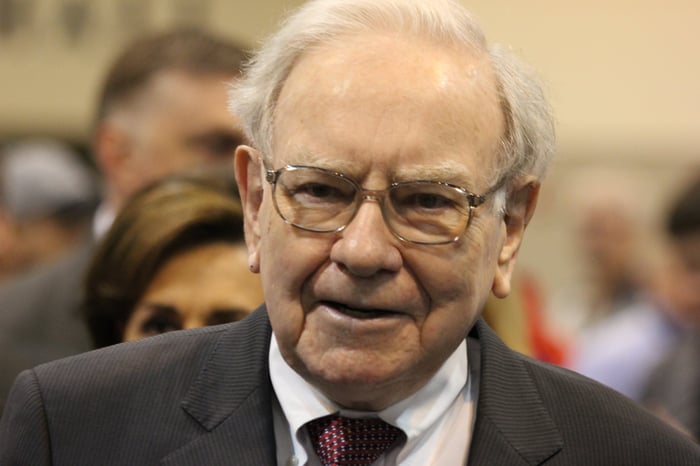
Berkshire Hathaway CEO Warren Buffett. Image source: The Motley Fool.
But one thing Buffett isn't known for is chasing after next-big-thing technologies. The Oracle of Omaha's wheelhouse is buying financial stocks and consumer staples -- and cutting-edge tech companies haven't exactly been his forte.
Nevertheless, the 44-stock, $301 billion portfolio Warren Buffett oversees at Berkshire Hathaway has roughly $74 billion collectively invested in two of Wall Street's leading artificial intelligence (AI) stocks.
Apple: $71.5 billion
The argument can be made that most companies are using AI in some capacity. For instance, longtime Berkshire holding Coca-Cola is using AI to generate relevant ads for younger audiences, while Domino's Pizza is leaning on AI to improve its productivity and make its supply chain more efficient. But few companies are more reliant on AI as an integral part of their future growth quite like Berkshire Hathaway's largest holding, Apple (NASDAQ: AAPL).
The AI revolution is nothing new for Apple. Voice assistant Siri, which was introduced to iPhone in October 2011, along with predictive text, are examples of Apple employing AI solutions for more than a decade.
The company's growth prospects rely heavily on its incorporation of Apple Intelligence into its physical products, including iPhone, iPad, and Mac. Apple Intelligence is the company's AI-driven model that can assist with understanding and creating text and images, along with summarizing copious amounts of text.
The reason so much is riding on Apple Intelligence is because its growth engine for its physical products has stalled out over the last two fiscal years (the company's fiscal year ends in late September). Even though iPhone accounts for more than half of domestic smartphone market share, sales of the device have been mostly flat. It's been a similar story for Mac and iPad as the U.S. has moved beyond the worst of the COVID-19 pandemic. Apple Intelligence is needed to boost the perceived value of its physical products and reignite sales growth.
However, the one operating segment Apple doesn't have to be worried about is Services. The company's subscription-driven platforms have been consistently growing by a double-digit percentage and are helping to keep customers loyal to its ecosystem of products and services.
Furthermore, the Oracle of Omaha probably appreciates Apple's capital-return program far more than its AI ties. Since the start of 2013, Apple has repurchased north of $725 billion worth of its own stock and reduced its outstanding share count by close to 43%. This has had a decisively positive impact on its earnings per share (EPS) and the company's share price.

Image source: Amazon.
Amazon: $2.4 billion
The other leading artificial intelligence stock that Warren Buffett and his team at Berkshire Hathaway have bet big on is e-commerce goliath Amazon (NASDAQ: AMZN).
Most people are familiar with Amazon because of its dominant online marketplace. In April 2024, eMarketer estimated Amazon would top a 40% share of U.S. online retail sales for the year. Buffett has a keen understanding of consumer behaviors and buying habits, which is why consumer staple stocks are a regular part of Berkshire's investment portfolio.
However, the growth in Amazon's cash flow and operating income has little to do with its low-margin e-commerce sales. Rather, the company's future is heavily reliant on Amazon Web Services (AWS) and its incorporation of AI solutions.
AWS is the world's top cloud infrastructure service platform by share of spending -- 33% as of the third quarter of 2024, per Canalys. Businesses are still relatively early in their cloud spending cycle, which bodes well for continued double-digit sales growth for AWS.
More importantly, AWS is allowing its customers access to generative AI solutions and other tools to improve their marketing efforts, create virtual agents/AI assistants, and build/train large language models. Artificial intelligence has the ability to reaccelerate growth for Amazon's highest-margin operating segment and its core driver of operating income.
Beyond AWS, Amazon is counting on advertising services and subscription services to also contribute to its rapid ascent. For example, the company's push into exclusive sporting events (Thursday Night Football and streaming National Basketball Association (NBA) games), coupled with the billions of visits its online marketplace receives each month, should encourage businesses to advertise with Amazon and lift its ad-pricing power.
While AI wasn't a core catalyst when Berkshire Hathaway first opened its position in Amazon six years ago, it's now integral to Amazon's long-term growth prospects.
Don’t miss this second chance at a potentially lucrative opportunity
Ever feel like you missed the boat in buying the most successful stocks? Then you’ll want to hear this.
On rare occasions, our expert team of analysts issues a “Double Down” stock recommendation for companies that they think are about to pop. If you’re worried you’ve already missed your chance to invest, now is the best time to buy before it’s too late. And the numbers speak for themselves:
- Nvidia: if you invested $1,000 when we doubled down in 2009, you’d have $334,473!*
- Apple: if you invested $1,000 when we doubled down in 2008, you’d have $45,122!*
- Netflix: if you invested $1,000 when we doubled down in 2004, you’d have $524,100!*
Right now, we’re issuing “Double Down” alerts for three incredible companies, and there may not be another chance like this anytime soon.
*Stock Advisor returns as of January 27, 2025
John Mackey, former CEO of Whole Foods Market, an Amazon subsidiary, is a member of The Motley Fool's board of directors. Sean Williams has positions in Amazon. The Motley Fool has positions in and recommends Amazon, Apple, Berkshire Hathaway, and Domino's Pizza. The Motley Fool has a disclosure policy.
Related Articles
Amazon Stock Predictions for 2026 to 2030: Will They Exceed Expectations and Achieve Major Long-Term Goals?
TradingKey - As we head into 2026, many investors are questioning where Amazon (AMZN) fits into the technology world.
A Crash After a Surge: Why Silver Lost 40% in a Week?
TradingKey - Spot silver (XAGUSD) prices continue to decline. Silver plunged 20% on Thursday, breaking below $71 per ounce, with the sell-off intensifying on Friday as prices fell further below $64. Compared to the all-time high set on January 29, silver prices have retraced more than 40%, wiping out nearly all gains accumulated over the previous month.
Is Bitcoin’s Four-Year Cycle Dead in 2026?
Is the Bitcoin 4-year cycle dead? After 2025 broke historical records with a red post-halving year, institutional analysts explore if the Bitcoin price has decoupled from the halving countdown. Analyze the impact of spot ETFs, global liquidity, and the roadmap to the 2028 halving in this 2026 market
Why Ripple ETFs are Winning the Capital War Against Bitcoin
While Bitcoin and Ethereum ETFs face massive outflows, XRP ETFs have defied market trends with a historic 30-day inflow streak reaching $1.37 billion. Explore why institutional "smart money" is rotating into Ripple, the structural impact of the "Liquidity Lock," and why analysts set a 2026 price tar