


Bitcoin (BTCUSD) Is up 1.14% on Jun 29: Here Is Why



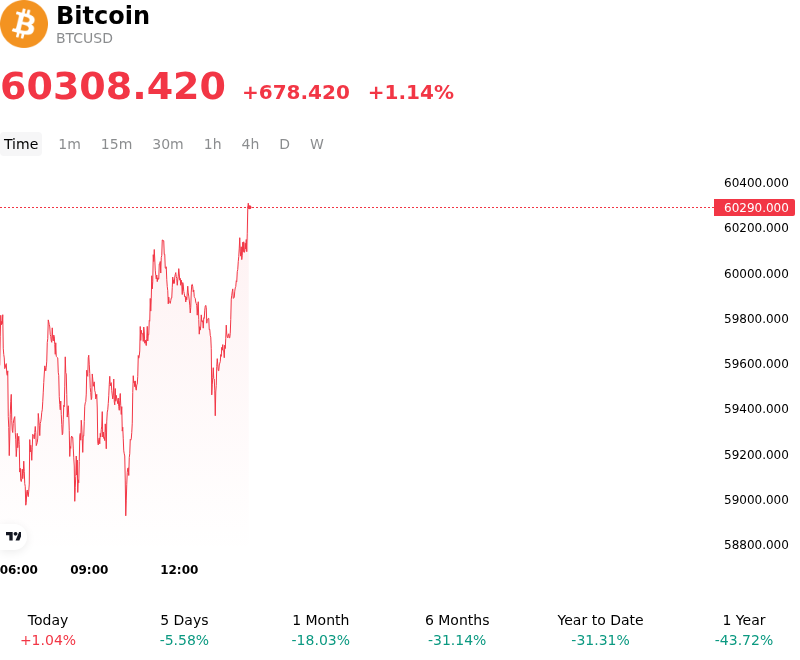
Bitcoin (BTCUSD) is up 1.14% at Jun 29 02:20(ET), now at $60308.42, with a 7-day down of 6.36%.
What is driving Bitcoin (BTCUSD)’s stock price up today?
The recent price action in Bitcoin reflects a technical consolidation and minor relief bounce near critical support thresholds, following a period of persistent downward pressure throughout late June. Having established a temporary local floor between the fifty-eight thousand and sixty thousand dollar levels, the asset has experienced heightened intraday volatility as buyers absorb selling pressure amid shifting macro liquidity conditions and institutional flows.
A primary driver of the recent stabilizing sentiment is the persistent accumulation of underlying spot assets by large corporate treasuries and long-term holders, even as retail interest remains momentarily diverted toward high-growth technology and artificial intelligence equities. Prominent institutional treasury players have continued to signal sustained accumulation campaigns, which helps reinforce structural support near these multi-month lows. On-chain metrics corroborate this trend, showing that long-term holders are continuing to transition their holdings into self-custody and cold storage rather than liquidating, signaling confidence in the long-term store-of-value thesis.
Furthermore, the derivative markets have played a critical role in driving intraday price action. With substantial options open interest concentrated around the psychologically significant sixty thousand dollar strike, short-term volatility has been amplified by hedging activities and short covering. As spot prices dipped into the fifty-eight thousand dollar range, the execution of put options and local liquidations cleared out leveraged long positioning, setting the stage for a technical rebound. This wash-out of leverage has allowed the spot market to experience a minor, technical-driven recovery.
However, significant macro headwinds continue to cap the broader upside momentum and keep market participants cautious. The Federal Reserve’s hawkish monetary stance remains a dominant challenge. Following the confirmation of Kevin Warsh as Fed Chair, the central bank’s decision to maintain rates at elevated levels and scale back expectations of near-term rate cuts has compressed valuations for non-yielding assets. Furthermore, geopolitical tensions in the Middle East, specifically involving recent military exchanges between the United States and Iran, have kept a risk-off premium in global markets, occasionally driving capital out of risk assets and into cash.
Additionally, the spot ETF landscape continues to weigh on the digital asset ecosystem. Having experienced record-breaking net outflows of over six billion dollars over the past month, the mechanical selling pressure from ETF redemptions has forced fund managers to liquidate spot holdings. While the current intraday advance suggests that the immediate wave of forced selling has temporarily subsided, sustainable upside remains dependent on a reversal of these ETF flows. Investors also remain focused on the legislative progress of the Digital Asset Market Clarity Act, which continues to face political gridlock in the Senate, leaving regulatory uncertainty as a persistent risk for pension funds and advisory networks.
Technical Analysis of Bitcoin (BTCUSD)
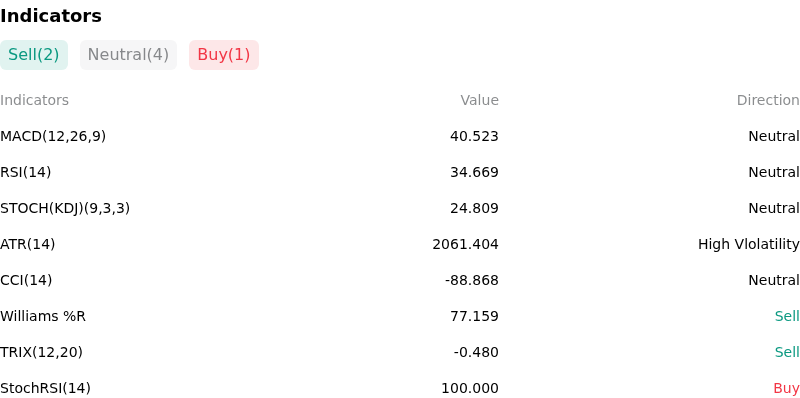
Technically, Bitcoin (BTCUSD) shows a MACD (12,26,9) value of 40.523, indicating a neutral signal. The RSI at 34.669 suggests neutral condition and the Williams %R at 77.159 suggests sell condition. Please monitor closely.
More details about Bitcoin (BTCUSD)
Recent Events and Risks:
- Accelerating Spot ETF Outflows and Negative Year-to-Date Net Flows: On June 26, 2026, U.S. spot Bitcoin ETFs suffered a massive single-day outflow of $696.3 million, led by BlackRock's IBIT and Fidelity's FBTC, bringing cumulative June outflows to $3.61 billion. This extended a devastating 13-day consecutive redemption streak that has drained roughly $4.4 billion from these products, flipping the 2026 year-to-date net flows negative (at approximately -$4.6 billion) for the first time. This sustained institutional retreat has hollowed out the spot market's demand floor, leaving BTC highly vulnerable to rapid, low-volume downside moves.
- Severe Technical Breakdown and Long Squeeze Threats: Bitcoin's recent fall below $60,000 to a 20-month low of $58,000 pushed the asset below its critical 200-week moving average for the first time since the 2022 bear market. This technical breakdown has sent over 50% of Bitcoin's circulating supply into unrealized losses and dragged the Crypto Fear & Greed Index to a multi-month low of 14 (Extreme Fear). Because retail futures positioning remains over-leveraged at 66.8% long, any failed attempt to reclaim the $60,750–$61,000 resistance zone threatens to trigger cascading long liquidations.
- Corporate Treasury Devaluation and Strategy’s Stalled Buying Engine: On June 26, 2026, Bloomberg reported that the market-value-to-NAV (mNAV) ratio of Bitcoin’s largest corporate holder, Strategy (formerly MicroStrategy), dropped below parity (<1.0). This indicates that investors no longer value the company above its underlying BTC holdings, disrupting its core model of issuing debt and equity to aggressively accumulate Bitcoin. When combined with Strategy’s first-ever documented BTC sales and drastically slowed June purchases (~3,600 BTC), a critical source of consistent institutional buying has effectively vanished.
- Looming MiCA Regulatory Compliance Shock: With the European Union's Markets in Crypto-Assets (MiCA) regulation set for full enforcement on July 1, 2026, the market faces an immediate compliance hurdle. Reports indicate that only 216 out of 3,167 Virtual Asset Service Providers (VASPs) are currently licensed under the new framework. Non-compliance across the remaining majority of European operators is expected to trigger sudden exchange delistings, localized liquidity freezes, and stablecoin trading disruptions in the coming days.
This article may include AI-generated content that is human-reviewed, which is for reference and general information purposes only and does not constitute investment advice.
Recommended Articles









Comments (0)
Click the $ button, enter the symbol, and select to link a stock, ETF, or other ticker.