


Bristol-Myers Squibb Co Stock (BMY) Moved Down by 3.18% on May 1: Drivers Behind the Movement



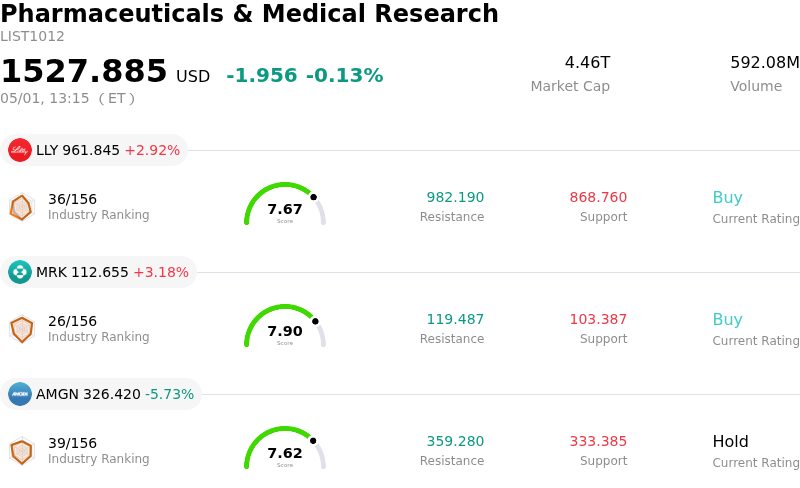
Bristol-Myers Squibb Co (BMY) moved down by 3.18%. The Pharmaceuticals & Medical Research sector is down by 0.13%. The company underperformed the industry. Top 3 stocks by turnover in the sector: Eli Lilly and Co (LLY) up 2.92%; Merck & Co Inc (MRK) up 3.18%; Amgen Inc (AMGN) down 5.73%.
What is driving Bristol-Myers Squibb Co (BMY)’s stock price down today?
Bristol Myers Squibb experienced downward movement today, despite reporting first-quarter financial results for 2026 that generally surpassed analyst expectations on both revenue and non-GAAP earnings per share (EPS). The company's reported revenue reached $11.5 billion, while non-GAAP EPS stood at $1.58, both exceeding consensus estimates. Management also reaffirmed its full-year 2026 financial guidance, indicating that both total revenues and non-GAAP EPS are trending towards the upper end of the projected ranges.
However, a closer examination of the financial details within the earnings report reveals several factors likely contributing to the current negative sentiment. Although overall revenue grew, non-GAAP diluted EPS declined by 12% compared to the prior year. Furthermore, the gross margin contracted to 70.3% from 73.1% in the first quarter of 2025, primarily due to an unfavorable shift in product mix as higher-margin legacy products experienced declines. The midpoint of the reaffirmed full-year revenue guidance was also noted to be slightly below the consensus analyst estimate, which may have led to a cautious investor reaction.
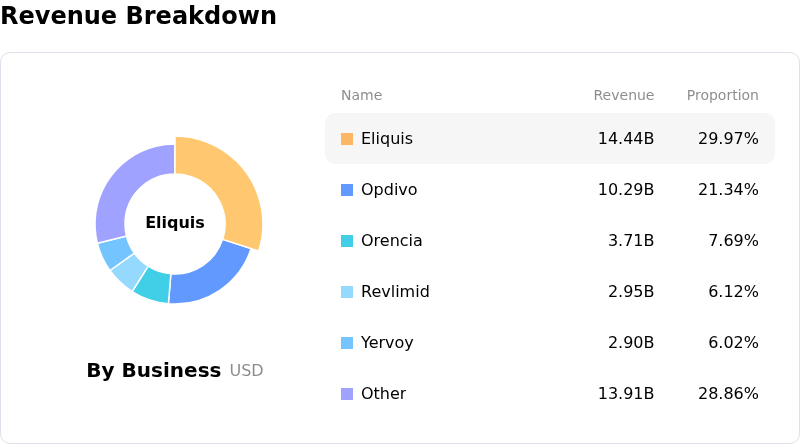
Underlying concerns about the company's portfolio dynamics persist. While the growth portfolio showed robust performance with a 12% increase in revenue, the legacy portfolio experienced a 6% decline. Notably, Opdivo revenue decreased by 8%, partly attributed to inventory drawdowns. Additionally, there is an anticipation of a reversal of Eliquis inventory build in the second quarter, which could impact future revenue. The long-term challenge posed by the "Eliquis patent cliff" and the eventual entry of generics remains a significant headwind, despite strategic efforts to extend patent protection for the drug.
Finally, recent institutional activity may also play a role in the stock's performance. Several large institutional investors, including the New York State Teachers Retirement System and US Bancorp DE, reduced their holdings in Bristol Myers Squibb in the fourth quarter of the previous year. An executive also sold shares recently, potentially signaling some insider caution. These factors, combined with a re-evaluation of the nuanced earnings report, likely contributed to today's downward price movement.
Technical Analysis of Bristol-Myers Squibb Co (BMY)
Technically, Bristol-Myers Squibb Co (BMY) shows a MACD (12,26,9) value of [-0.15], indicating a neutral signal. The RSI at 57.36 suggests neutral condition and the Williams %R at -5.34 suggests oversold condition. Please monitor closely.
Fundamental Analysis of Bristol-Myers Squibb Co (BMY)
Bristol-Myers Squibb Co (BMY) is in the Pharmaceuticals & Medical Research industry. Its latest annual revenue is $48.19B, ranking 11 in the industry. The net profit is $7.05B, ranking 12 in the industry. Company Profile
Over the past month, multiple analysts have rated the company as Hold, with an average price target of $61.97, a high of $75.00, and a low of $33.10.
More details about Bristol-Myers Squibb Co (BMY)
Company Specific Risks:
- The cessation of diabetes royalty income in 2025 led to a decrease in non-GAAP earnings per share in Q1 2026, creating a direct headwind for profitability.
- The Legacy Portfolio revenue declined by 6% in Q1 2026 due to ongoing generic impacts, indicating persistent erosion of sales from older, off-patent drugs.
- Gross margin compressed in Q1 2026, decreasing from 72.9% to 70.2% on a GAAP basis and from 73.1% to 70.3% on a non-GAAP basis, primarily driven by an unfavorable shift in product mix.
- Bristol Myers Squibb faces regulatory uncertainty and potential financial impact from its ongoing legal challenge against the Inflation Reduction Act's drug price negotiation provisions, which could hinder future R&D investment and pricing power.
This article may include AI-generated content that is human-reviewed, which is for reference and general information purposes only and does not constitute investment advice.
Recommended Articles






Comments (0)
Click the $ button, enter the symbol, and select to link a stock, ETF, or other ticker.