


ASML Holding NV Stock (ASML) Opened Down by 3.63% on Apr 28: What Investors Need To Know



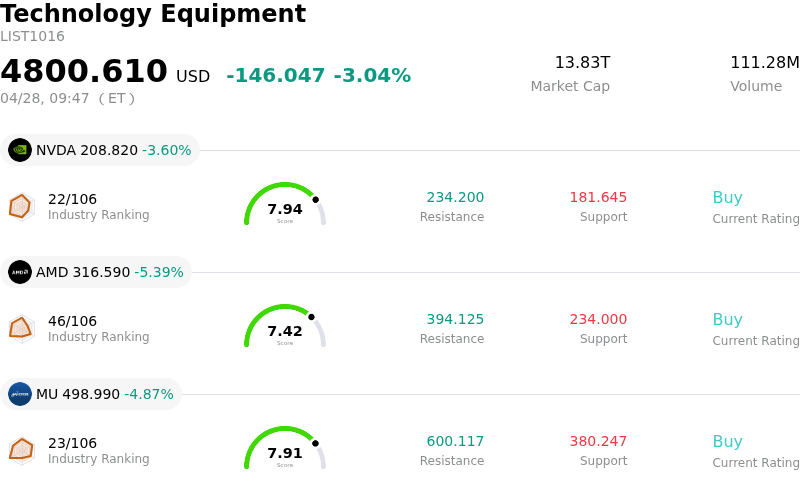
ASML Holding NV (ASML) opened down by 3.63%. The Technology Equipment sector is down by 3.04%. The company underperformed the industry. Top 3 stocks by turnover in the sector: NVIDIA Corp (NVDA) down 3.60%; Advanced Micro Devices Inc (AMD) down 5.39%; Micron Technology Inc (MU) down 4.87%.
What is driving ASML Holding NV (ASML)’s stock price down today?
ASML's stock experienced a notable intraday decline, influenced by a combination of company-specific news, industry dynamics, and broader market sentiment. Despite reporting robust first-quarter 2026 financial results that surpassed revenue and earnings per share forecasts, investor concerns emerged regarding the company's outlook for the second quarter. While ASML raised its full-year revenue guidance, the forecast for its second-quarter gross margin suggested a moderation from the previous quarter, leading to some investor apprehension about future profitability trends.
Adding to this cautious sentiment, a major customer, Taiwan Semiconductor Manufacturing Co., indicated it would postpone the deployment of ASML's most advanced High-NA EUV lithography machines for an extended period, which could impact the timeline for high-volume production of this cutting-edge technology and its contribution to ASML's long-term revenue targets.
Geopolitical factors also played a significant role in the stock's downward movement. A U.S. lawmaker recently called for stricter controls on the export of advanced semiconductor manufacturing equipment to China, specifically mentioning ASML's DUVi systems. This development highlights ongoing risks related to international trade policies and their potential to affect ASML's sales to a crucial market, particularly after a notable reduction in sales to that region in the first quarter. The broader semiconductor sector saw a collective decline, with various chip stocks experiencing negative pressure. This suggests a wider market trend of profit-taking and a reevaluation of valuations within the industry, especially after a period of significant growth driven by optimism around artificial intelligence. Underlying these industry-specific pressures are global macroeconomic uncertainties and persistent geopolitical tensions, such as the U.S.-Iran standoff, which contributed to a mixed performance across equity markets, further impacting investor confidence in growth-oriented technology companies.
Technical Analysis of ASML Holding NV (ASML)
Technically, ASML Holding NV (ASML) shows a MACD (12,26,9) value of [21.17], indicating a neutral signal. The RSI at 51.75 suggests neutral condition and the Williams %R at -64.77 suggests oversold condition. Please monitor closely.
Fundamental Analysis of ASML Holding NV (ASML)
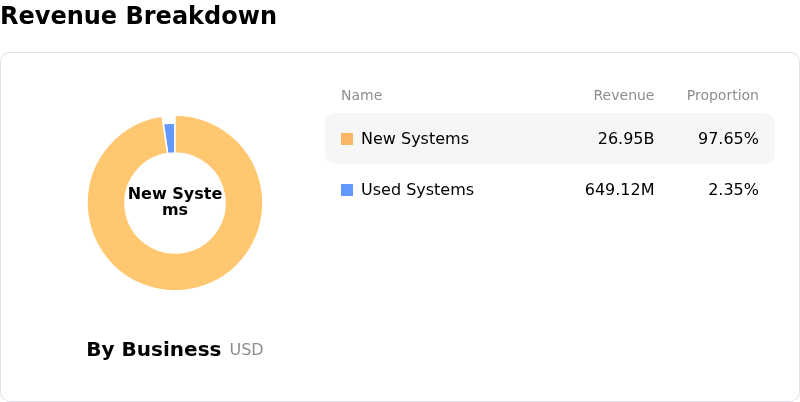
ASML Holding NV (ASML) is in the Technology Equipment industry. Its latest annual revenue is $36.83B, ranking 7 in the industry. The net profit is $10.83B, ranking 4 in the industry. Company Profile
Over the past month, multiple analysts have rated the company as Buy, with an average price target of $1688.72, a high of $1971.00, and a low of $994.01.
More details about ASML Holding NV (ASML)
Company Specific Risks:
- ASML's stock experienced a significant dip (7.08% pre-market) following its Q1 2026 earnings report, reflecting investor concerns over potential future margin compression and a slightly lower-than-expected outlook for Q2 2026, despite strong overall results.
- Taiwan Semiconductor Manufacturing Company (TSMC), a major customer, announced that ASML's new High-NA EUV lithography machines are too costly for current mass production plans, delaying their adoption until at least 2029 and causing a brief, negative market reaction for ASML.
- ASML is undergoing a significant organizational restructuring involving the elimination of up to 1,700 positions, primarily in middle management, and a six-week hiring freeze, which could introduce short-term operational execution risks and impact workforce stability.
- The company's decision to cease reporting quarterly new order intake numbers has raised concerns among institutional analysts regarding reduced transparency into future revenue visibility and potential disconnects between market expectations and operational performance.
This article may include AI-generated content that is human-reviewed, which is for reference and general information purposes only and does not constitute investment advice.
Recommended Articles








Comments (0)
Click the $ button, enter the symbol, and select to link a stock, ETF, or other ticker.