


Toyota Motor Corp Stock (TM) Opened Down by 3.94% on Apr 21: Key Drivers Unveiled



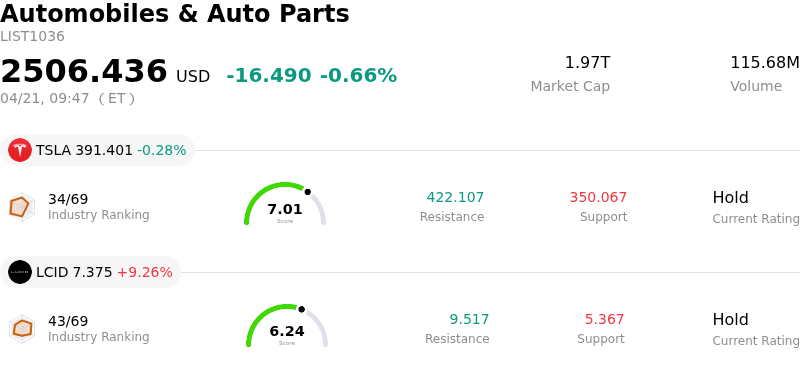
Toyota Motor Corp (TM) opened down by 3.94%. The Automobiles & Auto Parts sector is down by 0.66%. The company underperformed the industry. Top 3 stocks by turnover in the sector: Tesla Inc (TSLA) down 0.28%; LOBO EV Technologies Ltd (LOBO) up 94.52%; Lucid Group Inc (LCID) up 9.26%.
What is driving Toyota Motor Corp (TM)’s stock price down today?
Toyota Motor Corporation (TM) experienced a notable decline in share price today, reflecting investor concerns stemming from a confluence of factors impacting its operational and financial outlook.
Primary among these concerns are escalating supply chain disruptions. Reports indicate a tightening global helium shortage, exacerbated by geopolitical tensions in the Middle East, which poses a significant risk to semiconductor production, a critical component for the automotive industry. This shortage could lead to slower vehicle production and tighter inventory, particularly for advanced, tech-heavy models. Furthermore, the broader automotive sector is facing a new "semiconductor scarcity" as suppliers prioritize high-margin AI data center components, potentially threatening the production of vehicles equipped with advanced driver-assistance systems. The ongoing Middle East conflict is also contributing to higher freight, raw material, and fuel costs, further straining global auto supply chains, and Japan's automotive sector, including Toyota, is vulnerable to aluminum supply strains originating from the region.
Adding to these operational headwinds are recent financial disclosures and revised guidance. Toyota had previously reported a substantial decline in net income for the first quarter of fiscal year 2026, largely attributed to tariffs and other challenging market conditions. The company also updated its full-year forecast, projecting a significant reduction in operating income for FY2026 and a decrease in its net margin. The anticipated impact of U.S. tariffs alone for FY2026 is a considerable figure, which is weighing on investor sentiment. This negative financial outlook has led to some analyst downgrades, with at least one research firm recently shifting its rating to "hold" due to expected near-term headwinds to revenue growth and declining consumer confidence, forecasting a revenue decline for the fiscal year.
In terms of market performance, Toyota Motor North America reported mixed sales results for the first quarter of 2026, with overall U.S. sales experiencing a slight decrease and March sales seeing a more significant year-over-year decline. The company cited ongoing production constraints and limited inventory, particularly during the ramp-up of a new model for a popular SUV, as contributing factors to this performance. While Toyota has emphasized a "multi-pathway" approach to electrification, recent statements from a chief engineer indicated that a fully electric version of one of its top-selling SUVs is not planned for the immediate future. This cautious stance on full electrification for a high-volume model may be viewed critically by investors focused on the accelerating global transition to electric vehicles, despite a surge in EV demand in key markets.
Technical Analysis of Toyota Motor Corp (TM)
Technically, Toyota Motor Corp (TM) shows a MACD (12,26,9) value of [-2.82], indicating a neutral signal. The RSI at 52.31 suggests neutral condition and the Williams %R at -24.48 suggests oversold condition. Please monitor closely.
Fundamental Analysis of Toyota Motor Corp (TM)
Toyota Motor Corp (TM) is in the Automobiles & Auto Parts industry. Its latest annual revenue is $315.08B, ranking 1 in the industry. The net profit is $31.25B, ranking 1 in the industry. Company Profile
Over the past month, multiple analysts have rated the company as Buy, with an average price target of $254.36, a high of $290.00, and a low of $221.00.
More details about Toyota Motor Corp (TM)
Company Specific Risks:
- Ongoing scrutiny and potential financial impact from recent certification scandals and quality control deficiencies, including fraudulent testing and irregular engine certifications at Toyota and its affiliates, which have led to production suspensions and profit declines.
- Heightened competitive pressures and strategic execution risks in the evolving automotive market, particularly stemming from the rapid growth of Chinese electric vehicle manufacturers, as recently highlighted by the outgoing CEO's "survival" warning (April 1, 2026).
- Recurrent product safety and quality issues that necessitate frequent recalls, which can erode brand trust, incur significant costs, and negatively impact sales, as evidenced by multiple recent recall announcements.
This article may include AI-generated content that is human-reviewed, which is for reference and general information purposes only and does not constitute investment advice.
Recommended Articles








Comments (0)
Click the $ button, enter the symbol, and select to link a stock, ETF, or other ticker.