


EUR/USD bounces up to 1.1760, but tensions in the Middle East cap gains



- EUR/USD trims losses and reaches the 1.1760 area after bouncing up from session lows around 1.1730.
- German Producer prices accelerated at the fastest pace in nearly four years in March.
- The Euro remains capped below a previous support area around 1.1770.
The Euro (EUR) has retraced previous losses against the US Dollar (USD) following a weak weekly opening, as rising tensions between the US and Iran have curbed hopes of a swift resolution of the conflict. The pair has returned to the 1.1760 area after hitting daily lows below 1.1730, but upside attempts remain capped below the lows seen at the end of last week, in the 1.1770 area.
Risk appetite remains subdued, as investors await developments from the Middle East after the seizure of an Iranian vessel by US authorities undermined an already frail ceasefire. Iranian authorities have threatened retaliation and left their participation in the peace talks, scheduled to restart on Tuesday, in the air.
In Europe, the German Producer Price Index (PPI) data has shown a 2.5% monthly increase in March, its strongest reading since August 2022, confirming the upside risks for inflation stemming from Iran's war. These figures follow strong wholesale prices and higher consumer inflation numbers in several other EU countries released last week, and add pressure on the European Central Bank (ECB) to hike interest rates in the coming months.
Technical Analysis: Resistance at former support near 1.1770
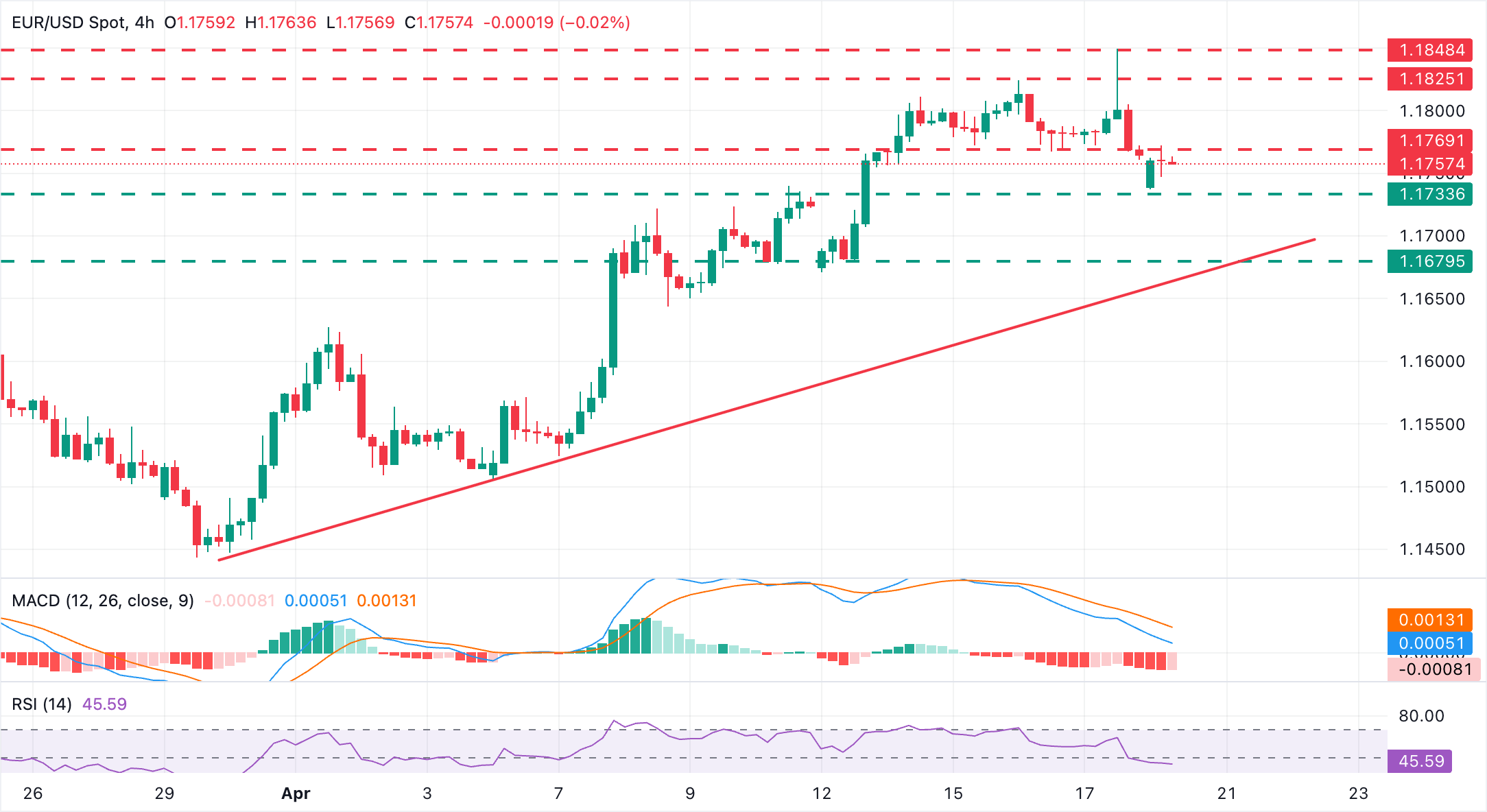
EUR/USD trades right above 1.1750, with a previous support area around 1.1770 capping bulls for now. Technical indicators in the 4-hour chart are in bearish territory. The Relative Strength Index (RSI) has eased to around 45, suggesting waning bullish momentum after the recent pullback, while the negative readings in the Moving Average Convergence Divergence (MACD) histogram hint that directional pressure remains modestly skewed to the downside.
Downside attempts remain contained above the previous tops, between 1.1720 and 1.1740, so far closing the path towards the key support area between the April 13 low, at 1.1680, and the support trendline from late March lows, now at 1.1660.
On the topside, initial resistance emerges at the aforementioned 1.1770 area (April 15, 16 lows). A break of that level exposes the April 16 highs at 1.1825 and then 1.1850.
(The technical analysis of this story was written with the help of an AI tool.)
Economic Indicator
Producer Price Index (YoY)
The Producer Price Index released by the Statistisches Bundesamt Deutschland measures the average changes in prices in the German primary markets. Changes in the PPI are widely followed as an indicator of commodity inflation. Generally speaking, a high reading is seen as positive (or bullish) for the EUR, whereas a low reading is seen as negative (or bearish).
Last release: Mon Apr 20, 2026 06:00
Frequency: Monthly
Actual: -0.2%
Consensus: -
Previous: -3.3%
Source: Federal Statistics Office of Germany
Economic Indicator
Producer Price Index (MoM)
The Producer Price Index released by the Statistisches Bundesamt Deutschland measures the average changes in prices in the German primary markets. Changes in the PPI are widely followed as an indicator of commodity inflation. Generally speaking, a high reading is seen as positive (or bullish) for the EUR, whereas a low reading is seen as negative (or bearish).
Last release: Mon Apr 20, 2026 06:00
Frequency: Monthly
Actual: 2.5%
Consensus: 1.4%
Previous: -0.5%
Source: Federal Statistics Office of Germany
Recommended Articles









Comments (0)
Click the $ button, enter the symbol, and select to link a stock, ETF, or other ticker.