


USD/CHF climbs to eight-session high as jobless claims plunge



- USD/CHF rallies for a fourth straight day on strong labor data and weak Swiss output
- US Initial Jobless Claims dropped to 206K, well below the 225K consensus, reinforcing Fed expectations for a prolonged rate hold.
- Swiss Q4 Industrial Production contracted 0.7% year over year, the first decline since mid-2024.
- Friday's US Personal Consumption Expenditures Price Index looms as the week's key risk event.
The US Dollar extended its winning streak against the Swiss Franc on Thursday after Initial Jobless Claims fell sharply to 206K from a revised 229K the prior week, well below the 225K forecast. The data added to evidence of labor market stability and supported the Federal Reserve's (Fed) decision to hold rates at 3.50% to 3.75% at its January meeting, where minutes released Wednesday showed officials divided on the path ahead, with some flagging the possibility of hikes if inflation stays elevated. On the Swiss side, Q4 Industrial Production fell 0.7% year over year, reversing the prior quarter's 2.0% expansion and marking the first contraction since Q2 2024, underscoring the economic headwinds facing the Swiss National Bank (SNB) at its 0% policy rate.
Friday's US core Personal Consumption Expenditures Price Index (PCE) for December, the Fed's preferred inflation gauge, is the week's final catalyst and could shape rate expectations heading into the March meeting.
Four-day rally lifts pair to eight-session high near 0.7750
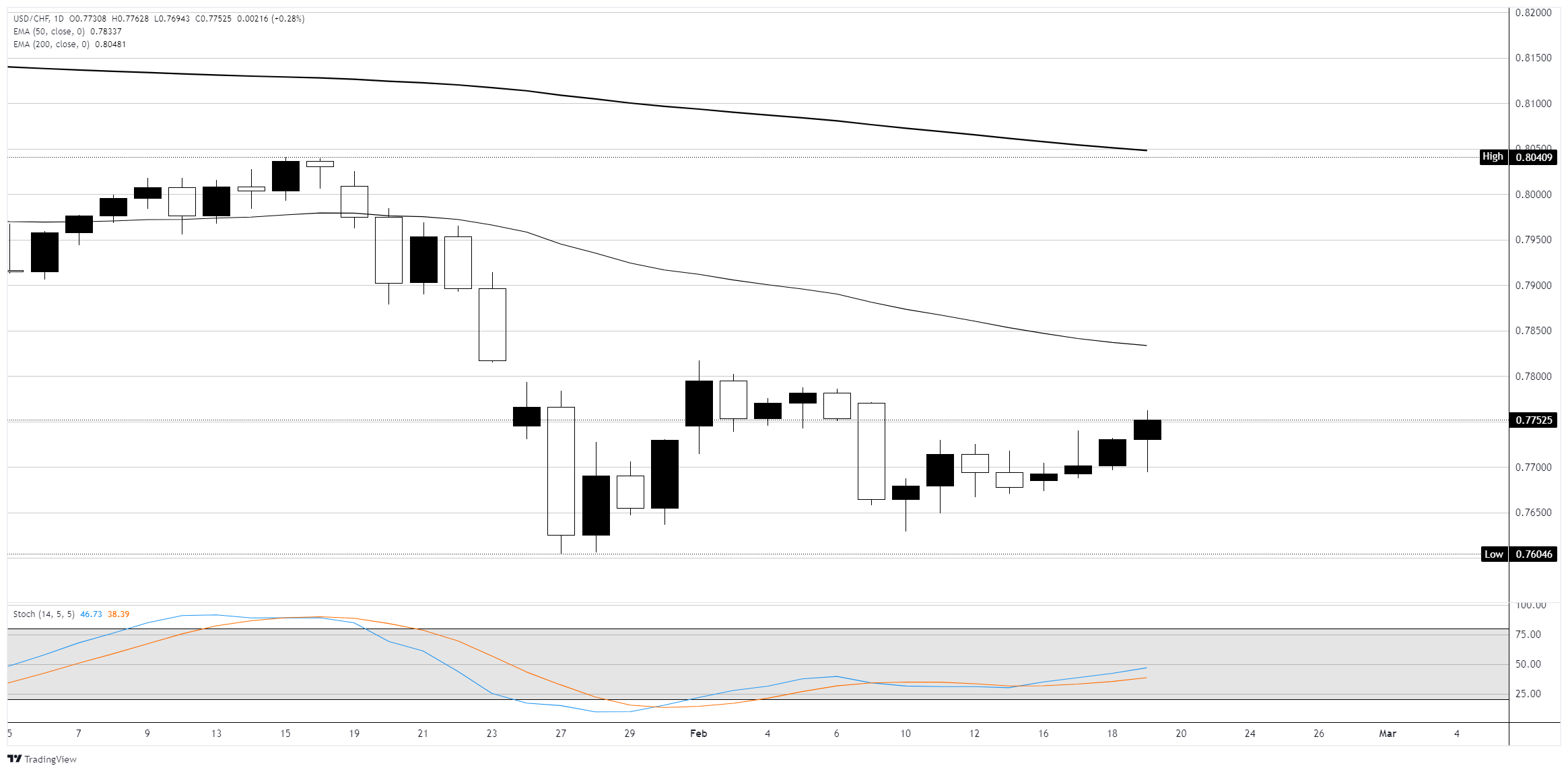
On the daily chart, USD/CHF rose for a fourth consecutive session on Thursday, tapping a near-term high of 0.7762 and rising nearly 0.3%, to reach its highest level in eight trading days. The pair continues to trade well below the declining 50-day Exponential Moving Average (EMA) at 0.7833 and the 200-day EMA at 0.8048, confirming the broader downtrend that has been in place since the pair's retreat from the January high near 0.8041. The four-day rally has lifted bids from the February 14 swing low near 0.7680, recovering roughly half of the prior week's decline.
The Stochastic Oscillator has crossed bullish from below the midline, pointing to building short-term momentum, though the reading remains in neutral territory. Thursday's candle printed a solid bullish body with a modest lower wick, continuing the pattern of progressively higher closes. Immediate resistance sits at the 0.7800 round number and the 50-day EMA at 0.7834; a sustained break above that zone would target the 0.7900 area. Support rests at 0.7700, with a failure there exposing the February low near 0.7605.
USD/CHF daily chart
Swiss Franc FAQs
The Swiss Franc (CHF) is Switzerland’s official currency. It is among the top ten most traded currencies globally, reaching volumes that well exceed the size of the Swiss economy. Its value is determined by the broad market sentiment, the country’s economic health or action taken by the Swiss National Bank (SNB), among other factors. Between 2011 and 2015, the Swiss Franc was pegged to the Euro (EUR). The peg was abruptly removed, resulting in a more than 20% increase in the Franc’s value, causing a turmoil in markets. Even though the peg isn’t in force anymore, CHF fortunes tend to be highly correlated with the Euro ones due to the high dependency of the Swiss economy on the neighboring Eurozone.
The Swiss Franc (CHF) is considered a safe-haven asset, or a currency that investors tend to buy in times of market stress. This is due to the perceived status of Switzerland in the world: a stable economy, a strong export sector, big central bank reserves or a longstanding political stance towards neutrality in global conflicts make the country’s currency a good choice for investors fleeing from risks. Turbulent times are likely to strengthen CHF value against other currencies that are seen as more risky to invest in.
The Swiss National Bank (SNB) meets four times a year – once every quarter, less than other major central banks – to decide on monetary policy. The bank aims for an annual inflation rate of less than 2%. When inflation is above target or forecasted to be above target in the foreseeable future, the bank will attempt to tame price growth by raising its policy rate. Higher interest rates are generally positive for the Swiss Franc (CHF) as they lead to higher yields, making the country a more attractive place for investors. On the contrary, lower interest rates tend to weaken CHF.
Macroeconomic data releases in Switzerland are key to assessing the state of the economy and can impact the Swiss Franc’s (CHF) valuation. The Swiss economy is broadly stable, but any sudden change in economic growth, inflation, current account or the central bank’s currency reserves have the potential to trigger moves in CHF. Generally, high economic growth, low unemployment and high confidence are good for CHF. Conversely, if economic data points to weakening momentum, CHF is likely to depreciate.
As a small and open economy, Switzerland is heavily dependent on the health of the neighboring Eurozone economies. The broader European Union is Switzerland’s main economic partner and a key political ally, so macroeconomic and monetary policy stability in the Eurozone is essential for Switzerland and, thus, for the Swiss Franc (CHF). With such dependency, some models suggest that the correlation between the fortunes of the Euro (EUR) and the CHF is more than 90%, or close to perfect.
Recommended Articles









Comments (0)
Click the $ button, enter the symbol, and select to link a stock, ETF, or other ticker.