


AUD/USD lurches into highs after NFP beats expectations



- AUD/USD tipped into a three-year peak on Wednesday.
- an upbeat NFP print has pushed back Fed rate cut bets, putting policymakers on a diverging collision course on policy statements.
The Australian Dollar surged to its highest level since August 2022 on Wednesday after the delayed US Non-Farm Payrolls (NFP) report came in stronger than expected at 130K, well above the 70K consensus, though massive downward revisions to 2025 payroll data (898K lower for March 2025 alone) painted a weaker picture of the broader labor market. The US Dollar sold off as markets interpreted the benchmark revisions as confirmation of a more entrenched slowdown, with average monthly job gains for 2025 revised to just 15K from the previously reported 49K.
On the Australian side, the Reserve Bank of Australia (RBA) hiked its cash rate by 25 basis points to 3.85% on February 3, the first increase since late 2023, after inflation reaccelerated in the second half of 2025. RBA Deputy Governor Andrew Hauser reinforced a tightening bias on Wednesday, warning that inflation is too high and that further hikes are possible. Thursday brings Australian Consumer Inflation Expectations for February, which could support the hawkish RBA narrative. The main event for the week is Friday's US Consumer Price Index (CPI) for January, with headline year-over-year expected at 2.5% (down from 2.7%) and core CPI month-over-month forecast at 0.3%. A softer print would further erode US Dollar support, while a hot reading could stall the pair's rally. Federal Reserve (Fed) speakers Hammack and Miran also delivered remarks Wednesday, with Miran rated dovish at 3.6 versus an average of 4.0; Fed's Logan and Miran speak again Friday.
AUD/USD price forecast
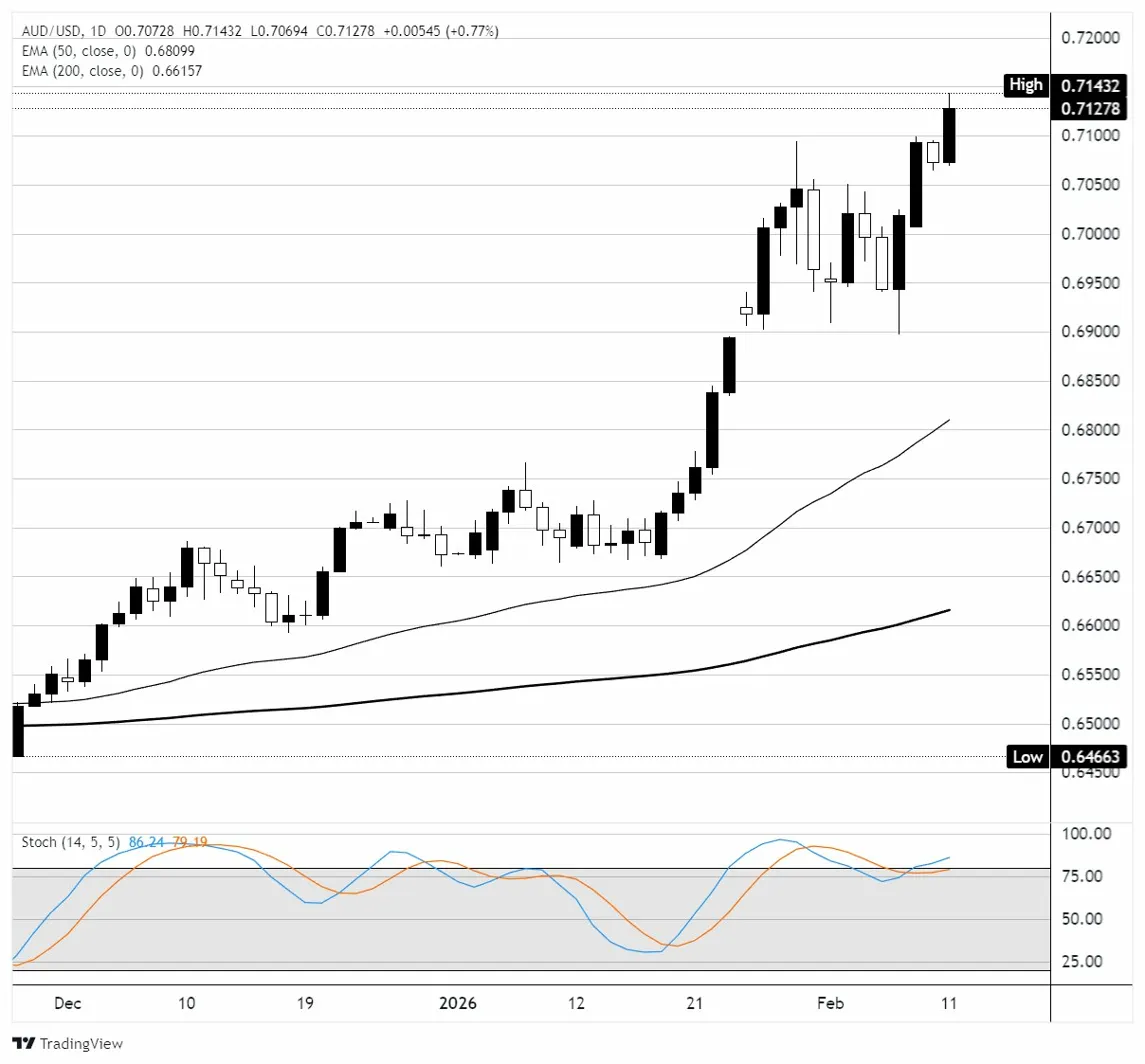
On the daily chart, AUD/USD is trading near 0.7130, up 0.77% on Wednesday alone, with price pushing to an intraday high of 0.7143. The pair is firmly above both the 50-day Exponential Moving Average (EMA) at 0.6810 and the 200-day EMA at 0.6616, confirming a strong bullish trend structure with higher highs and higher lows since the December low of 0.6466. The rally from late January has been aggressive, with the pair gaining over 600 pips from the consolidation zone around 0.6700. The Stochastic Oscillator (14, 5, 5) reads 86.24/79.19, deep in overbought territory, suggesting momentum is stretched but not yet showing a bearish crossover. Immediate resistance sits at the session high of 0.7143, with the next target at the psychological 0.7200 level. Support lies at the 0.7000 round number, followed by the late-January consolidation range between 0.6930 and 0.7000. A daily close above 0.7143 would open the door toward 0.7200 and potentially 0.7250, while a pullback below 0.7000 would signal a deeper correction toward 0.6930, where the breakout zone and prior resistance-turned-support converge.
AUD/USD daily chart
Australian Dollar FAQs
One of the most significant factors for the Australian Dollar (AUD) is the level of interest rates set by the Reserve Bank of Australia (RBA). Because Australia is a resource-rich country another key driver is the price of its biggest export, Iron Ore. The health of the Chinese economy, its largest trading partner, is a factor, as well as inflation in Australia, its growth rate and Trade Balance. Market sentiment – whether investors are taking on more risky assets (risk-on) or seeking safe-havens (risk-off) – is also a factor, with risk-on positive for AUD.
The Reserve Bank of Australia (RBA) influences the Australian Dollar (AUD) by setting the level of interest rates that Australian banks can lend to each other. This influences the level of interest rates in the economy as a whole. The main goal of the RBA is to maintain a stable inflation rate of 2-3% by adjusting interest rates up or down. Relatively high interest rates compared to other major central banks support the AUD, and the opposite for relatively low. The RBA can also use quantitative easing and tightening to influence credit conditions, with the former AUD-negative and the latter AUD-positive.
China is Australia’s largest trading partner so the health of the Chinese economy is a major influence on the value of the Australian Dollar (AUD). When the Chinese economy is doing well it purchases more raw materials, goods and services from Australia, lifting demand for the AUD, and pushing up its value. The opposite is the case when the Chinese economy is not growing as fast as expected. Positive or negative surprises in Chinese growth data, therefore, often have a direct impact on the Australian Dollar and its pairs.
Iron Ore is Australia’s largest export, accounting for $118 billion a year according to data from 2021, with China as its primary destination. The price of Iron Ore, therefore, can be a driver of the Australian Dollar. Generally, if the price of Iron Ore rises, AUD also goes up, as aggregate demand for the currency increases. The opposite is the case if the price of Iron Ore falls. Higher Iron Ore prices also tend to result in a greater likelihood of a positive Trade Balance for Australia, which is also positive of the AUD.
The Trade Balance, which is the difference between what a country earns from its exports versus what it pays for its imports, is another factor that can influence the value of the Australian Dollar. If Australia produces highly sought after exports, then its currency will gain in value purely from the surplus demand created from foreign buyers seeking to purchase its exports versus what it spends to purchase imports. Therefore, a positive net Trade Balance strengthens the AUD, with the opposite effect if the Trade Balance is negative.
Recommended Articles








Comments (0)
Click the $ button, enter the symbol, and select to link a stock, ETF, or other ticker.