


EUR/USD slides as Warsh Fed pick, hot US PPI supercharge Dollar rally



- EUR/USD tumbles 0.75% as Kevin Warsh’s Fed nomination boosts US yields and Dollar demand.
- Hot US producer inflation reinforces the Fed’s steady-rate stance, lifting Treasury yields above 4.25%.
- Strong German and Eurozone GDP data fail to offset Dollar strength driven by policy repricing.
EUR/USD drops during the North American session, down by 0.75% amid a session characterized by overall US Dollar strength, sponsored by Trump’s mild-hawkish pick to lead the Federal Reserve and an inflation report that warrants steady rates by the Federal Reserve. At the time of writing, the pair traded at 1.1882 down from daily highs of 1.1974.
Euro sinks below 1.19 as hawkish Fed leadership signals and sticky inflation crush rate-cut hopes
Kevin Warsh is Trump’s election to be the next Fed Chairman of the Federal Reserve, confirming rumors that leaked late on Thursday. The financial markets sent precious metals tumbling, while the Dollar nearly 1% according to the US Dollar Index (DXY), which tracks the buck’s performance against six peers.
The DXY is poised to end the day past the 97.00 figure. US Treasury yields rose with the 10-year yield rose nearly one basis points at 4.25%.
In addition to Warsh naming, US inflation in the producer side edged higher, distancing from the Federal Reserve’s 2% goal, justifying the Fed’s decision. Aside from the release of the Producer Price Index (PPI) figures for December, speeches by Federal Reserve officials grabbed the headlines.
Breaking news revealed that the US Senate reached a deal to get the government funding package through chamber tonight, averting a shutdown, according to Politico.
US Treasury yields are rising in a sign that speculators see fewer odds that Warsh could cut rates “indiscriminately” to please the White House. The US 10-year Treasury note yield is up one and a half basis points at 4.247% as of writing.
In Europe, the German economy rose by 0.4% YoY exceeding estimates. Better-than-expected Gross Domestic Product (GDP) figures in Germany and the Eurozone, and the uptick in German inflation, have failed to provide any significant support to the pair.
Next week, the US economic docket will feature a tranche of US jobs data, speeches by Fed officials and the ISM Manufacturing and Services PMIs for January. In Europe, HCOB Flash PMIs for the bloc and for Germany and France, and the European Central Bank monetary policy meeting, could trigger some volatility in the EUR/USD pair.
Euro Price This Month
The table below shows the percentage change of Euro (EUR) against listed major currencies this month. Euro was the strongest against the US Dollar.
| USD | EUR | GBP | JPY | CAD | AUD | NZD | CHF | |
|---|---|---|---|---|---|---|---|---|
| USD | -0.85% | -1.48% | -1.10% | -0.59% | -4.17% | -3.85% | -2.44% | |
| EUR | 0.85% | -0.69% | -0.18% | 0.32% | -2.98% | -2.95% | -1.53% | |
| GBP | 1.48% | 0.69% | 0.51% | 1.03% | -2.31% | -2.28% | -0.85% | |
| JPY | 1.10% | 0.18% | -0.51% | 0.42% | -3.01% | -3.24% | -1.24% | |
| CAD | 0.59% | -0.32% | -1.03% | -0.42% | -3.41% | -3.64% | -1.85% | |
| AUD | 4.17% | 2.98% | 2.31% | 3.01% | 3.41% | 0.03% | 1.50% | |
| NZD | 3.85% | 2.95% | 2.28% | 3.24% | 3.64% | -0.03% | 1.47% | |
| CHF | 2.44% | 1.53% | 0.85% | 1.24% | 1.85% | -1.50% | -1.47% |
The heat map shows percentage changes of major currencies against each other. The base currency is picked from the left column, while the quote currency is picked from the top row. For example, if you pick the Euro from the left column and move along the horizontal line to the US Dollar, the percentage change displayed in the box will represent EUR (base)/USD (quote).
Daily market movers: The Dollar’s comeback, tumbles the Euro
- St. Louis Federal President Alberto Musalem stated that the central bank does not need to cut interest rates further at this time, as the current 3.50%-3.75% policy rate range is roughly at a neutral level. He said further reductions would only be justified if the labor market deteriorates sharply or inflation drops materially
- Fed Governor Stephen Miran said Kevin Warsh would be an excellent choice for the Fed, adding that the recent rise in producer prices has been driven mainly by housing costs and portfolio management fees.
- Meanwhile, Christopher Waller noted that the labor market remains weak despite steady economic growth. He argued that inflation would be close to 2% were it not for tariffs, which he said kept price growth near 3%, and added that monetary policy should be closer to neutral, around 3%.
- Atlanta Fed President Raphael Bostic urged patience on policy, saying rates should remain somewhat restrictive. He warned that the full inflationary impact of tariffs has yet to materialize and expects price pressures to remain persistent.
- The US Bureau of Labor Statistics showed Producer Price Index (PPI) inflation held steady at 3.0% YoY in December, unchanged from November and missing expectations for a slowdown to 2.7%. Core PPI, which excludes food and energy, accelerated to 3.3% YoY from 3.0%, defying forecasts for a decline to 2.9%, underscoring continued upstream price pressures.
- Gross Domestic Product (GDP) for the last quarter of last year in the European Union expanded by 1.4% YoY, unchanged from Q3, but above forecasts of 1.2%. In Germany the economy in Q4 exceeded estimates of 0.3%, rose by 0.4% YoY, up from Q3 0.3% growth.
- Germany’s inflation in January as measured by the Harmonized Index of Consumer Prices (HICP) ticked a tenth up from 2% to 2.1%, but within the European Central Bank’s target.
Technical outlook: EUR/USD uptrend at risk, after diving below 1.1850
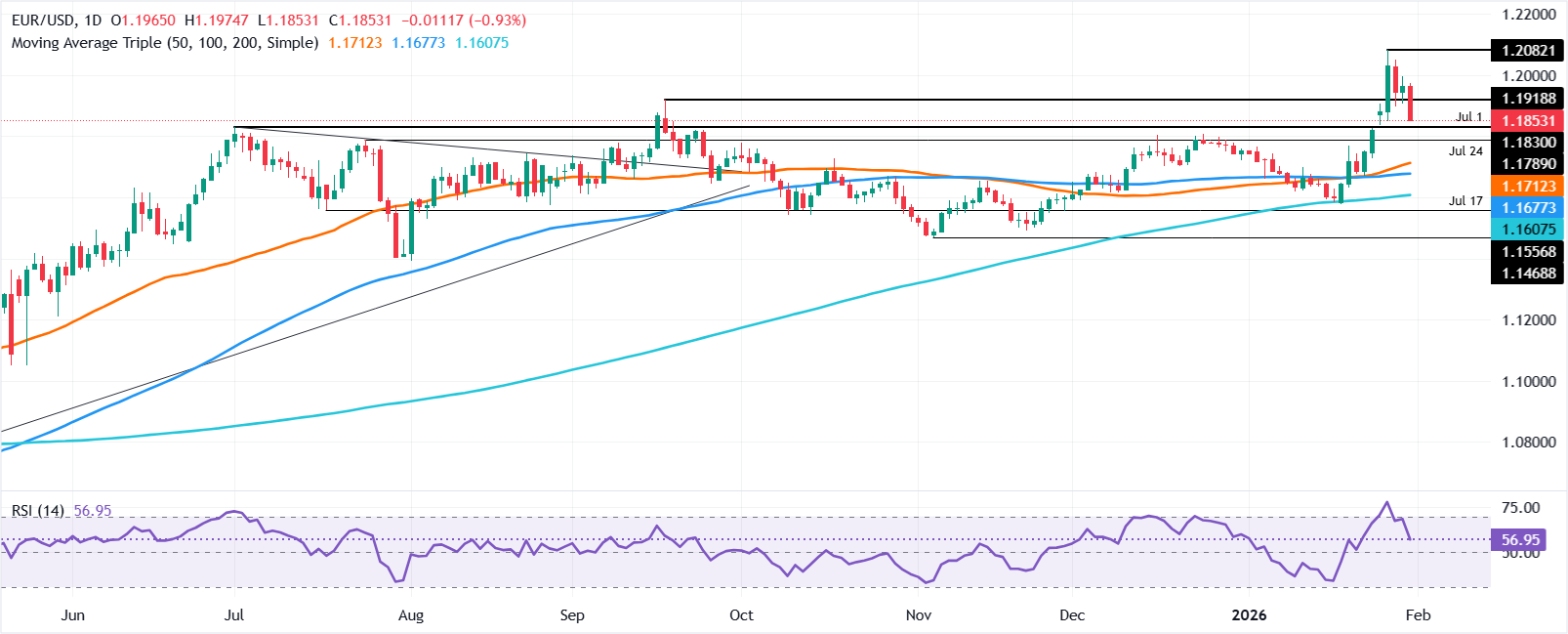
The EUR/USD technical picture shows that the uptrend is at risk after breaching 2025 yearly high of 1.1918, exacerbating a drop below 1.1850. The Relative Strength Index (RSI) showed that momentum shifted mildly bearish, which could pave the way for further downside in the pair.
In that outcome, the EUR/USD next support would be 1.1800 which if gives way, can send the pair to the 20-day SMA at 1.1743.
On the flip side, the EUR/USD first resistance is 1.1900. If reclaimed, the next key resistance would be 1.1950 followed by the yearly peak at 1.2082.
Euro FAQs
The Euro is the currency for the 20 European Union countries that belong to the Eurozone. It is the second most heavily traded currency in the world behind the US Dollar. In 2022, it accounted for 31% of all foreign exchange transactions, with an average daily turnover of over $2.2 trillion a day. EUR/USD is the most heavily traded currency pair in the world, accounting for an estimated 30% off all transactions, followed by EUR/JPY (4%), EUR/GBP (3%) and EUR/AUD (2%).
The European Central Bank (ECB) in Frankfurt, Germany, is the reserve bank for the Eurozone. The ECB sets interest rates and manages monetary policy. The ECB’s primary mandate is to maintain price stability, which means either controlling inflation or stimulating growth. Its primary tool is the raising or lowering of interest rates. Relatively high interest rates – or the expectation of higher rates – will usually benefit the Euro and vice versa. The ECB Governing Council makes monetary policy decisions at meetings held eight times a year. Decisions are made by heads of the Eurozone national banks and six permanent members, including the President of the ECB, Christine Lagarde.
Eurozone inflation data, measured by the Harmonized Index of Consumer Prices (HICP), is an important econometric for the Euro. If inflation rises more than expected, especially if above the ECB’s 2% target, it obliges the ECB to raise interest rates to bring it back under control. Relatively high interest rates compared to its counterparts will usually benefit the Euro, as it makes the region more attractive as a place for global investors to park their money.
Data releases gauge the health of the economy and can impact on the Euro. Indicators such as GDP, Manufacturing and Services PMIs, employment, and consumer sentiment surveys can all influence the direction of the single currency. A strong economy is good for the Euro. Not only does it attract more foreign investment but it may encourage the ECB to put up interest rates, which will directly strengthen the Euro. Otherwise, if economic data is weak, the Euro is likely to fall. Economic data for the four largest economies in the euro area (Germany, France, Italy and Spain) are especially significant, as they account for 75% of the Eurozone’s economy.
Another significant data release for the Euro is the Trade Balance. This indicator measures the difference between what a country earns from its exports and what it spends on imports over a given period. If a country produces highly sought after exports then its currency will gain in value purely from the extra demand created from foreign buyers seeking to purchase these goods. Therefore, a positive net Trade Balance strengthens a currency and vice versa for a negative balance.
Recommended Articles







Comments (0)
Click the $ button, enter the symbol, and select to link a stock, ETF, or other ticker.