


EUR/USD climbs toward 1.1870 as Dollar sinks on geopolitical jitters



- EUR/USD gains as speculation of coordinated US–Japan FX intervention pressures the Dollar.
- Trade-war tensions resurface as Trump targets Canada despite easing tariff threats on Europe.
- Focus shifts to the FOMC decision and Powell’s press conference for policy clarity.
The Euro post gains of over 0.39% on Monday as the Greenback weakens, following a sell-off sponsored by US geopolitical jitters and speculation of a coordinated intervention in the FX markets by the US and Japan. The EUR/USD trades at 1.1872, after bouncing off daily lows of 1.1835.
Euro strengthens as US geopolitical tensions and FX intervention speculation trigger broad Dollar selling
Trade-war woes sponsored the advance of the EUR/USD pair last week. Although US President Donald Trump dropped tariffs of 10% to European countries over Greenland, he escalated tensions with Canada, threatening to impose 100% duties if they negotiate a trade deal with Beijing.
The US economic schedule will feature the Federal Reserve’s monetary policy meeting, as the most important macroeconomic event, on Wednesday January 28. Money markets seem confident that the central bank will keep rates unchanged, but the main event would be the Fed Chair Jerome Powell press conference, following the Department of Justice indictment.
Earlier, Durable Goods Orders exceeded estimates and traders will eye the ADP Employment Change 4-week average, housing data and Consumer Confidence data on Tuesday.
The US Dollar Index (DXY), which measures the performance of the buck’s value against six currencies, is down 0.41% at 97.05.
In the Eurozone, the Ifo Business Climate Index for Germany was unchanged in January from a previous month. The Ifo President Clemens Fuest said that the German economy is starting the new year with little momentum.
What’s in the Eurozone and US economic calendar on January 27?
On Tuesday’ the EU docket will feature speeches by members of the European Central Bank Joachim Nagel and the ECB President Christine Lagarde. In the US, jobs, housing and consumer confidence data would be released.
Euro Price This Month
The table below shows the percentage change of Euro (EUR) against listed major currencies this month. Euro was the strongest against the Canadian Dollar.
| USD | EUR | GBP | JPY | CAD | AUD | NZD | CHF | |
|---|---|---|---|---|---|---|---|---|
| USD | -1.06% | -1.42% | -1.45% | 0.10% | -3.44% | -3.00% | -1.93% | |
| EUR | 1.06% | -0.42% | -0.35% | 1.24% | -2.06% | -1.88% | -0.79% | |
| GBP | 1.42% | 0.42% | 0.08% | 1.67% | -1.62% | -1.47% | -0.37% | |
| JPY | 1.45% | 0.35% | -0.08% | 1.50% | -1.91% | -2.01% | -0.34% | |
| CAD | -0.10% | -1.24% | -1.67% | -1.50% | -3.35% | -3.45% | -2.01% | |
| AUD | 3.44% | 2.06% | 1.62% | 1.91% | 3.35% | 0.16% | 1.27% | |
| NZD | 3.00% | 1.88% | 1.47% | 2.01% | 3.45% | -0.16% | 1.08% | |
| CHF | 1.93% | 0.79% | 0.37% | 0.34% | 2.01% | -1.27% | -1.08% |
The heat map shows percentage changes of major currencies against each other. The base currency is picked from the left column, while the quote currency is picked from the top row. For example, if you pick the Euro from the left column and move along the horizontal line to the US Dollar, the percentage change displayed in the box will represent EUR (base)/USD (quote).
Daily digest market movers: Euro's benefits from soft US Dollar
- Speculation over a potential coordinated intervention by Japanese and US authorities to support the Yen pressured the US Dollar. Bloomberg revealed that market chatter suggests that the Federal Reserve Bank of New York may have contacted financial institutions to gauge conditions around the Yen’s exchange rate.
- US Durable Goods Orders posted a sharp rebound in November, surging 5.3% MoM after October’s 2.1% decline and well above forecasts of 2.3%, highlighting a renewed upswing in demand for big-ticket items.
- Orders for core capital goods—a key gauge of underlying business investment—rose 0.5% MoM, beating expectations of 0.3% and accelerating from October’s 0.1% increase, pointing to firmer investment momentum toward the end of the year.
- Prime Market Terminal data shows that traders are expecting 44 basis points of easing by the Federal Reserve towards the end of the year.
- German Ifo Business Morale rose by 87.6 in January unchanged from December’s print, missed estimates for a modest rise to 88.2, according to Reuters.
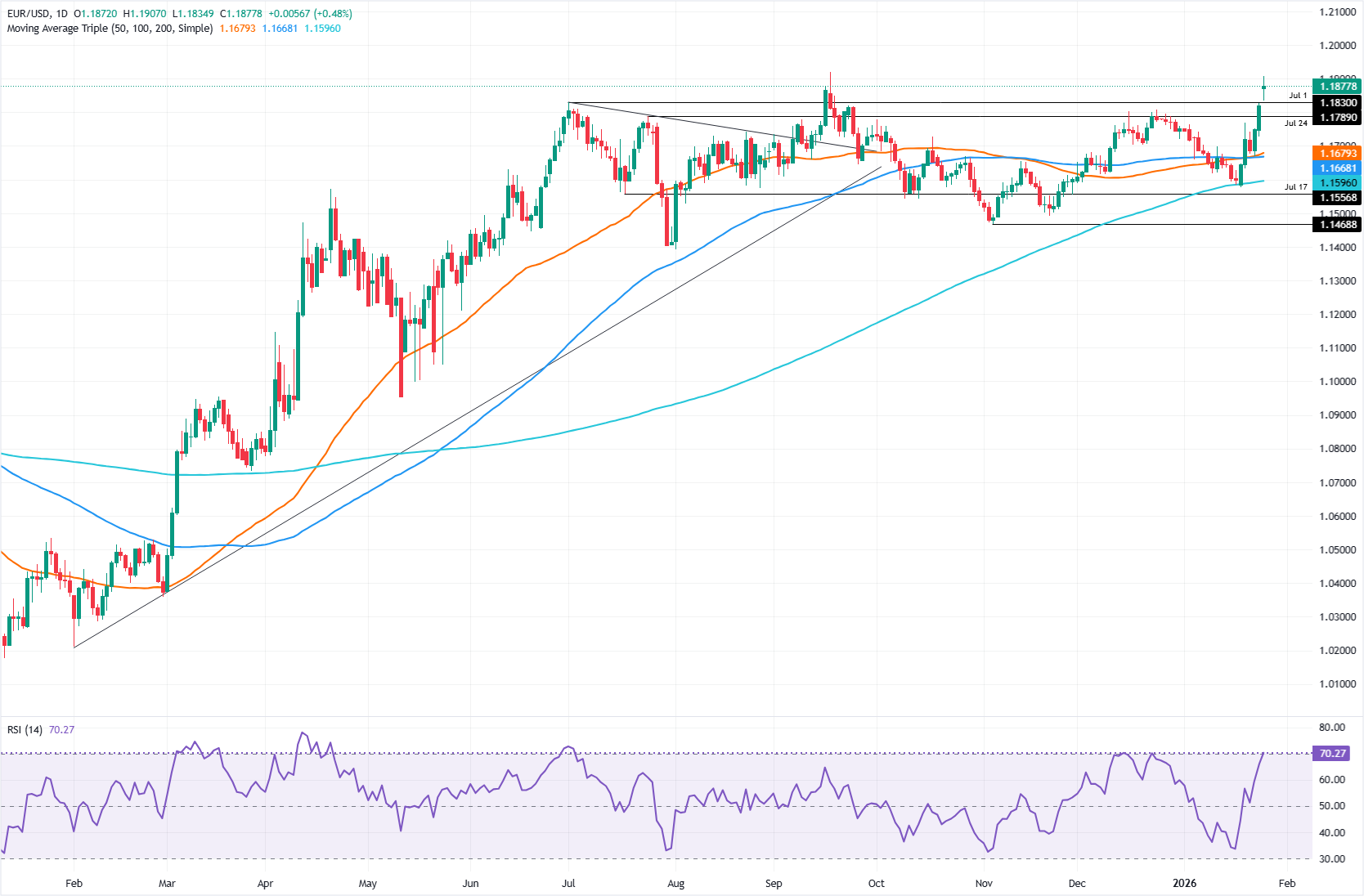
Technical outlook: EUR/USD breaks 1.1800, sight on 1.2000
The overall trend is up, yet the formation of a ‘high wave candle’ almost a doji, opens the door for some consolidation within the top-bottom of the January 26 daily ramge, between 1.1834-1.1907.
If EUR/USD clears 1.1907, traders would test the 025 yearly high of 1.1918, followed by 1.1950 and 1.2000. Conversely, if the pair retreats below 1.1800, it opens the door to test the January23 daily low of 1.1728, followed by 1.1700.
Momentum as measured by the Relative Strength Index (RSI) indicates that buyers are in charge. Also, the clear break above the December 24 swing high of 1.1807 shifted the trend from sideways to upwards.
Euro FAQs
The Euro is the currency for the 20 European Union countries that belong to the Eurozone. It is the second most heavily traded currency in the world behind the US Dollar. In 2022, it accounted for 31% of all foreign exchange transactions, with an average daily turnover of over $2.2 trillion a day. EUR/USD is the most heavily traded currency pair in the world, accounting for an estimated 30% off all transactions, followed by EUR/JPY (4%), EUR/GBP (3%) and EUR/AUD (2%).
The European Central Bank (ECB) in Frankfurt, Germany, is the reserve bank for the Eurozone. The ECB sets interest rates and manages monetary policy. The ECB’s primary mandate is to maintain price stability, which means either controlling inflation or stimulating growth. Its primary tool is the raising or lowering of interest rates. Relatively high interest rates – or the expectation of higher rates – will usually benefit the Euro and vice versa. The ECB Governing Council makes monetary policy decisions at meetings held eight times a year. Decisions are made by heads of the Eurozone national banks and six permanent members, including the President of the ECB, Christine Lagarde.
Eurozone inflation data, measured by the Harmonized Index of Consumer Prices (HICP), is an important econometric for the Euro. If inflation rises more than expected, especially if above the ECB’s 2% target, it obliges the ECB to raise interest rates to bring it back under control. Relatively high interest rates compared to its counterparts will usually benefit the Euro, as it makes the region more attractive as a place for global investors to park their money.
Data releases gauge the health of the economy and can impact on the Euro. Indicators such as GDP, Manufacturing and Services PMIs, employment, and consumer sentiment surveys can all influence the direction of the single currency. A strong economy is good for the Euro. Not only does it attract more foreign investment but it may encourage the ECB to put up interest rates, which will directly strengthen the Euro. Otherwise, if economic data is weak, the Euro is likely to fall. Economic data for the four largest economies in the euro area (Germany, France, Italy and Spain) are especially significant, as they account for 75% of the Eurozone’s economy.
Another significant data release for the Euro is the Trade Balance. This indicator measures the difference between what a country earns from its exports and what it spends on imports over a given period. If a country produces highly sought after exports then its currency will gain in value purely from the extra demand created from foreign buyers seeking to purchase these goods. Therefore, a positive net Trade Balance strengthens a currency and vice versa for a negative balance.
Recommended Articles










Comments (0)
Click the $ button, enter the symbol, and select to link a stock, ETF, or other ticker.