


EUR/USD eases from highs as German business sentiment data disappoints



- EUR/USD is showing moderate losses but remains at four-month highs above 1.1850.
- German IFO figures reveal a stalled Business Sentiment in January
- Market concerns of a joint US-Japan intervention to support the Yen keep the USD under pressure.
EUR/USD is posting moderate losses on Monday, trading at 1.1855 at the time of writing, after hitting fresh four-month highs at 1.1875. Mild risk aversion and uninspiring German business sentiment data have weighed on the pair, which surged at the market opening, as concerns of Yen intervention hammered the US Dollar.
The US Federal Reserve (Fed) conducted rate checks on the US Dollar-Yen on Friday, Reuters reported. Such a move often precedes an intervention, prompting investors to cut their US Dollar long positions. This sent the Greenback lower across the board on Friday, boosting the EUR/USD to its highest levels since last September.
The common currency, however, has been capped below the 1.1875 area, before turning negative on the daily chart, weighed by the risk-off mood. US President Donald Trump threatened to impose 100% tariffs on Canada, bringing his erratic trade policy back to the table, which is likely to keep risk appetite subdued in the coming sessions.
The economic calendar is thin on Monday. In the Eurozone, a speech by the European Central Bank’s (ECB) Governing Council member Joachim Nagel will provide some distraction. In the US, all eyes will be on November’s Durable Goods Orders report, although the highlight of the week will be the Federal Reserve’s Monetary Policy Decision on Wednesday.
Euro Price Today
The table below shows the percentage change of Euro (EUR) against listed major currencies today. Euro was the strongest against the US Dollar.
| USD | EUR | GBP | JPY | CAD | AUD | NZD | CHF | |
|---|---|---|---|---|---|---|---|---|
| USD | -0.19% | -0.09% | -1.06% | -0.03% | -0.26% | -0.18% | -0.38% | |
| EUR | 0.19% | 0.10% | -0.88% | 0.15% | -0.08% | 0.00% | -0.19% | |
| GBP | 0.09% | -0.10% | -0.95% | 0.05% | -0.18% | -0.10% | -0.29% | |
| JPY | 1.06% | 0.88% | 0.95% | 1.04% | 0.80% | 0.89% | 0.69% | |
| CAD | 0.03% | -0.15% | -0.05% | -1.04% | -0.24% | -0.15% | -0.35% | |
| AUD | 0.26% | 0.08% | 0.18% | -0.80% | 0.24% | 0.08% | -0.11% | |
| NZD | 0.18% | -0.00% | 0.10% | -0.89% | 0.15% | -0.08% | -0.19% | |
| CHF | 0.38% | 0.19% | 0.29% | -0.69% | 0.35% | 0.11% | 0.19% |
The heat map shows percentage changes of major currencies against each other. The base currency is picked from the left column, while the quote currency is picked from the top row. For example, if you pick the Euro from the left column and move along the horizontal line to the US Dollar, the percentage change displayed in the box will represent EUR (base)/USD (quote).
Daily Digest Market Movers: Yen intervention fears keep investors on their heels
- Investors' fears about a joint US-Japan intervention to support the Japanese Yen are the elephant in the room on Monday. The US Dollar is suffering as traders are reluctant to be caught by a massive action in Forex markets, while the risk-off mood weighs on the Euro. This is keeping the EUR/USD pair fairly steady, near highs.
- Earlier on Monday, Canada's Prime Minister, Mark Carney, affirmed that his country has no intention of pursuing a free trade deal with China, following US President Trump's threat of higher tariffs on its northern neighbour. The recent US-Canada standoff and the growing uncertainty about Trump's trade policies, however, are hurting risk-sensitive assets on Monday.
- In Europe, the German IFO Business Climate has remained at 87.6 in January, unchanged from the previous month and against expectations of a slight improvement to 88.1. The sentiment about the current economic situation barely improved to 85.7 from 85.6 in December, and the Expectations index deteriorated moderately, to 89.5 from 89.7
- In the US, November's Durable Goods Orders are expected to have bounced up 0.5% following a 2.2% decline in October. Excluding transportation, orders for all other products are seen increasing by 0.3% after a 0.2% rise in October.
Technical Analysis: EUR/USD remains steady, with support at the 1.1800 area
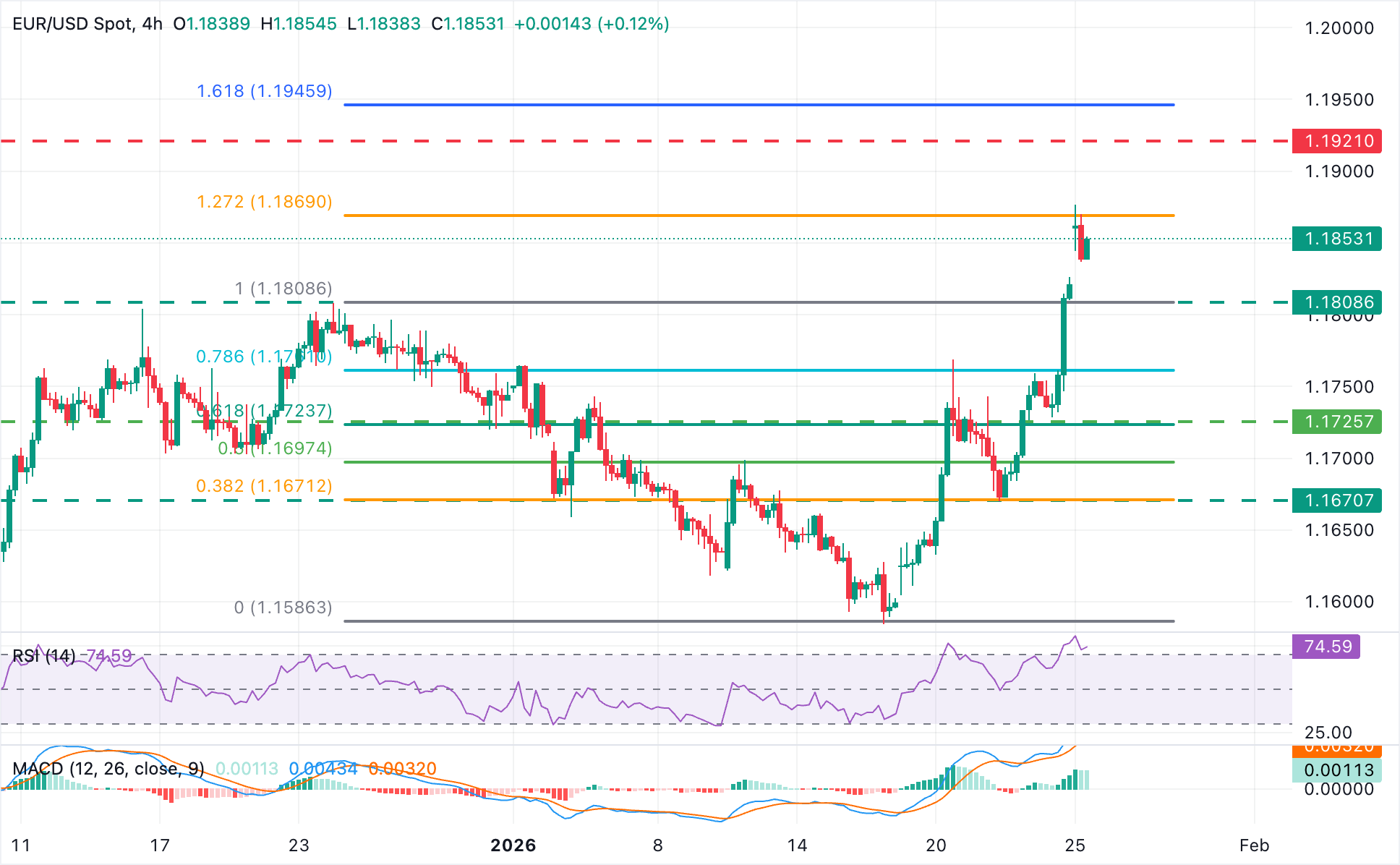
EUR/USD remains fairly steady at 1.1853 at the European session opening, with technical indicators pointing to a strong bullish momentum. The Moving Average Convergence Divergence (MACD) remains above zero and edges higher on the 4-hour chart, but the Relative Strength Index (RSI), however, is at overbought levels, which should act as a warning for bulls.
The pair hit resistance at the 127.2% Fibonacci retracement of the early January sell-off, in the 1.1875 area. Above here, the September 2025 high, at 1.1918, would come into focus.
On the downside, price action opened a gap in the early Asian session, and gaps tend to close. In that sense, a correction towards the late-December highs, at 1.1808, should be considered. Further down, the next target is the January 23 low, near 1.1730.
(The technical analysis of this story was written with the help of an AI tool.)
Economic Indicator
IFO – Business Climate
This German business sentiment index released by the CESifo Group is closely watched as an early indicator of current conditions and business expectations in Germany. The Institute surveys more than 7,000 enterprises on their assessment of the business situation and their short-term planning. The positive economic growth anticipates bullish movements for the EUR, while a low reading is seen as negative (or bearish).
Last release: Mon Jan 26, 2026 09:00
Frequency: Monthly
Actual: 87.6
Consensus: 88.1
Previous: 87.6
Source: IFO Institute
Economic Indicator
IFO – Expectations
The IFO Expectations released by the CESifo Group is closely watched as an early indicator of current conditions and business expectations for the next six months, where firms rate the future outlook as better, same, or worse. An optimistic view of those 7,000 business leaders and senior managers is considered as positive, or bullish for the EUR, whereas a pessimistic view is considered as negative, or bearish.
Review Alex Nekritin's Article - Trading Euro with IFO Report
Last release: Mon Jan 26, 2026 09:00
Frequency: Monthly
Actual: 89.5
Consensus: -
Previous: 89.7
Source: IFO Institute
Recommended Articles










Comments (0)
Click the $ button, enter the symbol, and select to link a stock, ETF, or other ticker.