


GBP/USD rallies as US–EU trade de-escalation lifts risk appetite



- GBP/USD gains as Trump signals a Greenland deal with NATO, easing US–Europe trade-war fears.
- Strong US GDP and jobs data fail to lift the Dollar as markets maintain Fed easing expectations.
- Focus turns to UK Retail Sales and US Flash PMIs, Consumer Sentiment for next catalysts.
GBP/USD rises during the North American session amid an improvement of risk appetite, following a de-escalation of the trade-war between the US and Europe. Meanwhile, traders shrug off strong US data, which despite signaling the strength of the economy, failed to underpin the Dollar. The pair trades at 1.1357, up 0.24%.
Sterling advances as easing trade tensions outweigh strong US data and keep the Dollar under pressure
On Wednesday, the US President Donald Trump revealed that he get an agreement with NATO in regard to Greenland, refraining from imposing duties on eight European countries and averting an escalation of the trader war.
Back to economic data, the US Bureau of Economic Analysis revealed Q3 2025 Gross Domestic Product figures, which rose by 4.4% YoY exceeding estimates and the previous print of 4.3%. The economy grew boosted by stronger exports and a reduced drag from inventories.
Jobs data revealed that fewer Americans filled for unemployment benefits last week, according to the Department of Labor. US Initial Jobless Claims report for the week ending January 17. Claims rose by 200K, up from the upward revised previous week from 198K to 199K but it was below forecasts for a 212K increase. Continuing claims fell to 1.85 million in the previous week, its lowest since November.
Following the data release, the US Dollar Index (DXY) dropped 0.25% to 98.55 against six major currencies. Expectations for further rate cuts by the Federal Reserve remained consistent, with traders eyeing 42 basis points of easing towards the end of the year.
Across the pond, the UK economic docket remained absent, yet previously released data showed an uptick in inflation. Contrarily, the latest jobs report was softer according to economists, which would warrant lower interest rates by the Bank of England.
Ahead of this week, the UK economic docke will feature Retail Sales for December. In the US, S&P Global Flash PMIs are expected, along with Consumer Sentiment by the University of Michigan.
GBP/USD Price Forecast: Technical outlook
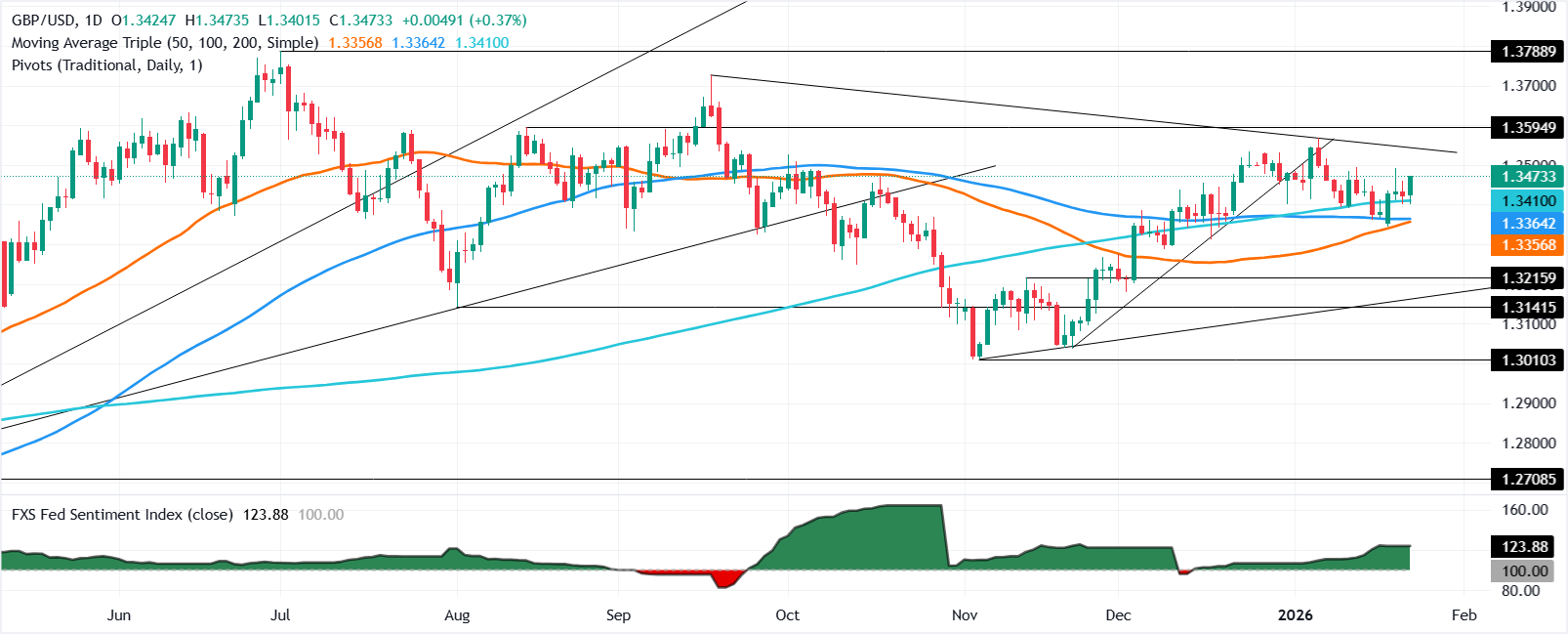
Despite reaching a two-day high of 1.3460, the GBP/USD remains consolidated within familiar levels. Although buyers are gaining momentum as measured by the Relative Strength Index (RSI), it remains below its latest peak.
If GBP/USD breaches the January 20 high at 1.3492, the pair could challenge 1.3500 and increase buyers’ chances of seeing higher prices. Once those levels are taken, the next resistance would be the January 6 high at 1.3567.
Conversely if GBP/USD drops below the 200-day SMA of 1.3406, the next support would be the 50-day SMA at 1.3341.
Pound Sterling FAQs
The Pound Sterling (GBP) is the oldest currency in the world (886 AD) and the official currency of the United Kingdom. It is the fourth most traded unit for foreign exchange (FX) in the world, accounting for 12% of all transactions, averaging $630 billion a day, according to 2022 data. Its key trading pairs are GBP/USD, also known as ‘Cable’, which accounts for 11% of FX, GBP/JPY, or the ‘Dragon’ as it is known by traders (3%), and EUR/GBP (2%). The Pound Sterling is issued by the Bank of England (BoE).
The single most important factor influencing the value of the Pound Sterling is monetary policy decided by the Bank of England. The BoE bases its decisions on whether it has achieved its primary goal of “price stability” – a steady inflation rate of around 2%. Its primary tool for achieving this is the adjustment of interest rates. When inflation is too high, the BoE will try to rein it in by raising interest rates, making it more expensive for people and businesses to access credit. This is generally positive for GBP, as higher interest rates make the UK a more attractive place for global investors to park their money. When inflation falls too low it is a sign economic growth is slowing. In this scenario, the BoE will consider lowering interest rates to cheapen credit so businesses will borrow more to invest in growth-generating projects.
Data releases gauge the health of the economy and can impact the value of the Pound Sterling. Indicators such as GDP, Manufacturing and Services PMIs, and employment can all influence the direction of the GBP. A strong economy is good for Sterling. Not only does it attract more foreign investment but it may encourage the BoE to put up interest rates, which will directly strengthen GBP. Otherwise, if economic data is weak, the Pound Sterling is likely to fall.
Another significant data release for the Pound Sterling is the Trade Balance. This indicator measures the difference between what a country earns from its exports and what it spends on imports over a given period. If a country produces highly sought-after exports, its currency will benefit purely from the extra demand created from foreign buyers seeking to purchase these goods. Therefore, a positive net Trade Balance strengthens a currency and vice versa for a negative balance.
Recommended Articles








Comments (0)
Click the $ button, enter the symbol, and select to link a stock, ETF, or other ticker.