


USD/CAD Price Forecast: Extends losing streak for fourth trading day



- USD/CAD falls further to near 1.3750 due to continued underperformance by the US Dollar.
- The Fed signaled on Wednesday that it will reduce the Federal Fund Rate to 3.4% by 2026.
- The BoC stated this week that interest rates should remain at their current levels in the near term.
The USD/CAD pair extends its losing streak for the fourth trading day on Friday. The Loonie pair trades 0.1% lower to near 1.3750 during the European trading hours. The pair is under pressure as the US Dollar (USD) underperforms, following the monetary policy announcement by the Federal Reserve (Fed) on Wednesday.
As of writing, the US Dollar Index (DXY), which tracks the Greenback’s value against six major currencies, trades vulnerably near its seven-week low of 98.13 posted on Thursday.
The US Dollar is broadly facing weakness on expectations that the Fed will deliver more interest rate cuts in 2026 than what the latest dot plot showed. According to the CME FedWatch tool, there is a 58% chance that the Fed will cut borrowing rates atleast two times through October 2026. On the contrary, the Fed’s dot plot showed that officials see the Federal Fund Rate sliding to 3.4% by the end of 2026, suggesting that there will be one interest rate cut next year.
Meanwhile, the Canadian Dollar (CAD) outperforms its peers, except antipodeans, as the Bank of Canada (BoC) is unlikely to cut interest rates in the near term. In the monetary policy statement on Wednesday, the BoC reiterated that the “current rate is at about the right level to keep inflation close to 2%” as long as the “economy and inflation evolve in line with projections”.
USD/CAD technical analysis
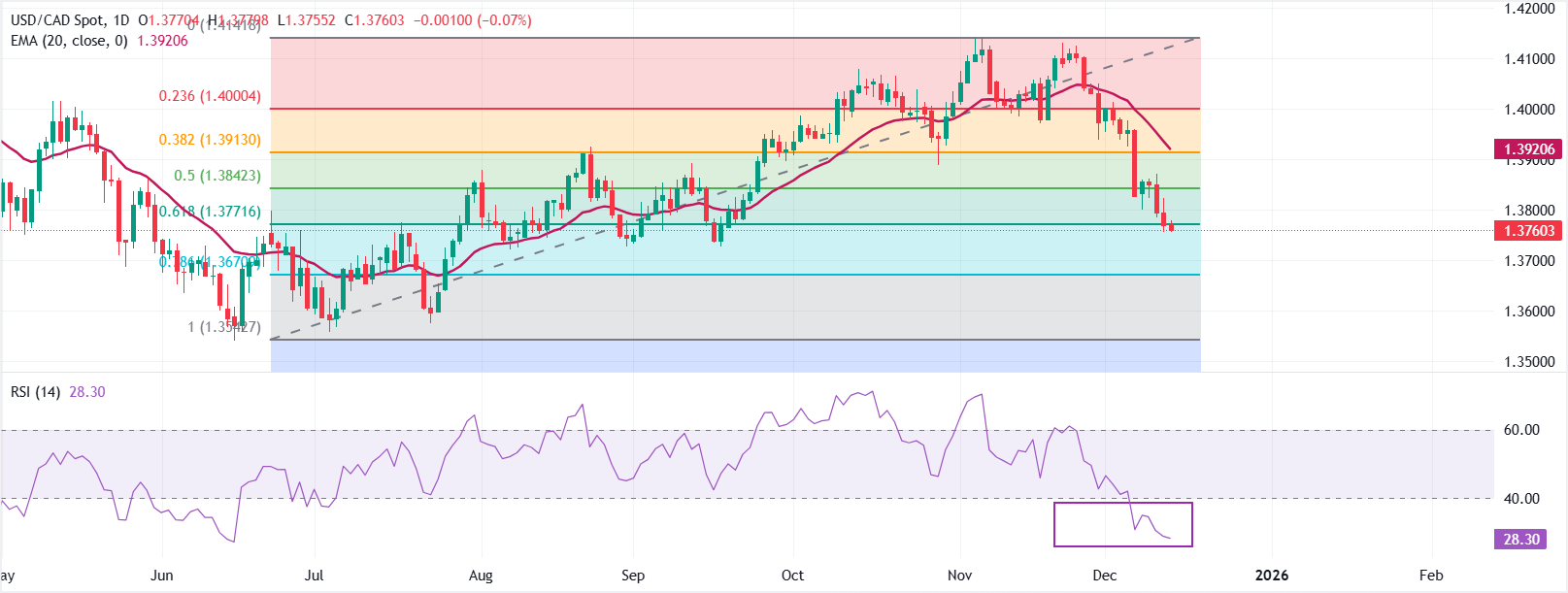
In the daily chart, USD/CAD trades at 1.3760. The pair sits below a descending 20-EMA at 1.3921, keeping the short-term bias bearish and capping rebounds. RSI at 28 (oversold) flags stretched downside conditions. Measured from the 1.3543 low to the 1.4142 high, the 61.8% retracement at 1.3772 offers interim support. A close below it would open the 78.6% retracement at 1.3671.
Downside pressure persists while price holds under the 20-EMA, with recovery attempts expected to struggle against this dynamic barrier. RSI remains below 30 and would need to rebound to stabilize momentum. A move back above the 20-EMA at 1.3921 would ease the bearish tone and allow a corrective bounce, whereas failure to defend 1.3772 would keep focus on lower levels.
(The technical analysis of this story was written with the help of an AI tool)
Central banks FAQs
Central Banks have a key mandate which is making sure that there is price stability in a country or region. Economies are constantly facing inflation or deflation when prices for certain goods and services are fluctuating. Constant rising prices for the same goods means inflation, constant lowered prices for the same goods means deflation. It is the task of the central bank to keep the demand in line by tweaking its policy rate. For the biggest central banks like the US Federal Reserve (Fed), the European Central Bank (ECB) or the Bank of England (BoE), the mandate is to keep inflation close to 2%.
A central bank has one important tool at its disposal to get inflation higher or lower, and that is by tweaking its benchmark policy rate, commonly known as interest rate. On pre-communicated moments, the central bank will issue a statement with its policy rate and provide additional reasoning on why it is either remaining or changing (cutting or hiking) it. Local banks will adjust their savings and lending rates accordingly, which in turn will make it either harder or easier for people to earn on their savings or for companies to take out loans and make investments in their businesses. When the central bank hikes interest rates substantially, this is called monetary tightening. When it is cutting its benchmark rate, it is called monetary easing.
A central bank is often politically independent. Members of the central bank policy board are passing through a series of panels and hearings before being appointed to a policy board seat. Each member in that board often has a certain conviction on how the central bank should control inflation and the subsequent monetary policy. Members that want a very loose monetary policy, with low rates and cheap lending, to boost the economy substantially while being content to see inflation slightly above 2%, are called ‘doves’. Members that rather want to see higher rates to reward savings and want to keep a lit on inflation at all time are called ‘hawks’ and will not rest until inflation is at or just below 2%.
Normally, there is a chairman or president who leads each meeting, needs to create a consensus between the hawks or doves and has his or her final say when it would come down to a vote split to avoid a 50-50 tie on whether the current policy should be adjusted. The chairman will deliver speeches which often can be followed live, where the current monetary stance and outlook is being communicated. A central bank will try to push forward its monetary policy without triggering violent swings in rates, equities, or its currency. All members of the central bank will channel their stance toward the markets in advance of a policy meeting event. A few days before a policy meeting takes place until the new policy has been communicated, members are forbidden to talk publicly. This is called the blackout period.
Recommended Articles









Comments (0)
Click the $ button, enter the symbol, and select to link a stock, ETF, or other ticker.