



Gold price jumps back above $3,400 amid reviving safe-haven demand

- Gold price regains positive traction as trade-related uncertainties boost safe-haven assets.
- The USD struggles to lure buyers despite the Fed’s hawkish pause.
- Bulls seem unaffected by a positive risk tone, which tends to undermine the XAU/USD pair.
Gold price (XAU/USD) attracts some dip-buying during the Asian session on Thursday and rallies back above the $3,400 mark in the last hour, reversing a major part of the overnight slide from a two-week high. US President Donald Trump tempered hopes for a quick resolution to the US-China trade war by saying that he is in no real hurry to sign any deals. This, along with geopolitical risks stemming from the Russia-Ukraine war, conflicts in the Middle East, and a dangerous military confrontation on the India-Pakistan border, underpin the safe-haven bullion.
Meanwhile, the initial market reaction to the Federal Reserve's (Fed) hawkish pause on Wednesday turns out to be short-lived amid the heightened economic uncertainty led by Trump's rapidly shifting stance on trade policies. This, in turn, fails to assist the US Dollar (USD) to capitalize on the previous day's modest gains and is seen as another factor underpinning demand for the Gold price. However, a generally positive tone around the equity markets might hold back the XAU/USD bulls from placing aggressive bets and keep a lid on any meaningful gains.
Daily Digest Market Movers: Gold price bulls look to retain control amid sustained safe-haven demand
- US President Donald Trump said on Wednesday that he was not open to lowering the 145% tariffs imposed on China in order to encourage trade-war negotiations. This keeps a lid on the optimism led by the announcement of US-China trade talks later this week and lends some support to the safe-haven Gold price.
- Airports were shut down across Moscow amid a massive Ukrainian drone attack ahead of Russian President Vladimir Putin’s unilaterally announced three-day truce. Furthermore, Ukraine said that Russia had launched guided bombs nearly three hours after the ceasefire came into force earlier this Thursday.
- Meanwhile, the Israeli military said that it had fully disabled Yemen's main airport in the capital, Sanaa, which is controlled by the Houthis. In response, a member of the Houthis' top political body said that the response to Israel's attacks is coming. This keeps geopolitical risks in play and further underpins the XAU/USD pair.
- The Federal Reserve, as was widely expected, held its key interest rate unchanged in a range between 4.25%-4.5% at the end of a two-day monetary policy meeting on Wednesday. In the accompanying statement, the US central bank noted that the uncertainty about the economic outlook has increased further.
- In the post-meeting press conference, Fed Chair Jerome Powell also noted that there is a great deal of uncertainty about tariffs and said that the right thing to do is wait for further clarity. This suggests that the US central bank is not leaning toward cutting rates anytime soon, though it failed to impress the US Dollar bulls.
- Trump said on Truth Social that he will announce a major trade deal, the first of many, with representatives of a big and highly respected country on Thursday. This remains supportive of a generally positive risk tone around the equity markets and could act as a headwind for the precious metal.
- The market focus will remain glued to Trump's press conference at 14 GMT in the Oval Office. Apart from this, Thursday's release of the US Weekly Initial Jobless Claims data will influence the USD price dynamics and provide a fresh impetus to the XAU/USD pair later during the North American session.
Gold price could aim to retest the all-time peak once the $3,434-3,435 immediate barrier is cleared
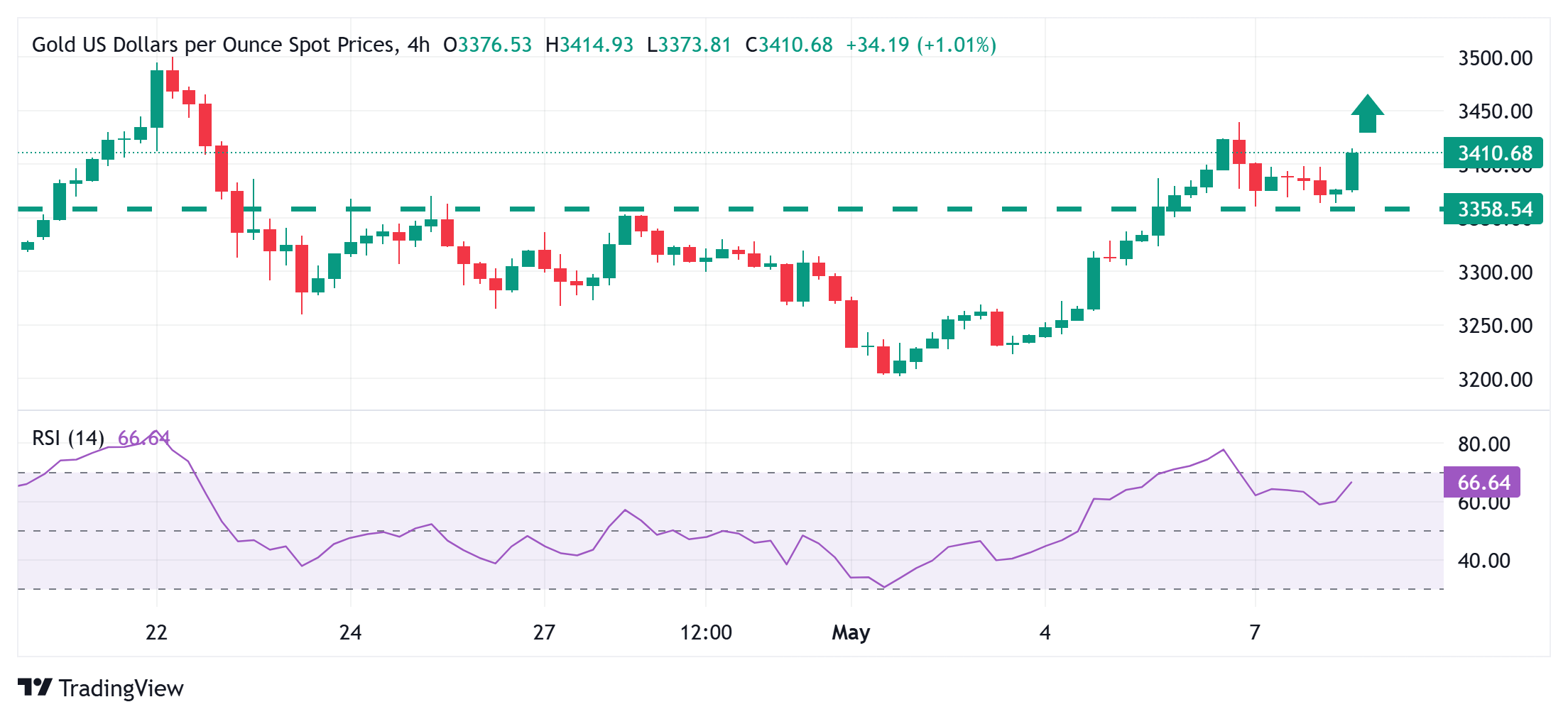
From a technical perspective, the emergence of fresh buying near the $3,260 resistance-turned-support and the subsequent move up favors the XAU/USD bulls. Moreover, oscillators on the daily chart are holding comfortably in positive territory, suggesting that the path of least resistance for the Gold price remains to the upside. Some follow-through buying beyond the $3,434-3,435 region, or the weekly high, will reaffirm the positive bias and allow the commodity to retest the all-time peak and make a fresh attempt to conquer the $3,500 psychological mark.
On the flip side, the $3,465-3,460 area might continue to act as an immediate strong support ahead of the $3,328-3,327 region and the $3,300 round figure. A convincing break below the latter would negate the near-term positive outlook and prompt some technical selling. The downward trajectory might then drag the Gold price to the $3,265-3,260 intermediate support en route to the $3,223-3,222 region and the last week's swing low, around the $3,200 neighborhood.
US-China Trade War FAQs
Generally speaking, a trade war is an economic conflict between two or more countries due to extreme protectionism on one end. It implies the creation of trade barriers, such as tariffs, which result in counter-barriers, escalating import costs, and hence the cost of living.
An economic conflict between the United States (US) and China began early in 2018, when President Donald Trump set trade barriers on China, claiming unfair commercial practices and intellectual property theft from the Asian giant. China took retaliatory action, imposing tariffs on multiple US goods, such as automobiles and soybeans. Tensions escalated until the two countries signed the US-China Phase One trade deal in January 2020. The agreement required structural reforms and other changes to China’s economic and trade regime and pretended to restore stability and trust between the two nations. However, the Coronavirus pandemic took the focus out of the conflict. Yet, it is worth mentioning that President Joe Biden, who took office after Trump, kept tariffs in place and even added some additional levies.
The return of Donald Trump to the White House as the 47th US President has sparked a fresh wave of tensions between the two countries. During the 2024 election campaign, Trump pledged to impose 60% tariffs on China once he returned to office, which he did on January 20, 2025. With Trump back, the US-China trade war is meant to resume where it was left, with tit-for-tat policies affecting the global economic landscape amid disruptions in global supply chains, resulting in a reduction in spending, particularly investment, and directly feeding into the Consumer Price Index inflation.
Related Articles
National Debt Bomb Ignited? Musk Warns U.S. Will Be 1000% Bankrupt Without AI
TradingKey - Tesla (TSLA) CEO Elon Musk recently issued another warning regarding the rapidly ballooning U.S. national debt. He stated clearly that without artificial intelligence and robotics, the United States will inevitably head toward fiscal bankruptcy.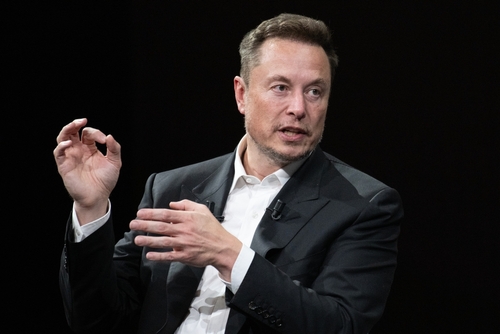
Tesla Stock Outlook: Competing With Rivian, Robotaxi Potential, and 2026 Prospects
There is much conversation about the prospect of investing in Tesla (TSLA) as we move closer to 2026. The volatility of its share price in 2025 is leading many investors to consider if they should purchase shares of Tesla given the alternatives available in terms of electric vehicles (Rivian, etc.).
Why Sanae Takaichi Winning Japan’s Diet Election Led to a Surge in Japanese Stock Indices?
TradingKey - Reports indicate that the ruling coalition led by Japanese Prime Minister Sanae Takaichi has secured a single-party majority in the parliamentary elections held on Sunday (February 8). Following the news, the yen weakened slightly, while the Nikkei Index surpassed 57,000 for the first t
A Crash After a Surge: Why Silver Lost 40% in a Week?
TradingKey - Spot silver (XAGUSD) prices continue to decline. Silver plunged 20% on Thursday, breaking below $71 per ounce, with the sell-off intensifying on Friday as prices fell further below $64. Compared to the all-time high set on January 29, silver prices have retraced more than 40%, wiping out nearly all gains accumulated over the previous month.

