Gold price jumps to two-week top as geopolitical risks underpin safe-haven assets

- Gold price continues to attract safe-haven flows amid rising geopolitical tensions.
- The intraday move up seems unaffected by the emergence of some USD buying.
- Traders keenly await the key two-day FOMC policy meeting starting this Tuesday.
Gold price (XAU/USD) attracts some follow-through buyers for the second straight day and jumps to a nearly two-week high, around the $3,381-3,382 area during the Asian session on Tuesday. Despite signs of easing US-China trade tensions, investors remain on edge in the wake of US President Donald Trump's erratic trade policies. Apart from this, persistent geopolitical risks stemming from the protracted Russia-Ukraine war and conflicts in the Middle East boost demand for the safe-haven precious metal.
Meanwhile, the strong intraday move up seems rather unaffected by the emergence of some US Dollar (USD) buying, which tends to undermine the Gold price. This, in turn, favors bullish traders and suggests that the path of least resistance for the XAU/USD is to the upside. Investors, however, might refrain from placing aggressive bets and opt to wait for more cues about the Federal Reserve's (Fed) future rate-cut path. Hence, the focus will remain glued to the outcome of a two-day FOMC policy meeting on Wednesday,
Daily Digest Market Movers: Gold price bulls regain control as geopolitical risks offset US-China trade deal hopes
- Speaking to reporters aboard Air Force One on Sunday, US President Donald Trump hinted at possible trade agreements with certain countries as early as this week, though he did not name any specific countries. Trump had signaled earlier that he is open to lowering massive tariffs imposed on China.
- Meanwhile, China's Commerce Ministry said last Friday that it was evaluating the possibility of trade talks with the US. This, in turn, adds to the optimism over a possible easing of the tit-for-tat tariff war between the world’s two largest economies and remains supportive of a generally positive risk tone.
- The Institute for Supply Management (ISM) survey showed on Monday that the growth in the US services sector picked up in April. In fact, the ISM Services PMI rose to 51.6 compared to 50.8 in March and 50.6 estimated. This comes on top of Friday's upbeat US jobs data and eases fears of a US recession.
- This assists the US Dollar to gain some positive traction following a two-day losing streak. The Gold price, however, continues to attract safe-haven flows amid uncertainty over Trump's erratic trade policies and rising geopolitical risks. Trump on Sunday announced a 100% tariff on movies produced overseas.
- On the geopolitical front, Russian officials said that Ukraine launched drones at Moscow for the second night in a row, forcing the closure of the capital’s three major airports. Moreover, Ukrainian forces were trying to advance in Kursk and attacked a power substation in Russia’s western Kursk region.
- Furthermore, Israel, reportedly in coordination with the US, launched airstrikes on Yemen's Hodeidah port in response to Houthi rebel's ballistic missile attack that hit Ben Gurion International Airport on Sunday. This, in turn, provides an additional boost to the commodity on Tuesday.
- Traders now look forward to the highly-anticipated two-day FOMC meeting starting this Tuesday amid reduced bets for a rate cut in June. Hence, the accompanying policy statement and Federal Reserve Chair Jerome Powell's comments on Wednesday will be scrutinized for cues about the rate-cut path.
Gold price could accelerate the positive momentum beyond $3,400 once the 61.8% Fibo. hurdle is cleared
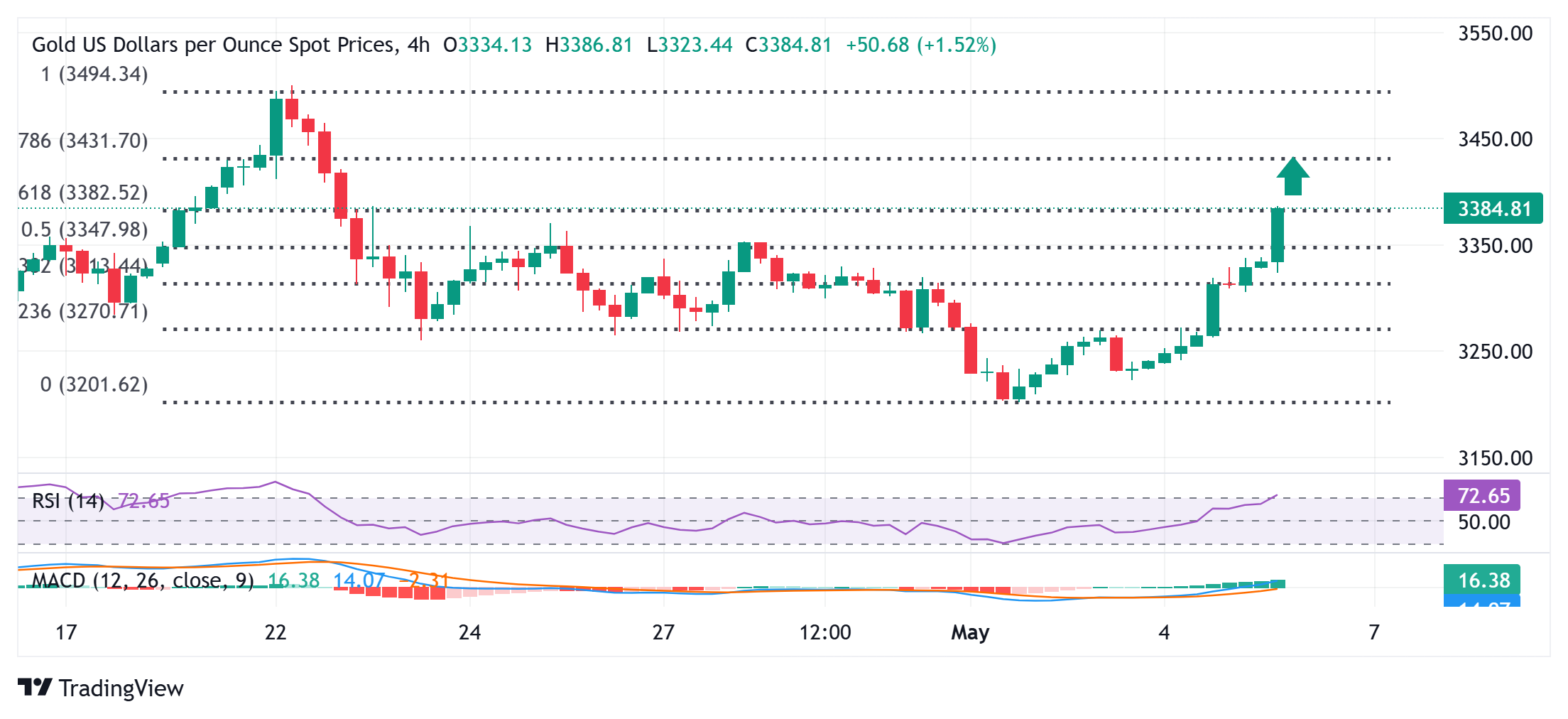
From a technical perspective, the strong intraday move higher lifts the Gold price beyond the $3,350 hurdle, which coincided with the 50% Fibonacci retracement level of the recent pullback from the all-time peak. This, along with positive oscillators on the daily chart, suggests that the path of least resistance for the commodity remains to the upside. Some follow-through buying beyond the 61.8% Fibo. level, around the $3,385 region, will reaffirm the positive bias and lift the XAU/USD beyond the $3,400 mark, towards the next relevant barrier near the $3,425 zone. The subsequent move up should allow bulls to make a fresh attempt to conquer the $3,500 psychological mark.
On the flip side, the $3,350 area now seems to protect the immediate downside ahead of the daily low, around the $3,325 zone. This is followed by the $3,300 mark, which if broken decisively might prompt some technical selling and drag the Gold price to the $3,275-3,270 intermediate support en route to the $3,245-3,244 region. A convincing break below the latter could make the XAU/USD vulnerable to accelerate the slide back towards challenging the $3,200 mark, or over a two-week low touched last Thursday.
Gold FAQs
Gold has played a key role in human’s history as it has been widely used as a store of value and medium of exchange. Currently, apart from its shine and usage for jewelry, the precious metal is widely seen as a safe-haven asset, meaning that it is considered a good investment during turbulent times. Gold is also widely seen as a hedge against inflation and against depreciating currencies as it doesn’t rely on any specific issuer or government.
Central banks are the biggest Gold holders. In their aim to support their currencies in turbulent times, central banks tend to diversify their reserves and buy Gold to improve the perceived strength of the economy and the currency. High Gold reserves can be a source of trust for a country’s solvency. Central banks added 1,136 tonnes of Gold worth around $70 billion to their reserves in 2022, according to data from the World Gold Council. This is the highest yearly purchase since records began. Central banks from emerging economies such as China, India and Turkey are quickly increasing their Gold reserves.
Gold has an inverse correlation with the US Dollar and US Treasuries, which are both major reserve and safe-haven assets. When the Dollar depreciates, Gold tends to rise, enabling investors and central banks to diversify their assets in turbulent times. Gold is also inversely correlated with risk assets. A rally in the stock market tends to weaken Gold price, while sell-offs in riskier markets tend to favor the precious metal.
The price can move due to a wide range of factors. Geopolitical instability or fears of a deep recession can quickly make Gold price escalate due to its safe-haven status. As a yield-less asset, Gold tends to rise with lower interest rates, while higher cost of money usually weighs down on the yellow metal. Still, most moves depend on how the US Dollar (USD) behaves as the asset is priced in dollars (XAU/USD). A strong Dollar tends to keep the price of Gold controlled, whereas a weaker Dollar is likely to push Gold prices up.
Related Articles
Amazon Stock Predictions for 2026 to 2030: Will They Exceed Expectations and Achieve Major Long-Term Goals?
TradingKey - As we head into 2026, many investors are questioning where Amazon (AMZN) fits into the technology world.
A Crash After a Surge: Why Silver Lost 40% in a Week?
TradingKey - Spot silver (XAGUSD) prices continue to decline. Silver plunged 20% on Thursday, breaking below $71 per ounce, with the sell-off intensifying on Friday as prices fell further below $64. Compared to the all-time high set on January 29, silver prices have retraced more than 40%, wiping out nearly all gains accumulated over the previous month.
Is Bitcoin’s Four-Year Cycle Dead in 2026?
Is the Bitcoin 4-year cycle dead? After 2025 broke historical records with a red post-halving year, institutional analysts explore if the Bitcoin price has decoupled from the halving countdown. Analyze the impact of spot ETFs, global liquidity, and the roadmap to the 2028 halving in this 2026 market
Why Ripple ETFs are Winning the Capital War Against Bitcoin
While Bitcoin and Ethereum ETFs face massive outflows, XRP ETFs have defied market trends with a historic 30-day inflow streak reaching $1.37 billion. Explore why institutional "smart money" is rotating into Ripple, the structural impact of the "Liquidity Lock," and why analysts set a 2026 price tar