


What Really Triggered Feb. 5’s Bitcoin Crash? Jeff Park’s New Theory



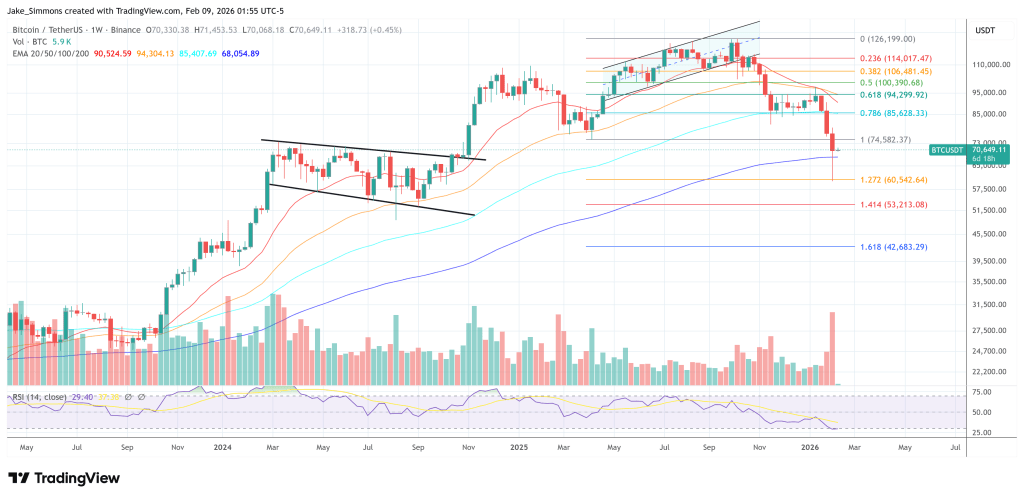
Bitcoin got hit hard on Feb. 5 (down 13.2%), and Jeff Park’s take is pretty blunt: this didn’t look like a crypto headline. It looked more like tradfi plumbing: margin, derivatives, and ETF mechanics, running through spot Bitcoin ETFs, with BlackRock’s IBIT right in the middle. Here’s the odd part: flows didn’t show the big redemptions you’d normally expect on a day like that.
Why Did Bitcoin Crash On Feb. 5?
Park starts with the ETF tape in his X post from Feb. 7. IBIT, he said, did record volume—“2x the prior high, 10B+”—and options were going nuts too, with contract counts at launch-era highs. And unlike prior spikes in options interest, he says this one leaned put-heavy, based on a clear volume imbalance.
That timing matters. It landed right as markets were going risk-off across the board. Park cited Goldman’s prime brokerage desk calling Feb. 4 one of the worst daily performance events for multi-strat funds, around a 3.5 z-score—basically a “0.05% event” in his framing. When that happens, pod-shop risk managers step in and tell everyone the same thing: cut gross, fast. Park frames Feb. 5 as the second leg of that forced deleveraging.
But the flow data didn’t line up with the obvious story. He points to prior IBIT drawdowns where you did see real redemptions: Jan. 30’s roughly $530 million of net outflows after a 5.8% down day, and Feb. 4’s roughly $370 million during the losing streak. On a -13% day, you’d think you’d see $500M–$1B of outflows. He didn’t. Instead, Park points to net creations: about 6 million new IBIT shares created, adding roughly $230 million in AUM. And the rest of the spot Bitcoin ETF complex was net positive too—$300M+. “That is a little perplexing,” he wrote. His point: it probably wasn’t one thing.
Deleveraging First, Then Short-Gamma Mechanics
His main claim: the trigger wasn’t crypto-native. “The catalyst to the sell off was that there was a broad based deleveraging across multi-asset funds/portfolios due to the high downside correlation of risk assets reaching statistically anomalous levels,” he wrote. In his view, that set off violent de-risking that included Bitcoin, even if a lot of the exposure was supposedly “delta neutral”: basis trades, RV versus crypto equities, and other setups that box delta across dealers.
After that, the hedging mechanics took over. “This deleveraging then caused some short gamma to come into effect that compounded to the downside,” he wrote, basically saying dealers had to sell IBIT as their hedges updated. And because it happened so fast, he thinks market makers ended up net short Bitcoin without really managing inventory the “normal” way. That can mute what you’d otherwise see as big ETF outflows on the tape.
He also notes how closely IBIT tracked software equities and other risk assets in the weeks leading into the drop. In his framing, the software-led selloff is the cleaner spark here: gold matters, sure, but it’s less central to the funded multi-strat trades he’s talking about.
One hard datapoint he leans on is the CME basis. Using a dataset he attributed to Anchorage Digital Head of Research David Lawant, Park said the near-dated CME BTC basis jumped from 3.3% on Feb. 5 to 9% on Feb. 6—an unusually big move since the ETF launch. He reads that as a forced unwind of the basis trade by large multi-strat shops (sell spot, buy futures).
As extra fuel, he brings up structured products: knock-ins and barrier levels. Not necessarily the driver, but something that can make a fast move nastier. He referenced a JPM note priced in November with a barrier “right at 43.6,” and argued that if similar notes were printed later as BTC slid, barriers could cluster around “38–39.”
That’s the kind of zone where a fast selloff can flip hedging into a cascade. If barriers break, negative vanna and quickly changing gamma can force dealers to sell hard into weakness. He also notes implied vol nearly touching 90% in his description.
Why Bitcoin Snapped Back On Feb. 6Park frames Feb. 6’s “heroic 10%+ recovery” as a positioning reset. CME open interest expanded faster than Binance’s. He says CME OI collapsed from Feb. 4 to Feb. 5 (supporting the basis-unwind idea), then recovered as players leaned back into relative-value setups.
In his telling, ETF creates/redeems can look flat-ish if the basis trade is being rebuilt, even if price stays heavy because crypto-native leverage and short-gamma exposures—often on offshore venues—are still clearing out.
Bottom line, in his view: this may not have been “fundamental” at all. It was technical plumbing: multi-asset de-risking, then derivatives feedback loops making it worse. If ETF inflows keep coming without a matching expansion in the basis trade, he implies, that’s the cleaner signal of real demand, less dealer recycling, more sticky buyers.
At press time, BTC traded at $70,649.
Recommended Articles








Comments (0)
Click the $ button, enter the symbol, and select to link a stock, ETF, or other ticker.