Bitcoin Price Forecast: BTC slips below $90,000 amid profit-taking, ETF outflows

- Bitcoin price extends its correction, slipping below $90,000 on Thursday after rejection from a key resistance level.
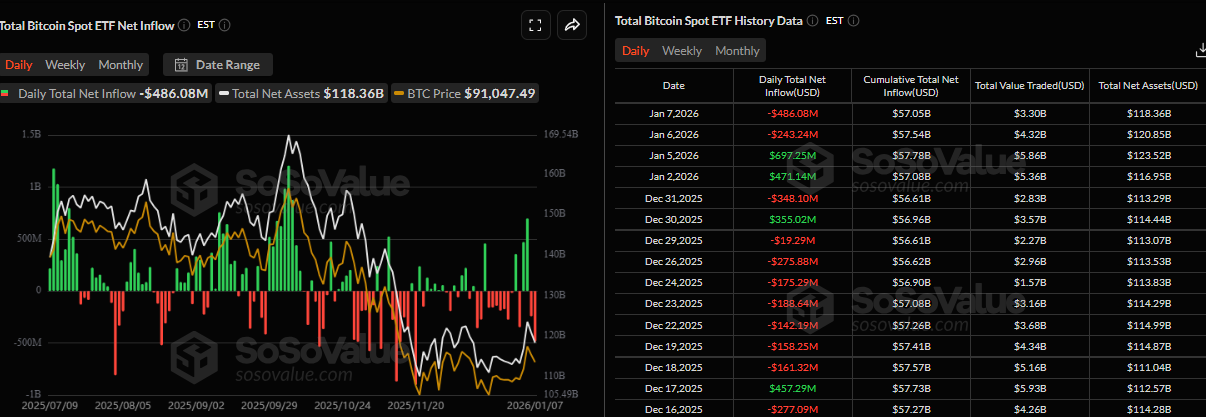
- US-listed spot ETFs recorded an outflow of $486.08 million on Wednesday, the highest single-day withdrawals since November 20.
- Santiment data show that BTC holders are realizing profits, slightly increasing selling pressure.
Bitcoin (BTC) slips below $90,000 on Thursday after a failed rejection at a key resistance level earlier this week. Bearish sentiment is strengthening as institutional demand fades, with spot Bitcoin Exchange-Traded Funds (ETFs) recording outflows. In addition, on-chain data indicate rising profit-taking among traders, suggesting a short-term correction in the largest cryptocurrency by market capitalization.
Fading institutional demand
Institutional demand for BTC has weakened so far this week. SoSoValue data show that Bitcoin spot ETFs recorded an outflow of $486.08 million on Wednesday, the second consecutive withdrawal this week and the largest single-day outflow since November 20. If these outflows continue and intensify, BTC could extend the ongoing correction.
Some holders realized profits, increasing the downward pressure
Santiments’ Network Realized Profit/Loss (NPL) metric indicates that some BTC holders are realizing gains.
As shown in the graph below, the NPL experienced spikes on Monday and Wednesday, the highest profit booking activity since December 12. These spikes indicate that holders are, on average, selling their bags at a significant profit, thereby increasing selling pressure.
 [14-1767867790788-1767867790789.47.08, 08 Jan, 2026].png)
Bitcoin Price Forecast: BTC could extend pullback if it closes below $90,000
Bitcoin price closed above the upper consolidation range of $90,000 on Saturday. BTC rose nearly 4%, retesting the 61.8% Fibonacci retracement level (drawn from the April low of $74,508 to October's all-time high of $126,199) at $94,253 on Monday. However, the rally paused as BTC restested this level on Tuesday, and the price declined 2.54% the next day. As of Thursday, BTC is slipping below $90,000.
If BTC continues its pullback and closes below $90,000 on a daily basis, it could extend the decline toward the next support level at $85,569.
The Relative Strength Index (RSI) on the daily chart is poised to slip below the neutral 50 level, signaling a fading bullish momentum. If the RSI remains below the neutral level, BTC could correct sharply.
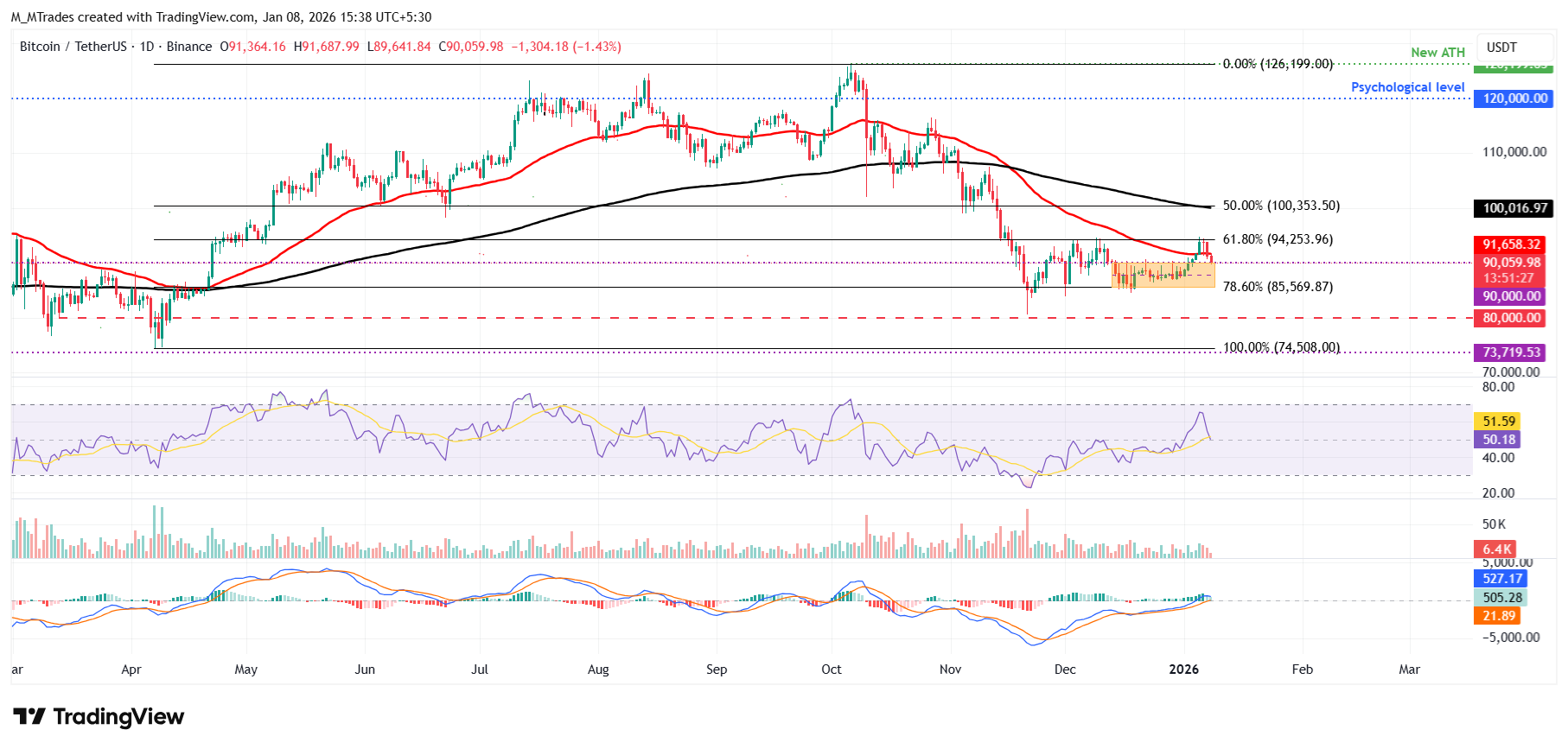
However, if BTC finds support around the $90,000, it could extend the recovery toward the key resistance level at $94,253.
Bitcoin, altcoins, stablecoins FAQs
Bitcoin is the largest cryptocurrency by market capitalization, a virtual currency designed to serve as money. This form of payment cannot be controlled by any one person, group, or entity, which eliminates the need for third-party participation during financial transactions.
Altcoins are any cryptocurrency apart from Bitcoin, but some also regard Ethereum as a non-altcoin because it is from these two cryptocurrencies that forking happens. If this is true, then Litecoin is the first altcoin, forked from the Bitcoin protocol and, therefore, an “improved” version of it.
Stablecoins are cryptocurrencies designed to have a stable price, with their value backed by a reserve of the asset it represents. To achieve this, the value of any one stablecoin is pegged to a commodity or financial instrument, such as the US Dollar (USD), with its supply regulated by an algorithm or demand. The main goal of stablecoins is to provide an on/off-ramp for investors willing to trade and invest in cryptocurrencies. Stablecoins also allow investors to store value since cryptocurrencies, in general, are subject to volatility.
Bitcoin dominance is the ratio of Bitcoin's market capitalization to the total market capitalization of all cryptocurrencies combined. It provides a clear picture of Bitcoin’s interest among investors. A high BTC dominance typically happens before and during a bull run, in which investors resort to investing in relatively stable and high market capitalization cryptocurrency like Bitcoin. A drop in BTC dominance usually means that investors are moving their capital and/or profits to altcoins in a quest for higher returns, which usually triggers an explosion of altcoin rallies.
Related Articles
Amazon Stock Predictions for 2026 to 2030: Will They Exceed Expectations and Achieve Major Long-Term Goals?
TradingKey - As we head into 2026, many investors are questioning where Amazon (AMZN) fits into the technology world.
A Crash After a Surge: Why Silver Lost 40% in a Week?
TradingKey - Spot silver (XAGUSD) prices continue to decline. Silver plunged 20% on Thursday, breaking below $71 per ounce, with the sell-off intensifying on Friday as prices fell further below $64. Compared to the all-time high set on January 29, silver prices have retraced more than 40%, wiping out nearly all gains accumulated over the previous month.
Is Bitcoin’s Four-Year Cycle Dead in 2026?
Is the Bitcoin 4-year cycle dead? After 2025 broke historical records with a red post-halving year, institutional analysts explore if the Bitcoin price has decoupled from the halving countdown. Analyze the impact of spot ETFs, global liquidity, and the roadmap to the 2028 halving in this 2026 market
USD Dollar Trend Forecast: Dollar Index Falls Below 97.0 to 4-Year Low, Will the Dollar Continue To Fall or Bottom Out in 2026?
TradingKey - In January 2026, the US Dollar Index continued its downward trend from 2025, officially breaking below the key 97.0 level and reaching a low of 95.5, marking a nearly four-year low since February 2022.