Pi Network Price Forecast: PI risks further losses ahead of 10M token unlock

- Pi Network edges lower to retest crucial support floor, erasing Tuesday's gains.
- CEXs’ token balances surge, signaling increased selling ahead of the 10.8 million PI token unlock on Monday.
- The technical outlook suggests a surge in bearish momentum, indicating further losses.
Pi Network (PI) edges lower by 2% at press time on Thursday, extending the declining trend to a crucial support floor. An inflow surge of the Centralized Exchanges (CEXs) wallet balances ahead of the 10.8 million PI token unlock signals a rise in selling pressure as traders book profit ahead of the incoming supply spike.
The technical outlook warns of further losses that could test the historical low of $0.40.
CEXs' wallet balances surge ahead of 10.8 million PI token unlock
PiScan data shows a net inflow of 704,237 PI tokens on CEXs' wallet balances so far on Thursday, with Gate.io holding over 194 million PI tokens out of the total 401 million CEXs' wallet balances. Typically, a surge in selling pressure boosts CEXs' balances as traders or the team book profits.
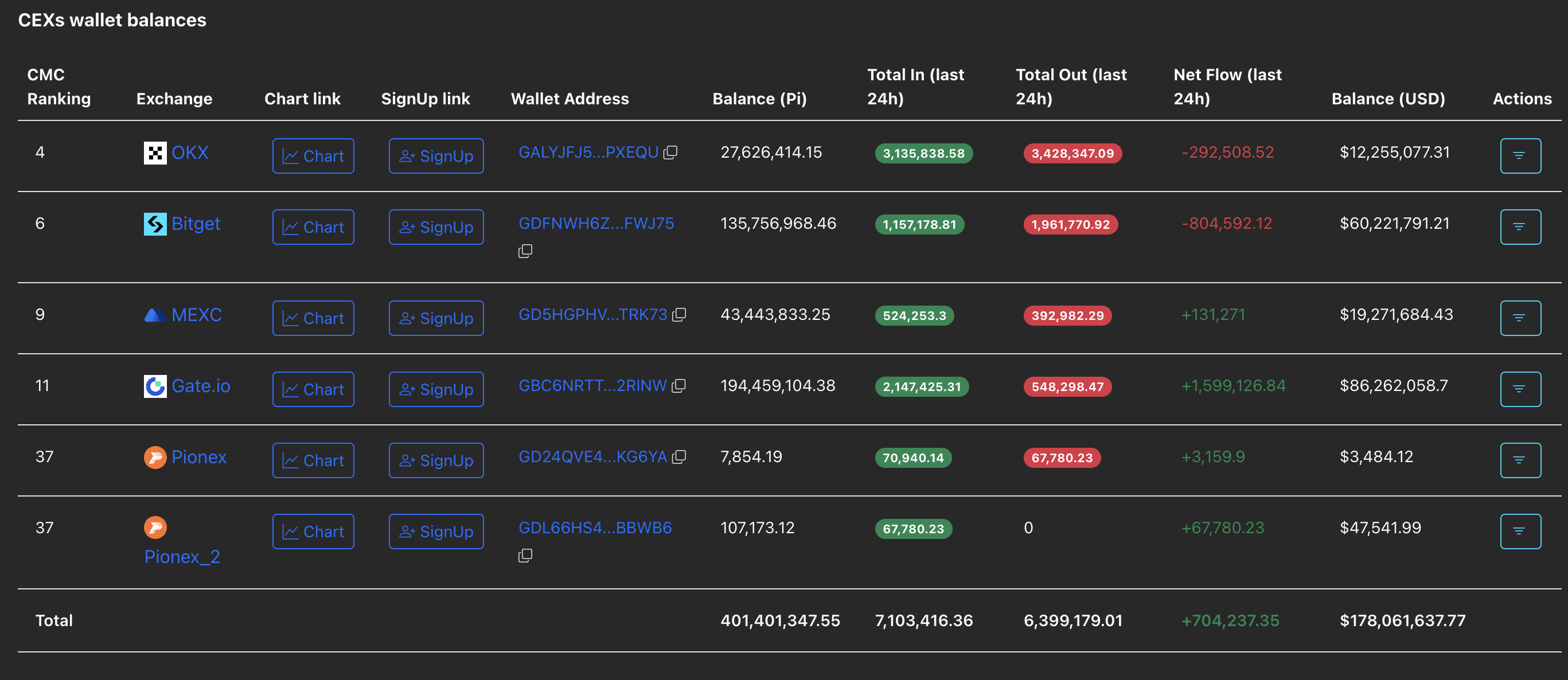
CEXs' wallet balances. Source: PiScan.
PiScan data indicates that 10.8 million PI tokens will be unlocked next Monday, the highest in the next 30 days, which accounts for a total of 171.25 million PI tokens worth $75.91 million. Typically, a surge in token unlock can fuel the selling pressure as traders may book profits.
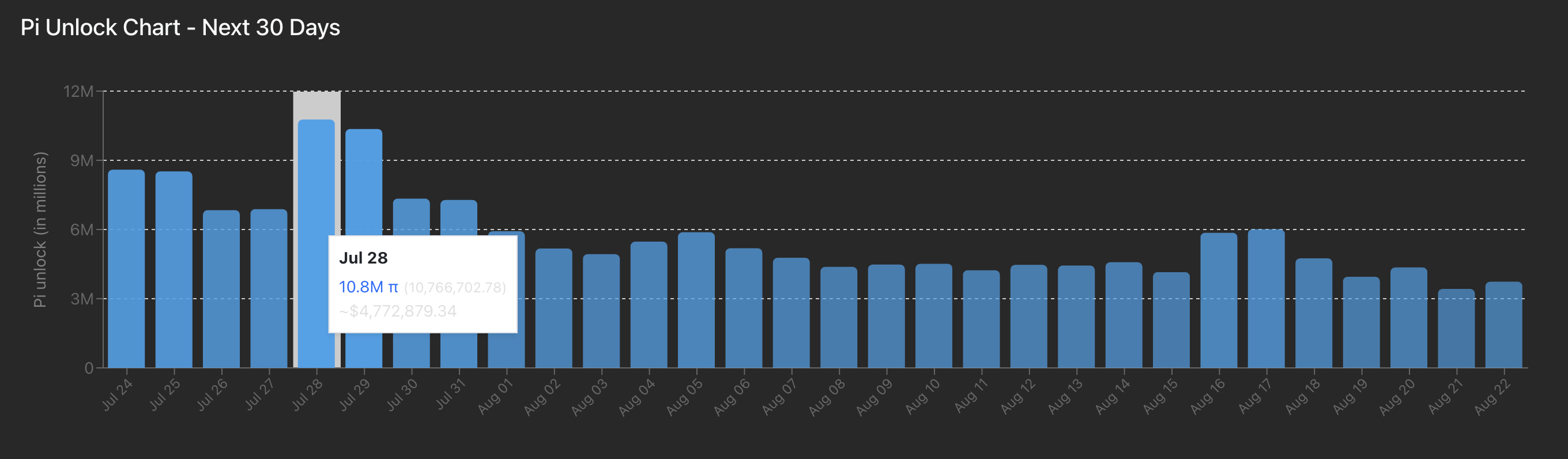
PI unlock chart. Source: PiScan.
Pi Network risks losing $0.43 support floor as bearish momentum surges
Pi Network holds above the $0.4371 support floor that previously acted as the base of a consolidation range, marked by green on the 4-hour price chart. PI struggles to float above this crucial support level with a long shadow candle, while the path of least resistance signals a downside.
A decisive close below the $0.4371 level could test the $0.4204 low marked on July 15 or the $0.4000 support, last tested on June 13.
The Moving Average Convergence Divergence (MACD) drops below the zero line as the red histogram bars intensify, signaling increased bearish momentum.
Still, the Relative Strength Index (RSI) reads 40 on the 4-hour chart, indicating a significant decline in buying pressure. A drop below 30 would indicate overbought conditions in the PI network, potentially increasing the chances of a turnaround.
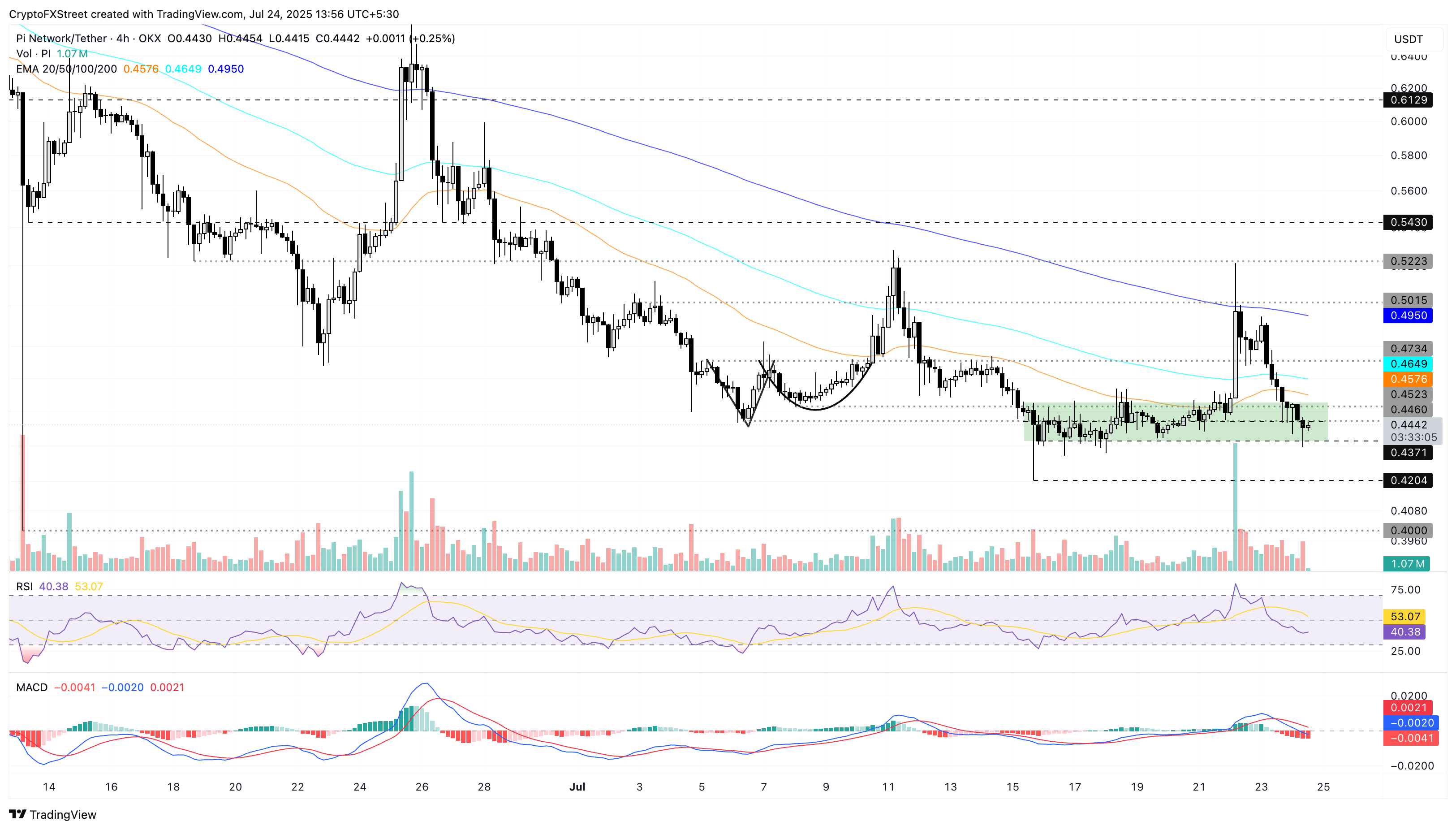
PI/USDT daily price chart.
To renew a bullish run, PI bulls must reclaim the 200-period Exponential Moving Average (EMA) at $0.4950, which could stretch the uptrend to $0.5430.
Bitcoin, altcoins, stablecoins FAQs
Bitcoin is the largest cryptocurrency by market capitalization, a virtual currency designed to serve as money. This form of payment cannot be controlled by any one person, group, or entity, which eliminates the need for third-party participation during financial transactions.
Altcoins are any cryptocurrency apart from Bitcoin, but some also regard Ethereum as a non-altcoin because it is from these two cryptocurrencies that forking happens. If this is true, then Litecoin is the first altcoin, forked from the Bitcoin protocol and, therefore, an “improved” version of it.
Stablecoins are cryptocurrencies designed to have a stable price, with their value backed by a reserve of the asset it represents. To achieve this, the value of any one stablecoin is pegged to a commodity or financial instrument, such as the US Dollar (USD), with its supply regulated by an algorithm or demand. The main goal of stablecoins is to provide an on/off-ramp for investors willing to trade and invest in cryptocurrencies. Stablecoins also allow investors to store value since cryptocurrencies, in general, are subject to volatility.
Bitcoin dominance is the ratio of Bitcoin's market capitalization to the total market capitalization of all cryptocurrencies combined. It provides a clear picture of Bitcoin’s interest among investors. A high BTC dominance typically happens before and during a bull run, in which investors resort to investing in relatively stable and high market capitalization cryptocurrency like Bitcoin. A drop in BTC dominance usually means that investors are moving their capital and/or profits to altcoins in a quest for higher returns, which usually triggers an explosion of altcoin rallies.
Related Articles
Amazon Stock Predictions for 2026 to 2030: Will They Exceed Expectations and Achieve Major Long-Term Goals?
TradingKey - As we head into 2026, many investors are questioning where Amazon (AMZN) fits into the technology world.
A Crash After a Surge: Why Silver Lost 40% in a Week?
TradingKey - Spot silver (XAGUSD) prices continue to decline. Silver plunged 20% on Thursday, breaking below $71 per ounce, with the sell-off intensifying on Friday as prices fell further below $64. Compared to the all-time high set on January 29, silver prices have retraced more than 40%, wiping out nearly all gains accumulated over the previous month.
Is Bitcoin’s Four-Year Cycle Dead in 2026?
Is the Bitcoin 4-year cycle dead? After 2025 broke historical records with a red post-halving year, institutional analysts explore if the Bitcoin price has decoupled from the halving countdown. Analyze the impact of spot ETFs, global liquidity, and the roadmap to the 2028 halving in this 2026 market
Why Ripple ETFs are Winning the Capital War Against Bitcoin
While Bitcoin and Ethereum ETFs face massive outflows, XRP ETFs have defied market trends with a historic 30-day inflow streak reaching $1.37 billion. Explore why institutional "smart money" is rotating into Ripple, the structural impact of the "Liquidity Lock," and why analysts set a 2026 price tar