


Gold declines as US Dollar stays firm, geopolitical tensions persist



- Gold eases on Tuesday as a firmer US Dollar prompts profit-taking.
- US tariffs and escalating tensions with Iran keep geopolitical risks elevated.
- Technically, the daily chart shows strengthening upside momentum following the break above $5,100.
Gold (XAU/USD) edges lower on Tuesday as a firmer US Dollar (USD) tempers demand for the precious metal, even as geopolitical and economic risks remain in focus. At the time of writing, XAU/USD trades near $5,175, down around 1.20% on the day.
The mild pullback reflects a bout of profit-taking after Bullion rallied for four consecutive days to its highest level in over three weeks. The recent advance was fueled by fresh uncertainty surrounding US trade policy and escalating tensions between Washington and Tehran.
US tariffs and Iran tensions keep risks elevated
Global trade tensions remain front and center as US President Donald Trump’s new 10% global tariff comes into effect on Tuesday. The measure was announced after the US Supreme Court ruled last week that Trump’s use of the International Emergency Economic Powers Act (IEEPA) to impose sweeping tariffs was unlawful.
While the current tariff stands at 10%, White House officials have indicated that a formal order is being prepared to raise the rate to 15%. The latest shift in US trade policy has also cast doubt over previously negotiated trade arrangements.
The European Parliament has reportedly paused the ratification process for the US-EU trade deal, while India has postponed negotiations to finalize an interim trade agreement with Washington.
On Monday, Trump warned that countries that “play games” would “be met with a much higher tariff, and worse, than that which they just recently agreed to.”
Meanwhile, the risk of potential US military action against Iran continues to mount, with high-level talks scheduled to resume in Geneva on Thursday.
Fed outlook in focus as traders price 50 bps of easing
Elsewhere, fading expectations of near-term Federal Reserve (Fed) interest rate cuts could act as a short-term headwind for the precious metal. However, traders are still pricing in nearly 50 basis points (bps) of easing by year-end, which may help limit deeper losses.
Looking ahead, the US economic docket features the Conference Board’s Consumer Confidence report and a heavy slate of Fed speakers, which could drive moves in the USD and Gold.
Technical analysis: Bulls regain control above $5,100
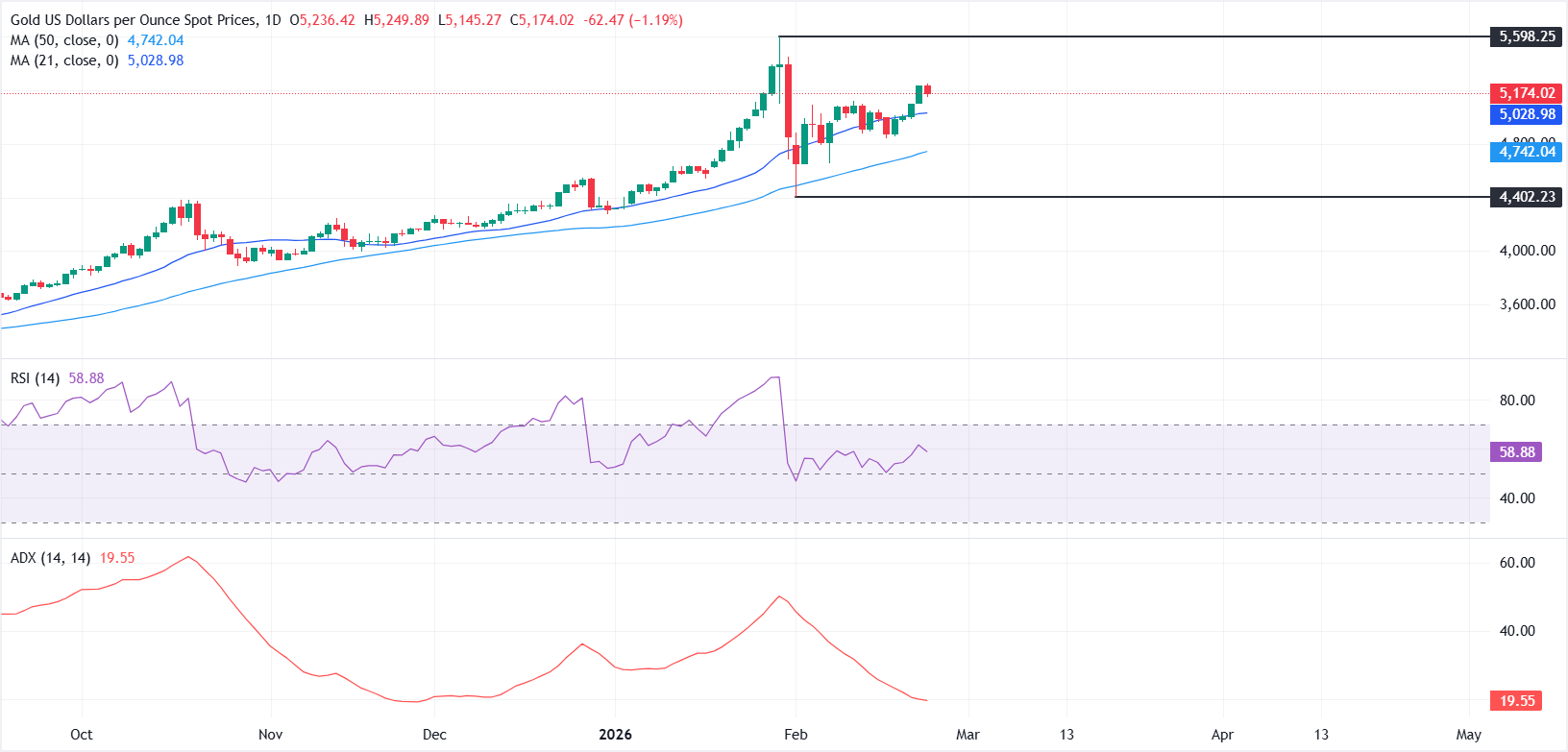
From a technical perspective, XAU/USD’s outlook has turned constructive following the break above the $5,100 barrier. On the daily chart, the near-term bias remains mildly bullish as prices hold comfortably above the rising 21-day and 50-day Simple Moving Averages (SMAs), both of which continue to slope higher and reflect an intact uptrend despite recent volatility.
The Relative Strength Index (RSI) at 58 has eased from overbought territory and is now hovering in the upper-mid range, suggesting positive but less stretched momentum. Meanwhile, the Average Directional Index (ADX) has softened slightly, indicating the trend remains in place, albeit with moderating strength.
Initial support is seen at the 21-day SMA near $5,030. A sustained hold above this level would keep buyers in control. Stronger support lies at the 50-day SMA around $4,740.
On the upside, immediate resistance stands near Tuesday’s peak around $5,250. A daily close above this level would open the door toward the $5,500 region as the next upside target.
(The technical analysis of this story was written with the help of an AI tool.)
Gold FAQs
Gold has played a key role in human’s history as it has been widely used as a store of value and medium of exchange. Currently, apart from its shine and usage for jewelry, the precious metal is widely seen as a safe-haven asset, meaning that it is considered a good investment during turbulent times. Gold is also widely seen as a hedge against inflation and against depreciating currencies as it doesn’t rely on any specific issuer or government.
Central banks are the biggest Gold holders. In their aim to support their currencies in turbulent times, central banks tend to diversify their reserves and buy Gold to improve the perceived strength of the economy and the currency. High Gold reserves can be a source of trust for a country’s solvency. Central banks added 1,136 tonnes of Gold worth around $70 billion to their reserves in 2022, according to data from the World Gold Council. This is the highest yearly purchase since records began. Central banks from emerging economies such as China, India and Turkey are quickly increasing their Gold reserves.
Gold has an inverse correlation with the US Dollar and US Treasuries, which are both major reserve and safe-haven assets. When the Dollar depreciates, Gold tends to rise, enabling investors and central banks to diversify their assets in turbulent times. Gold is also inversely correlated with risk assets. A rally in the stock market tends to weaken Gold price, while sell-offs in riskier markets tend to favor the precious metal.
The price can move due to a wide range of factors. Geopolitical instability or fears of a deep recession can quickly make Gold price escalate due to its safe-haven status. As a yield-less asset, Gold tends to rise with lower interest rates, while higher cost of money usually weighs down on the yellow metal. Still, most moves depend on how the US Dollar (USD) behaves as the asset is priced in dollars (XAU/USD). A strong Dollar tends to keep the price of Gold controlled, whereas a weaker Dollar is likely to push Gold prices up.
Recommended Articles








Comments (0)
Click the $ button, enter the symbol, and select to link a stock, ETF, or other ticker.