


Gold consolidates near $5,000 on soft USD and supportive macro backdrop



- Gold reclaims the $5,000 level as a weaker US Dollar and a supportive macro backdrop help stabilise prices.
- Traders remain cautious ahead of this week’s key US data, led by delayed NFP and CPI.
- Technically, Gold maintains a neutral-to-slightly bullish bias, with price holding above key daily moving averages.
Gold (XAU/USD) holds firm on Monday, steadying after a turbulent end to last week as supportive fundamentals continue to underpin demand. At the time of writing, XAU/USD is trading around $5,010, up nearly 1.15% on the day, with the intraday high marked near $5,047.
However, the metal lacks strong follow-through buying, as heightened volatility across the precious metals space keeps speculative traders on the sidelines. At the same time, markets also remain cautious ahead of a heavy US economic data calendar this week, with the spotlight firmly on the delayed Nonfarm Payrolls (NFP) report and the Consumer Price Index (CPI).
The upcoming US data could shape expectations around when the Federal Reserve (Fed) may begin cutting interest rates again, with markets currently pricing in two cuts this year.
Meanwhile, tentative progress in US-Iran talks points to easing geopolitical tensions, which could temper near-term safe-haven flows into Gold as fears of immediate military action diminish.
That said, a dovish Fed outlook, alongside a softer US Dollar (USD), persistent geopolitical and economic uncertainty and solid institutional demand, continues to favour further upside in Gold.
Market movers: Dollar Weakness, Fed Uncertainty and Institutional Demand Keep Gold Supported
- Bloomberg reported on Monday that US Treasury Secretary Scott Bessent said Chinese trading activity helped drive last week’s sharp swings in Gold. “The gold move thing — things have gotten a little unruly in China,” Bessent said on Fox News. “They’re having to tighten margin requirements. So gold looks to me kind of like a classical, speculative blowoff.”
- The Greenback continues to face headwinds as US President Donald Trump’s unpredictable trade and foreign policy, repeated criticism of the Federal Reserve’s independence and mounting US debt fuel concerns over policy credibility.
- China has urged domestic banks to curb exposure to US Treasuries on market-risk concerns, citing worries over concentration risk and heightened volatility, Bloomberg News reported on Monday, citing people familiar with the matter. The advisory does not apply to China’s government’s sovereign holdings of US Treasuries.
- The US Dollar Index (DXY), which tracks the Greenback against a basket of six major currencies, is trading near four-day lows around 97.36, extending its decline for a second straight day.
- China’s central bank extended its gold-buying streak to a fifteenth straight month in January, with holdings rising to 74.19 million fine troy ounces from 74.15 million in December, according to the People's Bank of China. The value of China’s Gold reserves increased to $369.58 billion at the end of January, up from $319.45 billion a month earlier.
- Tether has acquired a 12% minority stake in Gold.com for $150 million, and said the partnership will integrate Tether Gold (XAUT) directly into Gold.com’s platform, allowing users to buy, sell and hold tokenised Gold alongside physical bullion. Each XAUT token represents ownership of one troy ounce of London Good Delivery Gold, held in secure vaults in Switzerland, according to Tether’s official announcement.
Technical analysis: Dip buyers defend trend as RSI stabilises
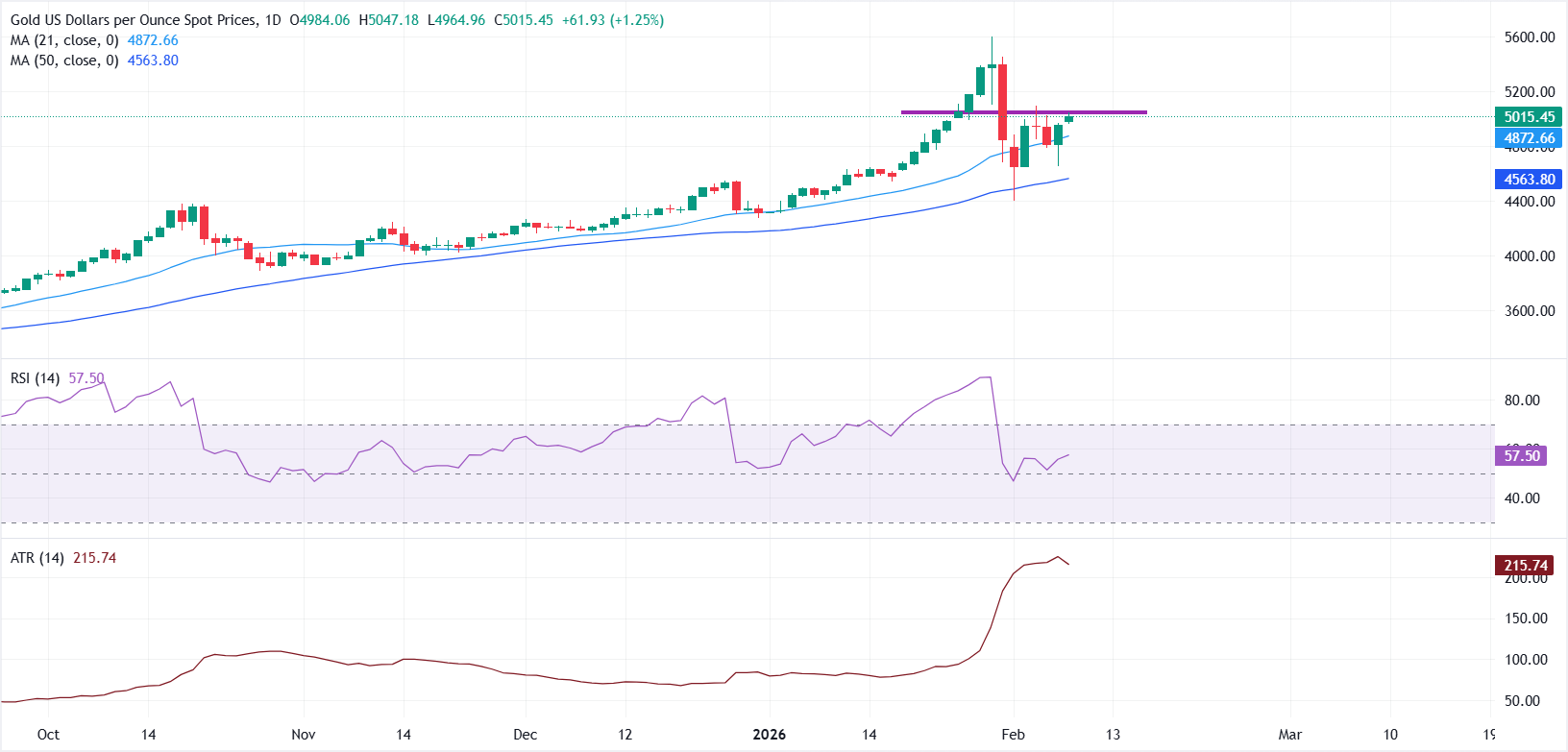
From a near-term perspective, Gold’s technical bias remains neutral to slightly bullish, with dip buyers continuing to limit the downside following last week’s sharp volatility.
On the daily chart, the 21-day Simple Moving Average (SMA) sits above the 50-day SMA and both are sloping higher, pointing to a firm underlying uptrend.
On the upside, the $5,000-$5,050 resistance zone is capping immediate upside attempts. A clear daily close above this area would signal renewed bullish momentum and open the door toward the next upside target near $5,200.
On the downside, as long as buyers manage to defend the $5,000 handle, immediate support is seen at the 21-day SMA near $4,872, followed by the 50-day SMA around $4,563.
The Relative Strength Index (RSI) stands at 57, recovering after retreating from extremely overbought territory, suggesting that upside momentum has cooled but remains positive overall. Volatility, however, remains elevated. The Average True Range (ATR) at 215.74 continues to reflect wider daily price swings.
Gold FAQs
Gold has played a key role in human’s history as it has been widely used as a store of value and medium of exchange. Currently, apart from its shine and usage for jewelry, the precious metal is widely seen as a safe-haven asset, meaning that it is considered a good investment during turbulent times. Gold is also widely seen as a hedge against inflation and against depreciating currencies as it doesn’t rely on any specific issuer or government.
Central banks are the biggest Gold holders. In their aim to support their currencies in turbulent times, central banks tend to diversify their reserves and buy Gold to improve the perceived strength of the economy and the currency. High Gold reserves can be a source of trust for a country’s solvency. Central banks added 1,136 tonnes of Gold worth around $70 billion to their reserves in 2022, according to data from the World Gold Council. This is the highest yearly purchase since records began. Central banks from emerging economies such as China, India and Turkey are quickly increasing their Gold reserves.
Gold has an inverse correlation with the US Dollar and US Treasuries, which are both major reserve and safe-haven assets. When the Dollar depreciates, Gold tends to rise, enabling investors and central banks to diversify their assets in turbulent times. Gold is also inversely correlated with risk assets. A rally in the stock market tends to weaken Gold price, while sell-offs in riskier markets tend to favor the precious metal.
The price can move due to a wide range of factors. Geopolitical instability or fears of a deep recession can quickly make Gold price escalate due to its safe-haven status. As a yield-less asset, Gold tends to rise with lower interest rates, while higher cost of money usually weighs down on the yellow metal. Still, most moves depend on how the US Dollar (USD) behaves as the asset is priced in dollars (XAU/USD). A strong Dollar tends to keep the price of Gold controlled, whereas a weaker Dollar is likely to push Gold prices up.
Recommended Articles







Comments (0)
Click the $ button, enter the symbol, and select to link a stock, ETF, or other ticker.