


Gold steadies above $4,800 as traders await key US economic data



- Gold stabilizes above $4,800 after retreating from Wednesday’s record high.
- Easing tariff fears weigh on safe-haven demand, but broader fundamentals remain supportive.
- Traders eye key US data, including PCE inflation, GDP and Jobless Claims.
Gold (XAU/USD) trims its intraday losses on Thursday as traders reposition ahead of a heavy slate of US economic data due later in the American session. At the time of writing, XAU/USD trades around $4,820, recovering after a short-lived pullback below the $4,800 psychological level.
Bullion came under brief selling pressure, retreating from the record high of $4,888 set on Wednesday, as global risk appetite improved after US President Donald Trump backed away from his threat to impose tariffs on several European countries linked to the Greenland dispute.
However, traders are looking past the easing of immediate trade-war fears, as the broader macro backdrop remains supportive for Gold. Lingering concerns over Federal Reserve (Fed) independence, sustained expectations of lower US interest rates, the ongoing Russia-Ukraine conflict and continued strong central bank demand are keeping dip buyers engaged.
Turning to the US economic calendar, traders await the delayed Personal Consumption Expenditures (PCE) inflation report, along with Personal Income and Personal Spending figures. The docket also includes the advance estimate of Q3 Gross Domestic Product (GDP) and Weekly Initial Jobless Claims.
Market movers: Trump backs away from tariffs; markets weigh geopolitics and Fed risks
- In a post on Truth Social late Wednesday, US President Donald Trump said he would not impose the tariffs scheduled to take effect on February 1 after a “very productive meeting” with NATO Secretary General Mark Rutte, adding that a “framework of a future deal” had been reached on Greenland and the Arctic region.
- NATO Secretary General Mark Rutte said the framework deal with President Trump would require NATO allies to step up efforts on Arctic security. Rutte also said specific negotiations on Greenland will continue between the United States, Denmark, and Greenland.
- Danish Prime Minister Mette Frederiksen struck a firmer tone, saying: “We can negotiate on everything — political issues, security, investments, the economy. But we cannot negotiate on our sovereignty.”
- US Supreme Court justices voiced skepticism on Wednesday over President Trump’s bid to fire Fed Governor Lisa Cook, raising concerns about the lack of due process. Justice Brett Kavanaugh warned that it could “weaken, if not shatter, the independence of the Federal Reserve.”
- On the monetary policy front, markets are pricing in around 50 basis points of easing by year-end, although the Federal Reserve is widely expected to remain on hold at the January 27-28 meeting. A Reuters poll published on Wednesday showed that 58% of economists forecast no change in rates during the first quarter. Looking further ahead, 55 out of 100 respondents expect rate cuts to resume in June or later, once Jerome Powell’s tenure as Fed Chair ends in May.
Technical analysis: Gold consolidates near highs as momentum cools
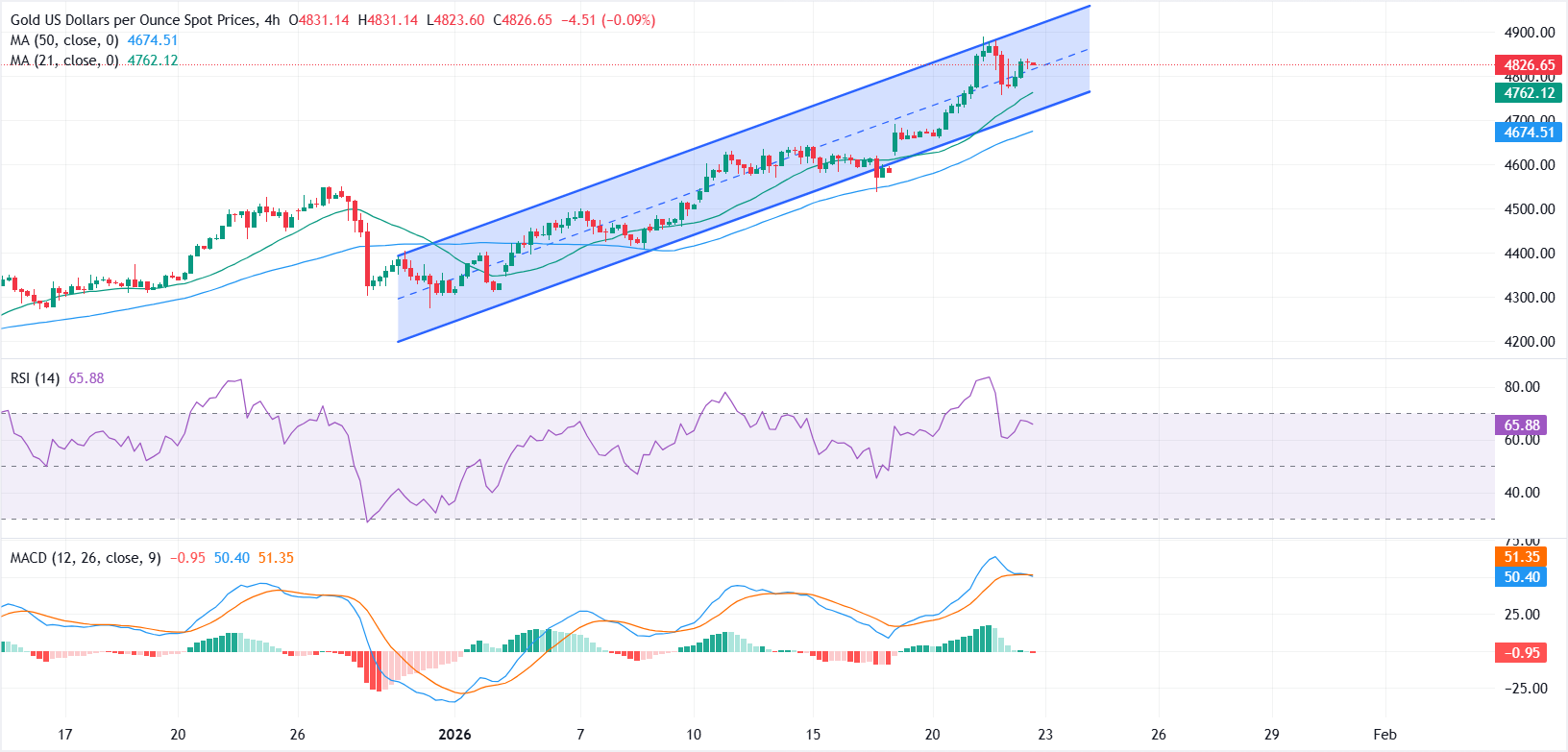
XAU/USD remains in a strong uptrend, with prices up nearly 11% so far this month after surging about 64% in 2025. On the 4-hour chart, Gold is trading within a well-defined ascending parallel channel, marked by a clear sequence of higher highs and higher lows. Prices remain comfortably above the 21-period and 50-period Simple Moving Averages (SMAs), reinforcing the view that buyers are firmly in control.
That said, momentum is starting to cool. Daily and monthly Relative Strength Index (RSI) readings remain overbought, increasing the risk of a near-term pullback.
On the downside, the $4,800 psychological zone is the first line of support. A sustained break below this area would expose the 21-period SMA near $4,762, followed by the 50-period SMA around $4,674.50.
The Moving Average Convergence Divergence (MACD) has crossed below its signal line near the zero level, and the histogram has turned slightly negative, pointing to fading upside momentum. Meanwhile, the Relative Strength Index (RSI) near 66 keeps a neutral-to-bullish tone, but has eased from overbought levels.
Gold FAQs
Gold has played a key role in human’s history as it has been widely used as a store of value and medium of exchange. Currently, apart from its shine and usage for jewelry, the precious metal is widely seen as a safe-haven asset, meaning that it is considered a good investment during turbulent times. Gold is also widely seen as a hedge against inflation and against depreciating currencies as it doesn’t rely on any specific issuer or government.
Central banks are the biggest Gold holders. In their aim to support their currencies in turbulent times, central banks tend to diversify their reserves and buy Gold to improve the perceived strength of the economy and the currency. High Gold reserves can be a source of trust for a country’s solvency. Central banks added 1,136 tonnes of Gold worth around $70 billion to their reserves in 2022, according to data from the World Gold Council. This is the highest yearly purchase since records began. Central banks from emerging economies such as China, India and Turkey are quickly increasing their Gold reserves.
Gold has an inverse correlation with the US Dollar and US Treasuries, which are both major reserve and safe-haven assets. When the Dollar depreciates, Gold tends to rise, enabling investors and central banks to diversify their assets in turbulent times. Gold is also inversely correlated with risk assets. A rally in the stock market tends to weaken Gold price, while sell-offs in riskier markets tend to favor the precious metal.
The price can move due to a wide range of factors. Geopolitical instability or fears of a deep recession can quickly make Gold price escalate due to its safe-haven status. As a yield-less asset, Gold tends to rise with lower interest rates, while higher cost of money usually weighs down on the yellow metal. Still, most moves depend on how the US Dollar (USD) behaves as the asset is priced in dollars (XAU/USD). A strong Dollar tends to keep the price of Gold controlled, whereas a weaker Dollar is likely to push Gold prices up.
Recommended Articles








Comments (0)
Click the $ button, enter the symbol, and select to link a stock, ETF, or other ticker.