


Gold edges lower despite Fed rate cut hopes on cooling US inflation



- Gold price loses traction in Friday’s early Asian session.
- Cooling US CPI inflation data could pave the way for more Fed rate cuts.
- The University of Michigan Consumer Sentiment Index for December will be the highlight on Friday.
Gold price (XAU/USD) declines to below $4,350 during the early Asian trading hours on Friday. The precious metal edges lower due to some profit-taking and weak long liquidation from shorter-term futures traders.
Nonetheless, the potential downside for the yellow metal might be limited amid rising expectations of further US Federal Reserve (Fed) rate cuts after the US Consumer Price Index (CPI) inflation cooled unexpectedly in November. Lower interest rates could reduce the opportunity cost of holding Gold, supporting the non-yielding precious metal.
Additionally, geopolitical tensions between the US and Venezuela, coupled with strong industrial and investment demand, could provide some support to the safe-haven asset such as Gold.
The longest federal government shutdown in US history had impacted data collection for the inflation report. Traders will take more cues from the University of Michigan Consumer Sentiment Index for December, which will be released later on Friday.
Daily Digest Market Movers: Gold drifts lower despite Fed rate cut hopes
- The US CPI inflation declined to 2.7% in November, according to the US Bureau of Labor Statistics (BLS) on Thursday. This reading came in below the market consensus of 3.1%.
- The US core CPI, which excludes volatile food and energy prices, rose by 2.6%, falling short of analysts' estimates for an increase of 3.0%.
- "A surprisingly sharp decline in U.S. consumer price inflation should grease the wheels for further Fed easing in 2026," said Sal Guatieri, senior economist at BMO Capital Markets.
- US President Donald Trump said on Wednesday that the next Fed chair will be someone who believes in lower interest rates "by a lot.” He further stated that he will soon announce a successor to the current Fed Chair Jerome Powell.
- Financial markets are pricing in only a 26.6% chance the Fed will reduce interest rates at its next meeting in January, after it cut them by a quarter-point at each of its last three meetings, according to the CME FedWatch tool.
- The New York Times reported on Thursday that Venezuela’s government has ordered its navy to escort ships carrying petroleum products from its port. This action could escalate the risk of a confrontation with the US after Trump ordered a “blockade” aimed at the country’s oil industry.
Gold keeps the bullish bias and is set to retest a record high
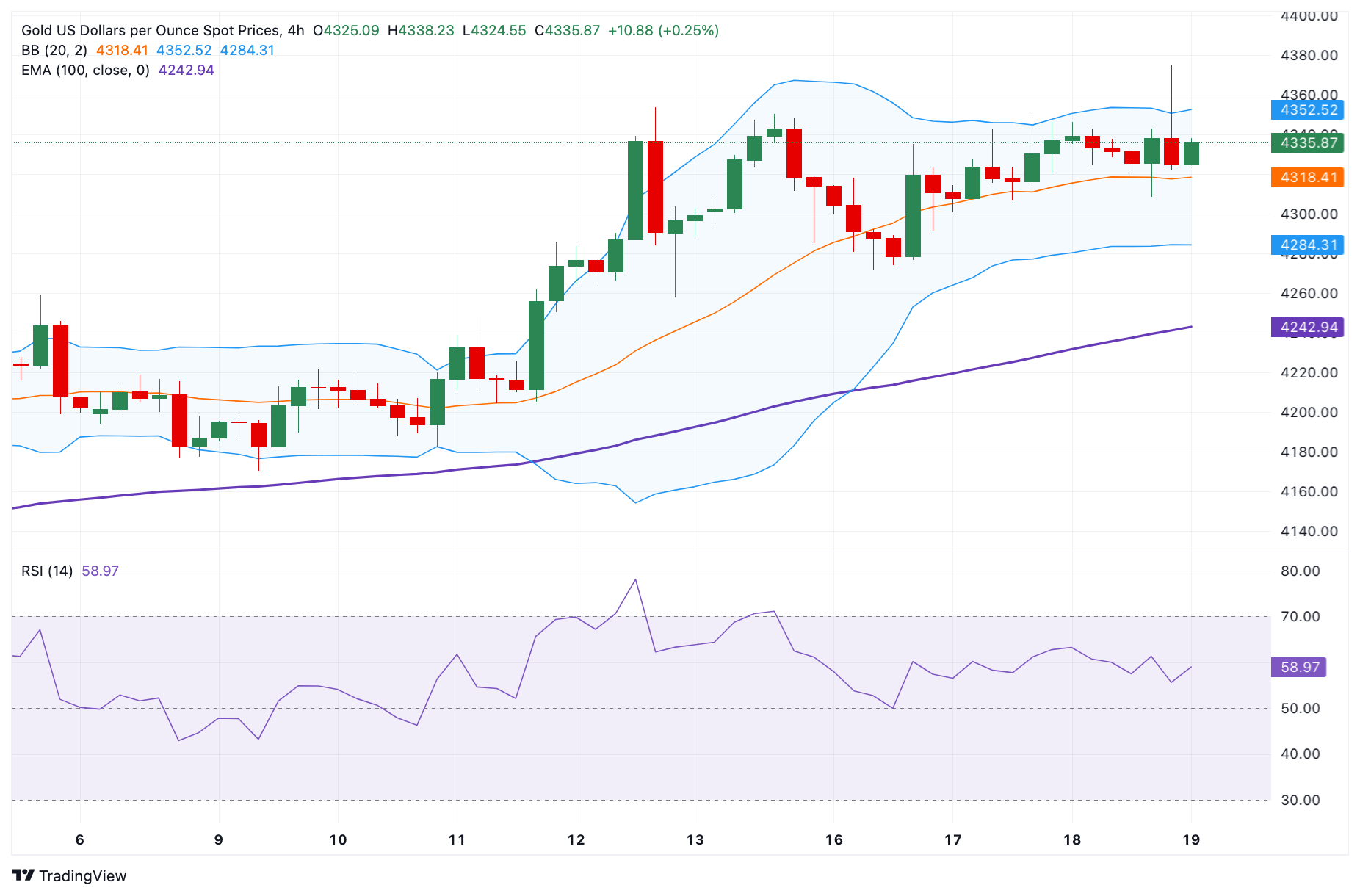
Gold trades in negative territory on the day. According to the four-hour chart, the positive outlook of the precious metal remains intact as the price puts in higher highs and higher lows, and holds above the key 100-period Exponential Moving Average. Furthermore, the Bollinger Bands widen, and the 14-day Relative Strength Index (RSI) is located above the midline, suggesting that the path of least resistance is to the upside.
The first upside barrier for XAU/USD emerges at the upper boundary of the Bollinger Band of $4,352. A decisive break above this level could suggest that buyers are ready to jump in and sustain the climb back to an all-time high of $4,381, en route to the $4,400 psychological mark.
On the flip side, if bearish candlesticks start to show up and prices stay below the December 17 low of $4,300, sellers could gain traction and pull Gold toward the December 16 low of $4,271. Further south, the next contention level to watch is the 100-day EMA of $4,242.
Gold FAQs
Why do people invest in Gold?
Gold has played a key role in human’s history as it has been widely used as a store of value and medium of exchange. Currently, apart from its shine and usage for jewelry, the precious metal is widely seen as a safe-haven asset, meaning that it is considered a good investment during turbulent times. Gold is also widely seen as a hedge against inflation and against depreciating currencies as it doesn’t rely on any specific issuer or government.
Who buys the most Gold?
Central banks are the biggest Gold holders. In their aim to support their currencies in turbulent times, central banks tend to diversify their reserves and buy Gold to improve the perceived strength of the economy and the currency. High Gold reserves can be a source of trust for a country’s solvency. Central banks added 1,136 tonnes of Gold worth around $70 billion to their reserves in 2022, according to data from the World Gold Council. This is the highest yearly purchase since records began. Central banks from emerging economies such as China, India and Turkey are quickly increasing their Gold reserves.
How is Gold correlated with other assets?
Gold has an inverse correlation with the US Dollar and US Treasuries, which are both major reserve and safe-haven assets. When the Dollar depreciates, Gold tends to rise, enabling investors and central banks to diversify their assets in turbulent times. Gold is also inversely correlated with risk assets. A rally in the stock market tends to weaken Gold price, while sell-offs in riskier markets tend to favor the precious metal.
What does the price of Gold depend on?
The price can move due to a wide range of factors. Geopolitical instability or fears of a deep recession can quickly make Gold price escalate due to its safe-haven status. As a yield-less asset, Gold tends to rise with lower interest rates, while higher cost of money usually weighs down on the yellow metal. Still, most moves depend on how the US Dollar (USD) behaves as the asset is priced in dollars (XAU/USD). A strong Dollar tends to keep the price of Gold controlled, whereas a weaker Dollar is likely to push Gold prices up.
Recommended Articles






Comments (0)
Click the $ button, enter the symbol, and select to link a stock, ETF, or other ticker.