


Nvidia Plunges 14% After Jensen Huang's Departure: Stock Price Lessons From Four Tech Giants' CEO Changes — Average Gain of 2.43% After 60 Trading Days



AI Podcast


Nvidia shares tumbled 14% on November 12 ET following Jensen Huang's resignation, with CFO Colette Kress stepping in as interim CEO while a permanent successor is sought. Unlike historical tech transitions at Apple, Oracle, Alphabet, and Amazon—where designated successors and retained founder roles mitigated disruption—Nvidia faces distinct leadership uncertainty. While historical tech giants averaged a 2.43% 60-day return post-transition, Nvidia's valuation recovery depends heavily on maintaining operational continuity, customer relationships, and strategic execution. If product deliveries and earnings expectations remain stable, uncertainty will fade; however, impaired execution risks compressing profit margins and triggering earnings downgrades.
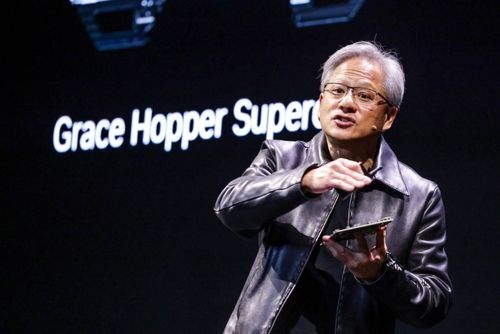
TradingKey - On November 12 ET, after Jensen Huang announced his resignation as president, chief executive officer, and director, Nvidia (NVDA) shares tumbled 14% at the open. Chief Financial Officer Colette Kress was named interim CEO, while the board initiated a search for a permanent successor.
For investors, the focus has shifted from Jensen Huang's personal situation to company operations. Having lost its longtime founder at the helm, whether Nvidia can sustain its technology strategy, customer relationships, and execution capabilities remains an open question.
Tech Giants Including Apple, Oracle, Alphabet, and Amazon Gain Average 2.43% Over 60 Days After Founders Step Down
Taking history as a guide, below are statistics on historical leadership transitions among tech giants—Apple (AAPL), Oracle (ORCL), Google parent Alphabet (GOOGL), and Amazon (AMZN), all of which experienced founders stepping down from the CEO role.
On August 24, 2011, Steve Jobs resigned as Apple CEO; on September 18, 2014, Oracle announced that Larry Ellison would transition to executive chairman and chief technology officer. On December 3, 2019, Larry Page and Sergey Brin stepped down as Alphabet CEO and president, respectively. On February 2, 2021, Jeff Bezos announced that he would hand over the Amazon CEO role in the third quarter.
Company | Purchase Date | 20-Day Stock Return | Same-Period S&P 500 Return | 60-Day Stock Return | Same-Period S&P 500 Return | 60-Day Excess Return |
Apple | 2011/8/25 | 8.18% | -1.97% | 0.33% | 4.86% | -4.54 percentage points |
Oracle | 2014/9/19 | -4.85% | -6.15% | 3.29% | -1.03% | +4.32 percentage points |
Alphabet | 2019/12/4 | 3.23% | 3.92% | 1.42% | -3.51% | +4.94 percentage points |
Amazon | 2021/2/3 | -10.11% | -1.61% | 4.68% | 9.16% | -4.49 percentage points |
Arithmetic Mean | — | -0.89% | -1.45% | 2.43% | 2.37% | +0.06 percentage points |
All four samples achieved positive returns after 60 trading days, but only two outperformed the broader market. Apple rose 8.18% over 20 days, but was up just 0.33% by 60 days; Amazon, meanwhile, reversed from a 10.11% decline over 20 days to a 4.68% gain by 60 days.
Nvidia’s Key Distinction: Official Successor Has Yet to Be Determined
These four cases share an important condition: a successor had already been identified at the time of the announcement, and the founder retained a board seat or other roles. A mature transition arrangement helps reduce the risk of strategic and operational disruption.
Nvidia is currently led by Kress on an interim basis, while a permanent CEO is still being selected. The board stated that customer commitments and product roadmaps are expected to remain undisturbed, but the market still needs to judge whether a future leader can sustain Jensen Huang's role in technical decision-making, customer coordination, and industry partnerships. This uncertainty affects the valuation multiple investors are willing to grant, even if short-term orders have yet to change.
Historical data also suggests that a stock rebound and outperforming the market are two different things. Over the 60-day period, the four companies gained an average of 2.43%, virtually on par with the S&P 500's average gain of 2.37% over the same timeframe. Earnings reports, industry conditions, and macroeconomic trends all occurred during the holding period, meaning the gains cannot be attributed entirely to the founders' departures.
Therefore, what holds greater reference value for Nvidia is whether the handover can maintain business continuity. If product deliveries, customer procurement, and earnings expectations remain stable, the fading of leadership uncertainty could support a valuation recovery.
If the transition impairs strategic execution, or if rising customer bargaining power compresses profit margins, the stock price will simultaneously need to digest downward revisions to earnings expectations. Formal succession arrangements and subsequent performance will determine the foundation for any rebound far more directly than the percentage of gainers in historical samples.
This content was translated using AI and reviewed for clarity. It is for informational purposes only.
Recommended Articles








Comments (0)
Click the $ button, enter the symbol, and select to link a stock, ETF, or other ticker.