


Micron Falls Over 4% Pre-Market as Taiwan Taoyuan Plant Union Exits Profit-Sharing Talks, Labor Dispute Continues



AI Podcast


As of press time on November 12, Eastern Time, Micron Technology shares fell 4.61% pre-market amid an escalating profit-sharing dispute with its Taiwan labor union. The union withdrew from upcoming negotiations over unmet demands for a 15% global operating profit allocation. While existing DRAM production remains normal and operations unaffected, uncertainties have reportedly paused construction on the $3 billion to $4.5 billion Fab 11E expansion project in Taoyuan. Micron denies claims regarding individual waiver agreements and maintains its commitment to constructive dialogue, though significant divisions persist over bonus terms and payout ratios.

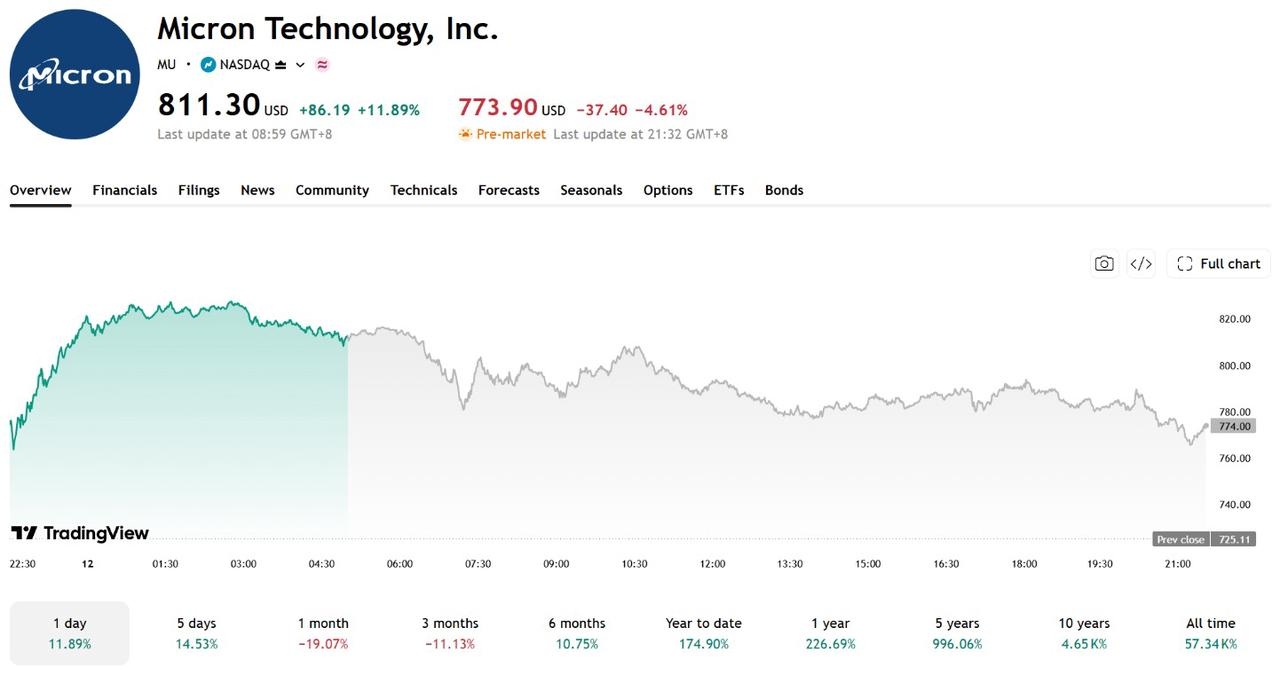
TradingKey - As of press time on November 12, Eastern Time, Micron Technology (MU) was down 4.61% in pre-market trading, as the profit-sharing dispute between the company and its Taiwan labor union continued to escalate.
[Source: TradingView]
On November 12 local time, the labor union at Micron's Taoyuan plant issued an open letter announcing its withdrawal from subsequent profit-sharing negotiations and its decision not to participate in talks originally scheduled for November 17. The union acknowledged that its push to establish a long-term profit-sharing mechanism had failed to achieve the expected results, while stating that members may decide for themselves whether to sign the agreement proposed by the company.
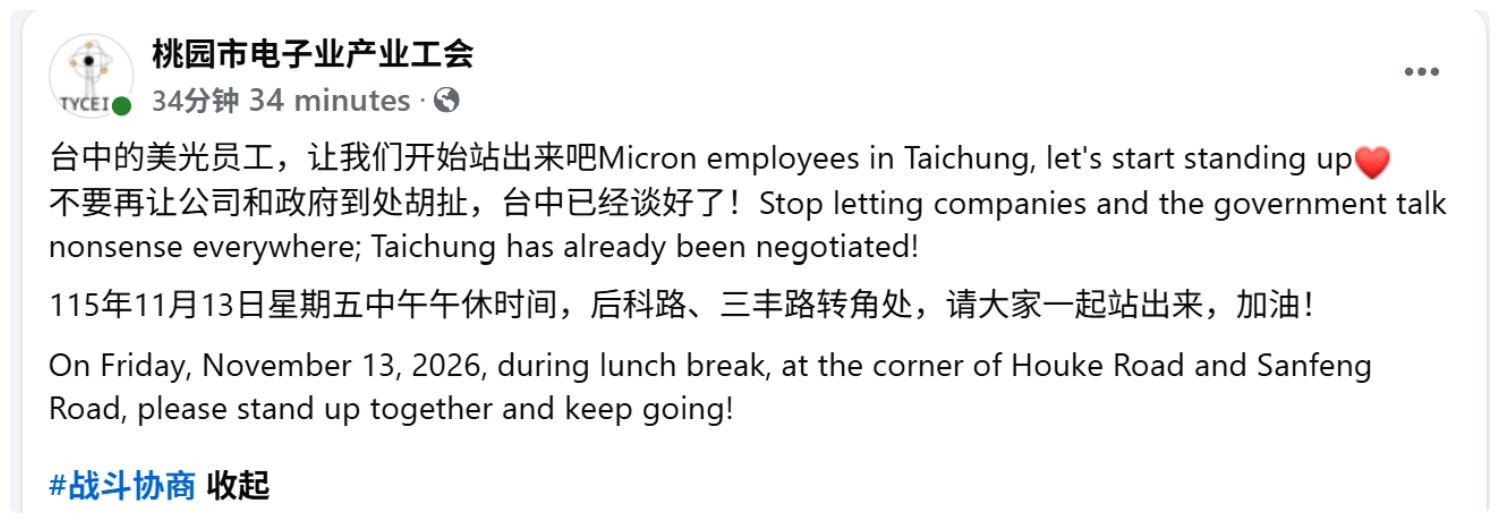
On the evening of November 12 local time, the Taoyuan Electronic Industry Trade Union posted a mobilization message on Facebook, calling on employees at Micron's Taichung plant to gather at the intersection of Houke Road and Sanfeng Road during their lunch break on November 13 to voice their demands regarding profit sharing and workers' rights.
[Source: Facebook]
Micron had previously signed a labor agreement with the union at its Taichung plant. According to arrangements subsequently disclosed by the company, the agreement includes increasing quarterly profit-sharing bonuses and raising the company's pension contribution rate from 8% to 10%.
However, some Taichung employees expressed dissatisfaction with the signing process and specific terms of the agreement, and the Taoyuan union has also attempted to rally support among Taichung union members to push for renegotiation.
In its open letter, the Taoyuan union stated that it had recently received reports that the company might require employees to sign individual agreements in order to receive bonuses and other newly added working conditions, raising concerns that the agreements could entail waiving future rights.
Micron denied this, emphasizing that it has not required employees to sign individual agreements or waive relevant rights, and stated that it will continue communicating with the union. The company also said that incidents involving employee safety and negotiation confidentiality occurred during the talks, which have been handled in accordance with the law, and that it will continue to seek constructive dialogue with the Taoyuan union.
The two sides currently remain divided over the profit-sharing ratio, bonus payout terms, and employee agreement arrangements.
Parties Remain Divided as 15% Profit-Sharing Demand Left Unmet
Earlier, labor unions in Taoyuan and Taichung jointly demanded that 15% of Micron's global operating profit be allocated to employee compensation and that a long-term profit-sharing mechanism be established to replace one-off bonus arrangements.
Micron has announced that it will provide quarterly profit-sharing bonuses to eligible global employees starting in fiscal 2027, but it did not accept the unions' proposed fixed 15% allocation plan.
Notably, Bloomberg reported on November 5, citing people familiar with the matter, that Micron's Fab 11E expansion project in Taoyuan—budgeted at approximately $3 billion to $4.5 billion and originally slated to begin production in 2028—had largely paused construction due to uncertainties stemming from the labor dispute, with only minimal safety and maintenance work continuing. Micron did not publicly disclose the specific reasons for the construction halt at the time.
Micron stated that its existing operations in Taiwan are running normally and that it is confident in maintaining customer supply. The suspension involves the construction of new capacity and does not signify an interruption to existing DRAM production.
This content was translated using AI and reviewed for clarity. It is for informational purposes only.
Recommended Articles










Comments (0)
Click the $ button, enter the symbol, and select to link a stock, ETF, or other ticker.