


US Memory Stocks Rebound Strongly Pre-Market: SanDisk Rises 12%, Micron Gains Over 9%, but AI Selloff Cloud Has Not Dissipated



AI Podcast


Following a sharp sell-off driven by concerns over AI infrastructure spending sustainability and regulatory risks in data center construction, the U.S. storage sector staged a technical pre-market rebound on November 6, with major semiconductor stocks posting notable gains. Despite the oversold bounce, long-term AI-driven demand for high-capacity storage remains fundamentally robust, though policy uncertainties persist. Whether these gains hold during regular trading and prevent new lows will determine if panic selling has abated, or if the rally merely reflects short covering amid ongoing market caution regarding capital expenditures and the storage cycle.

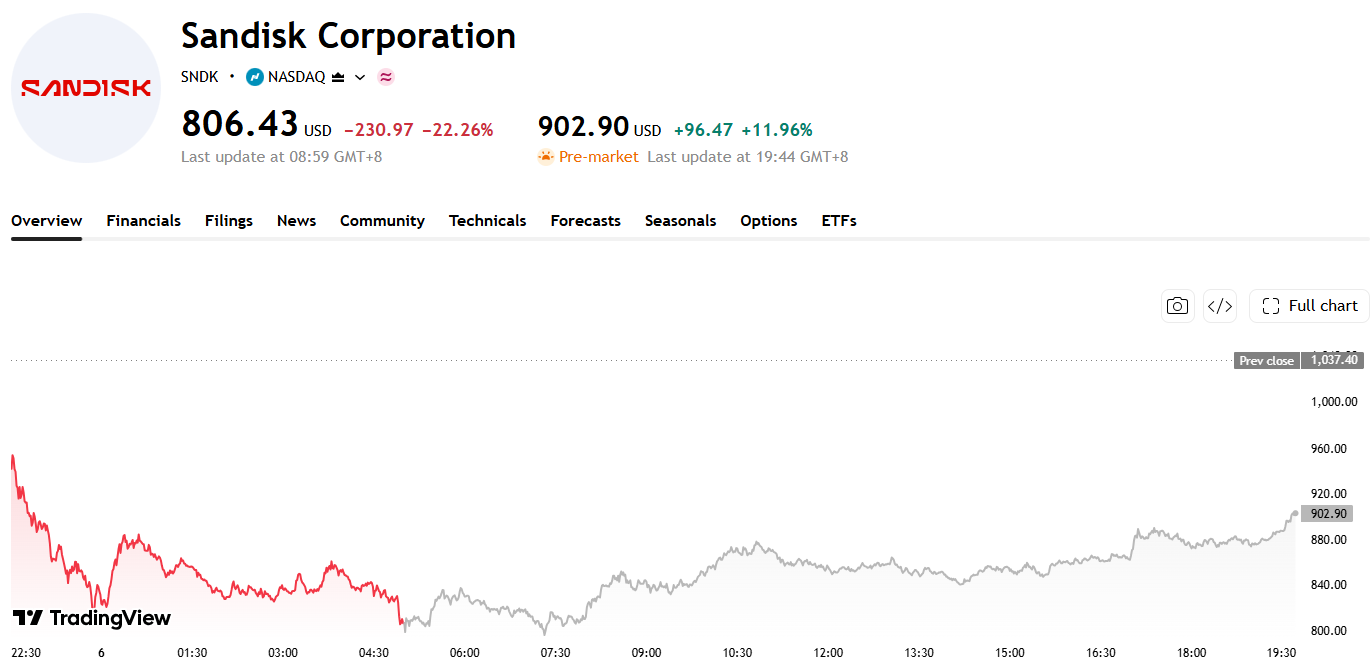
TradingKey - Following a heavy sell-off in the previous trading session, the U.S. storage sector staged a collective rebound in pre-market trading on November 6. SanDisk (SNDK) rose nearly 12%, Micron Technology (MU) gained over 9%, Western Digital (WDC) and Silicon Motion (SIMO) both surged more than 8%, Seagate Technology (STX) climbed over 7%, and SK Hynix (SKHY) also rebounded nearly 6%. Capital flowed back into the AI hardware supply chain, lifting chip, semiconductor equipment, and optical communication stocks in tandem.
Source: TradingView
This uptick was largely a technical rebound following consecutive sharp declines. In the previous trading session, market concerns erupted simultaneously over whether AI infrastructure spending is sustainable, whether data center construction faces tighter restrictions, and whether companies can deliver on investment returns, sending the Philadelphia Semiconductor Index plunging about 12.25%. SanDisk tumbled 22.26% that day, while Micron Technology and Western Digital both fell more than 17%, and Seagate Technology also dropped about 16%, pushing these stocks into deeply oversold territory in the short term. Compared with the earlier losses, the pre-market rebound merely recouped a portion of the lost ground and remains insufficient to confirm that the market trend has reversed.
Following Democratic gains in the U.S. midterm elections, the market began assessing potential policy adjustments facing data center construction. Investors worry that issues such as rising electricity prices, land approvals, water usage, and energy consumption could prompt some states to restrict or delay large-scale data center projects. Because memory chips, enterprise solid-state drives, and high-capacity hard drives are critical components of AI data centers, any slowdown in project construction could impact upstream vendors' shipment growth, product pricing, and earnings expectations.
However, from an industry fundamentals perspective, long-term demand for high-capacity storage driven by AI training and inference has not disappeared due to short-term policy changes. Earnings and orders previously reported by storage vendors still indicate that cloud computing customers maintain robust procurement demand for enterprise solid-state drives, server memory, and high-performance storage products.
From a trading perspective, volume after the opening bell and whether the gains can hold will determine the quality of this rebound. If stocks such as SanDisk and Micron can hold most of their pre-market gains on heavy volume and stop making new lows over the next few trading sessions, it would indicate that panic selling may have temporarily abated. Conversely, if share prices open higher but fade, or even break below the previous session's lows, it would imply that the rally was primarily driven by short covering, and that market concerns over AI capital expenditures, regulatory risks, and the storage cycle remain unresolved.
This content was translated using AI and reviewed for clarity. It is for informational purposes only.
Recommended Articles











Comments (0)
Click the $ button, enter the symbol, and select to link a stock, ETF, or other ticker.