


Alphabet's Google Advances $17 Billion Wyoming Data Center as Regulatory Tightening May Strengthen Cloud Giants' Compute Advantage



AI Podcast


Alphabet’s Google is progressing with a $17 billion data center project in Wyoming, backed by secured power agreements. Simultaneously, tightening regulatory pressures and shifting political landscapes threaten to restrict future data center construction. While a slowdown in new developments could negatively impact upstream vendors, it may ease capital expenditure pressure for cloud providers and enhance the scarcity value of existing computing assets. Companies like Google, with established infrastructure, are positioned to benefit from constrained supply and sustained demand, though unpermitted projects face potential delays and front-loaded investments.

TradingKey - Alphabet (GOOGL) unit Google is advancing a $17 billion investment plan to build its first data center in the state in Laramie County, Wyoming. The project is being developed in partnership with collaborators such as Tallgrass Energy and Related Digital, with supporting power supply agreements already signed, and is expected to drive local employment and energy infrastructure development.
As Google continues to advance its investments, the U.S. midterm election results are shifting market expectations for AI expansion. A sweeping Democratic victory has sparked concerns over data center construction limits, but the impact of a construction slowdown on major cloud providers is more complex: new investments may decrease, while computing capacity already in operation could become more valuable due to constrained supply.
As of press time, Google was down 1.44% at $284.76, a decline far smaller than the Nasdaq Composite Index's nearly 5% drop.
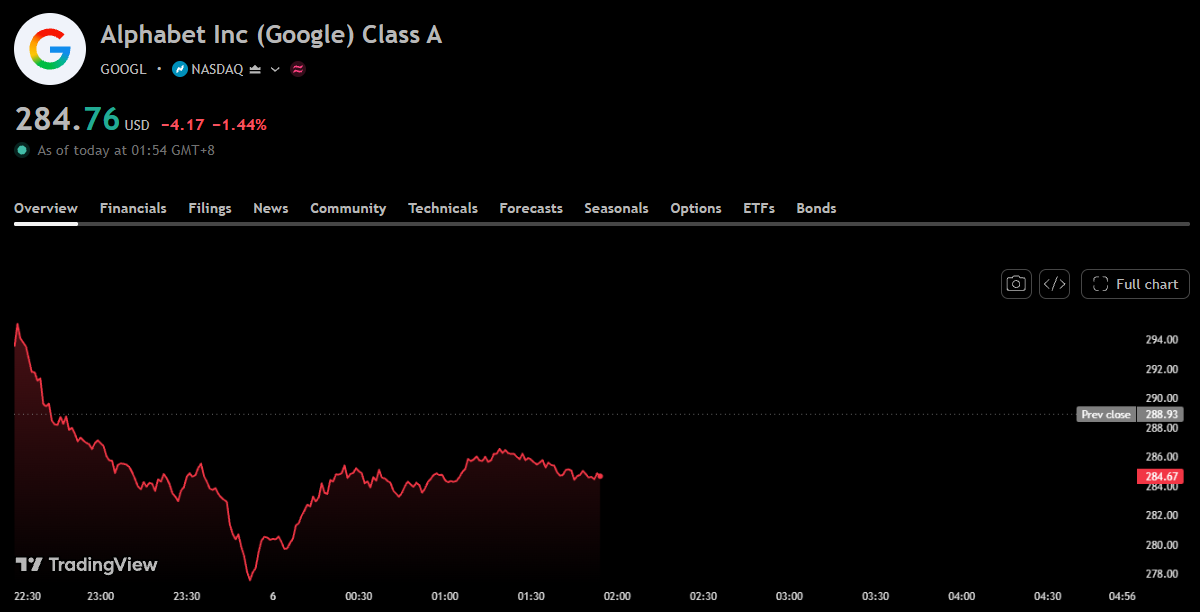
Google stock chart, Source: TradingView
Cloud Giants’ Existing Compute Value in Focus as Data Center Regulation Tightens
According to CNBC, out of 41 local referendums involving data centers, 40 are expected to lean toward restricting development, including supporting restrictions or rejecting pro-development proposals. How the new Democratic governors of Texas and Ohio implement their campaign promises will also impact the pace of expansion.
Judging by market performance on November 5, Google's decline was notably smaller than that of most AI cloud companies, equipment makers, and power suppliers. If cloud cash collections remain stable, a slowdown in new construction could ease capital expenditure pressure and improve free cash flow; upstream vendors, however, face more direct exposure to order and delivery delays.
Rich Privorotsky, head of European equity trading at Goldman Sachs, suggested another possibility: companies may front-load investments to 2027, pushing forward projects and strategic transactions before permitting policies undergo further adjustments. He believes that if future expansion is restricted, computing assets already in operation will become even scarcer, potentially benefiting companies with substantial existing capacity such as Google, Microsoft, and Amazon.
This could create two coexisting investment paces: projects that have yet to resolve permitting and power supply issues will be delayed, while shovel-ready projects will be expedited. If computing demand continues to grow, constraints on new supply are expected to support existing facility utilization rates and cloud service pricing. For Google, long-term power arrangements for the Wyoming project will help enhance the executability of its expansion plans and secure headroom to capture future AI demand.
This content was translated using AI and reviewed for clarity. It is for informational purposes only.
Recommended Articles










Comments (0)
Click the $ button, enter the symbol, and select to link a stock, ETF, or other ticker.