


SanDisk Stock Price Forecast: Slowing New Data Center Demand May Reverse Storage Price Rally, Technicals Signal Drop to $750



AI Podcast


Democratic victories in the U.S. midterms have raised regulatory risks for data centers, threatening SanDisk’s revenue growth. Goldman Sachs estimates states representing 45% of planned U.S. capacity may tighten rules, potentially delaying AI-driven server equipment deliveries. With data center sales comprising 43.5% of total revenue, SanDisk faces heightened exposure. Meanwhile, consumer segment momentum has weakened, and storage price gains are largely confined to AI-related products. Technically, SanDisk exhibits a fully bearish moving average alignment and extended downside momentum, with primary support at $806.52. Long-term AI capital expenditure projections remain supportive, but near-term execution risks weigh on valuation and delivery pace.
TradingKey - The Democrats' sweeping victory in the U.S. midterm elections has sparked investor concerns over tightening data center regulations. For SanDisk (SNDK), potential construction pauses could delay server and storage equipment deliveries, introducing new timing uncertainties to revenue growth supported by AI demand.
Goldman Sachs estimates that states likely to tighten data center regulations account for about 45% of planned new capacity in the U.S., with Texas representing roughly one-quarter of the nationwide total. Relevant regions could pause approvals for new projects pending new legislation regarding power, water usage, and tax incentives.
SanDisk's reliance on data center growth is deepening. In the first quarter of fiscal 2027, the company's data center revenue reached $4.802 billion, up 61% quarter-over-quarter and accounting for approximately 43.5% of total revenue, while consumer business revenue fell 29% quarter-over-quarter during the same period. This indicates that it will be difficult for the consumer segment to fill the growth gap left by delayed AI projects in the short term.
If approvals for data centers, power supply, or construction are delayed, customers may push back storage equipment procurement and deliveries accordingly, which could also postpone SanDisk's revenue and cash collections. Even if end procurement demand persists, the incremental profit originally anticipated for the coming quarters will need to be reassessed.
On the pricing front, support for broad-based acceleration is likewise lacking. Market analysis indicates that fourth-quarter storage price increases were concentrated in AI server-related products, while price momentum for mainstream consumer-grade products weakened noticeably. If incremental demand from data centers slows, the momentum for price hikes in high-end storage products could also be affected, leaving SanDisk facing dual pressures on shipment cadence and average selling price expectations.
However, Goldman Sachs expects such pauses will not last long, and JPMorgan still projects that hyperscalers' AI capital expenditures will rise to $1.5 trillion by 2027. Long-term investment continues to support storage demand, but whether capital commitments can be converted into project construction and equipment procurement on schedule will affect the pace of SanDisk's future revenue and profit delivery, thereby impacting the valuation multiple the market assigns to its growth.
From a technical perspective, SanDisk's stock price gapped down below its late-July prior low ($998.19), currently representing an extended decline following the breakdown of historical support, with weakness deepening further compared to the prior consolidation within the pullback range.
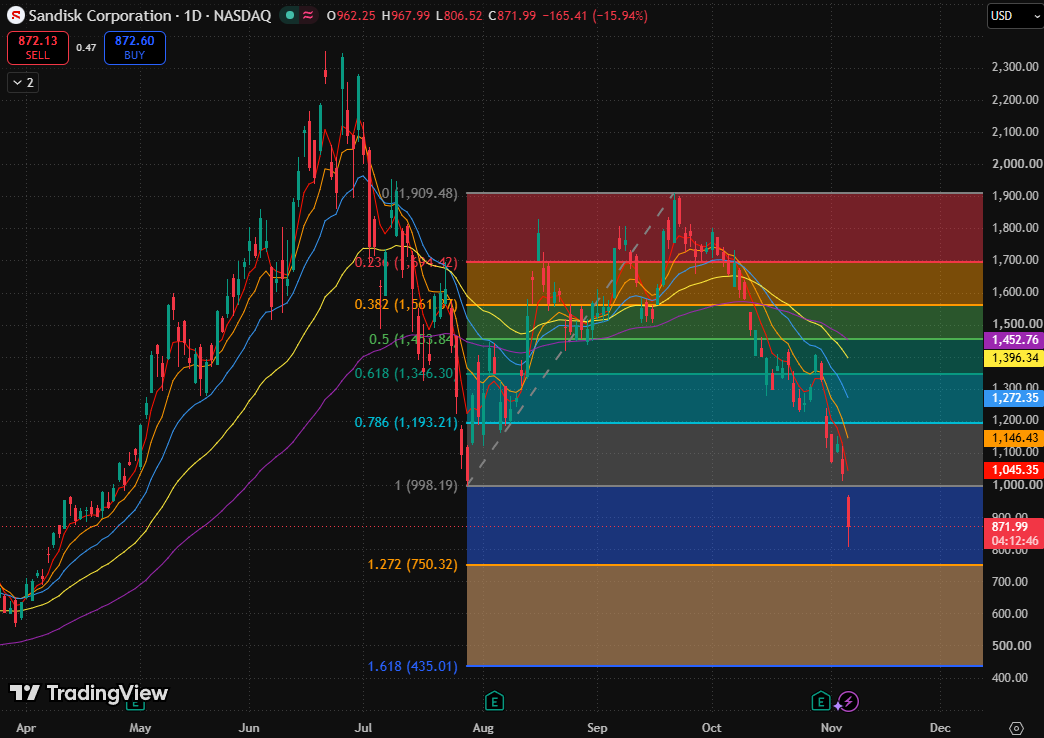
SanDisk Stock Price Chart, Source: TradingView
Regarding moving averages, the 5-day, 10-day, and 20-day exponential moving averages (EMAs) continue to head downward, with short-term moving averages fanning out to the downside. The 80-day and 160-day EMAs are also trending lower in tandem. All five moving averages maintain a fully bearish alignment, with short-term and medium-term directions aligned. The distance between the current price and short-term moving averages has widened noticeably, which could increase the magnitude of any rebound.
On the upside, only if the daily chart reclaims the prior low would it help transition from an extended breakdown into a recovery.
However, looking solely at current price action, the risk of a continued decline remains greater. The primary support below lies at $806.52, corresponding to today's intraday low, serving as the nearest observation level for short-term buying support. If it breaks below this level, the stock will look for support near the 1.272 Fibonacci extension ($750).
This content was translated using AI and reviewed for clarity. It is for informational purposes only.
Recommended Articles










Comments (0)
Click the $ button, enter the symbol, and select to link a stock, ETF, or other ticker.