


Nvidia-Favored Marvell and Lumentum Announce Merger: What Does This Mean for NVDA?



AI Podcast


On November 2 ET, Marvell Technology announced an all-stock acquisition of Lumentum Holdings with an enterprise value of approximately $115 billion, prompting sharp share price declines amid market scale and financial impact concerns. The deal aims to combine Marvell's custom chips and optical technologies with Lumentum's lasers and semiconductor manufacturing to expand their AI data center business, targeting a $550 billion market size with over $1 billion in annual cost synergies. For strategic partner Nvidia, the transaction consolidates its existing investments into the merged entity while potentially strengthening supply chain collaboration in optical interconnects and CPO technology development.
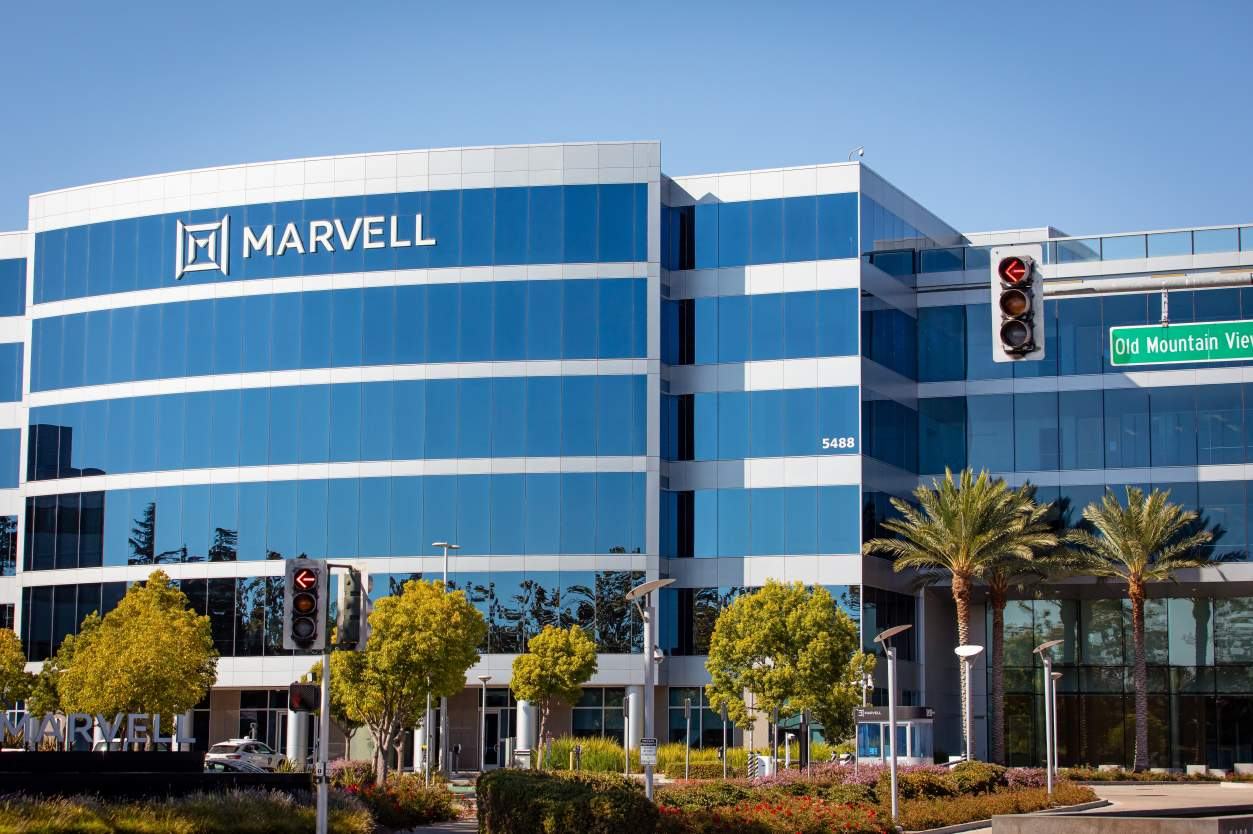
TradingKey - On November 2 ET, Marvell Technology (MRVL) announced an all-stock acquisition of optical communication component manufacturer Lumentum Holdings (LITE), in a transaction with an enterprise value of approximately $115 billion.
Following the announcement, shares of both Lumentum and Marvell fell sharply, tumbling 18.59% and 12.72%, respectively. Market concerns centered primarily on the massive scale of the acquisition and its potential financial impact.
The acquisition aims to combine Marvell's capabilities in custom chips, electrical interconnects, and optical technologies with Lumentum's strengths in lasers, optical transceivers, and compound semiconductor manufacturing, thereby expanding their AI data center business.
According to reports, Marvell CEO Matt Murphy discussed the acquisition plan with Nvidia (NVDA) CEO Jensen Huang during the early planning stages of the deal. Lumentum CEO Michael Hurlston stated that Nvidia's reaction to the merger plan was "very positive," believing the combined entity could deliver a more diversified portfolio of products to Nvidia more quickly.
In March 2026, Nvidia invested $2 billion each in Marvell and Lumentum, establishing strategic partnerships with both companies. Now, with Marvell intending to acquire Lumentum, what impact will this transaction have on Nvidia?
Why Marvell Is Acquiring Lumentum?
[Source: Counterpoint Research]
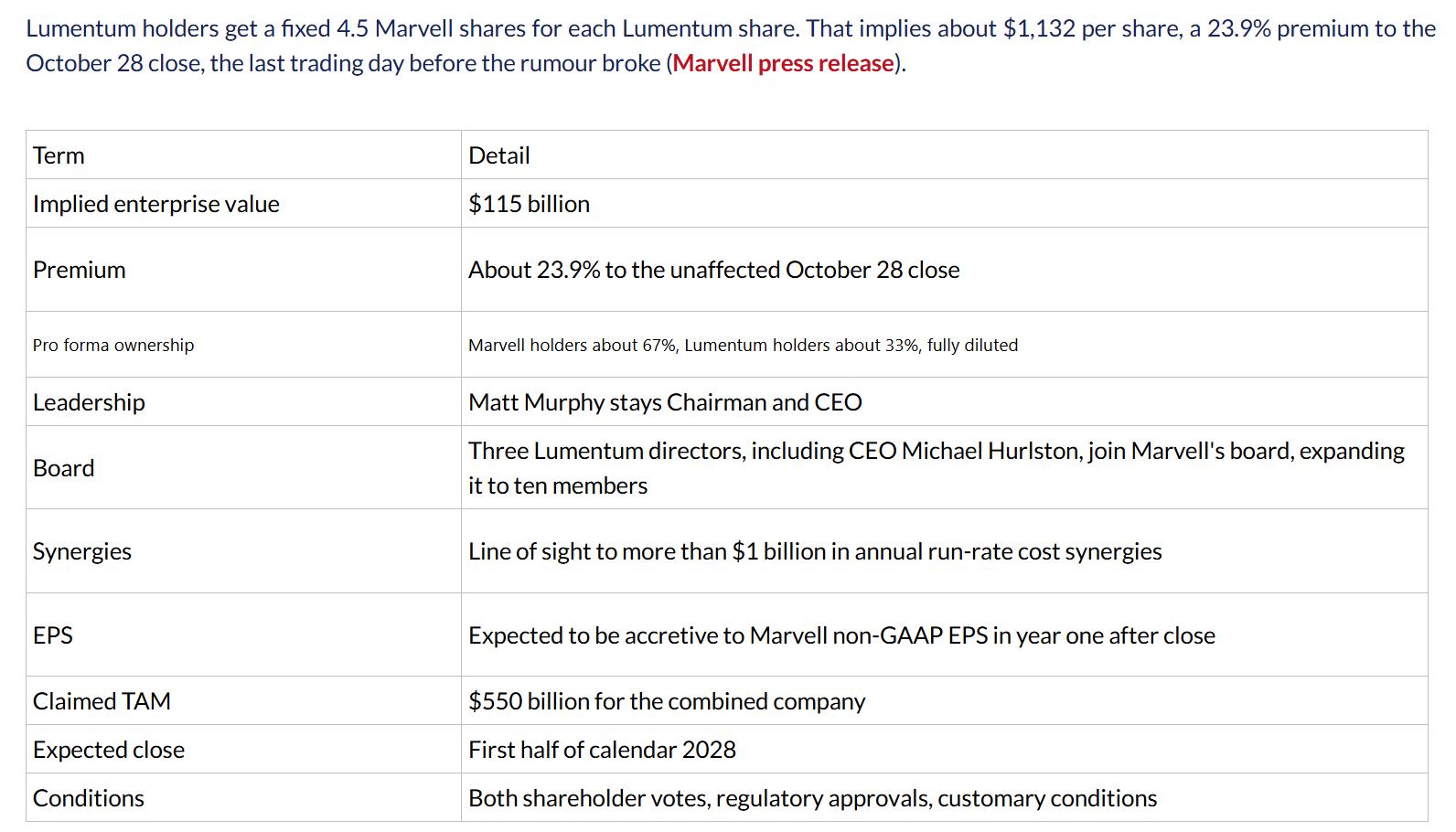
Under the agreement, Lumentum shareholders will receive 4.5 shares of Marvell stock for each share of Lumentum held, implying a value of approximately $1,132 per share, representing a 23.9% premium over the October 28 closing price before merger rumors emerged. The all-stock transaction values the equity at approximately $102.5 billion.
Upon completion of the transaction, existing Marvell shareholders are expected to hold approximately 67% of the combined company, with Lumentum shareholders holding approximately 33%. The transaction is expected to close in the first half of 2028, subject to regulatory and shareholder approvals from both companies.
At the core of this acquisition is laser capacity. Marvell's legacy business primarily includes custom XPUs, network switching, optical DSPs, and silicon photonics technology, whereas Lumentum possesses high-performance lasers, optical transceivers, optical circuit switching (OCS) technology, and indium phosphide (InP) chip manufacturing capabilities.
The development of optical interconnect technologies such as LPO, LRO, and CPO may alter the configuration of traditional DSPs in optical links, but lasers remain critical components. Acquiring Lumentum will help Marvell cover different optical interconnect solutions and reduce its reliance on a single technology route.
Tight laser capacity further highlights the value of this acquisition. According to Counterpoint Research, Lumentum and Coherent (COHR) are major suppliers in the global high-speed InP laser market, while building new relevant fabs takes several years.
Lumentum's CEO previously stated that the company's relevant product capacity is sold out through early 2029. The acquisition is expected to help Marvell secure scarce InP manufacturing capabilities and expand laser capacity.
Marvell expects the combined company's target market size to reach $550 billion, with annual cost synergies expected to exceed $1 billion, and to be accretive to non-GAAP earnings per share in the first year following transaction completion.
What Does Marvell’s Acquisition of Lumentum Mean for Nvidia?
In March 2026, Nvidia invested $2 billion each in Lumentum and Marvell and established strategic partnerships with both companies. Among them, the partnership with Lumentum involves commitments to purchase advanced lasers and access to future production capacity under a non-exclusive arrangement, while the partnership with Marvell focuses on custom XPUs, NVLink Fusion, and silicon photonics technologies.
First, the acquisition will alter Nvidia's shareholding structure. Based on a 4.5-to-1 share exchange ratio, the Lumentum shares held by Nvidia will be converted into Marvell stock upon completion of the transaction. Combined with its existing Marvell holdings, Nvidia's investments in both companies will be consolidated into the merged Marvell.
The impact on Nvidia's overall investment value is expected to be largely neutral. Following the merger, Nvidia will gain exposure to the combined business growth opportunities of both companies by holding Marvell stock; however, its investment will also be more concentrated in a single company, entailing a degree of shareholding concentration risk.
Second, on the supply chain front, the merged Marvell will integrate chip design, optical interconnects, and laser manufacturing capabilities, which is expected to strengthen optoelectronic tech synergies and accelerate the development and delivery of related products.
Nvidia could benefit from this, particularly in the supply of lasers required for optical interconnects and co-packaged optics (CPO) technology in AI data centers.
However, Nvidia has secured purchase commitments and access to future production capacity. While these arrangements help safeguard its supply of optical components, they do not imply that Nvidia will directly control the merged company's production capacity. Actual supply will still depend on procurement agreements, expansion timelines, and capacity allocation.
Overall, the acquisition is expected to strengthen Nvidia's supply chain collaboration in optical interconnects and provide further support for its AI data center and CPO technology development. However, whether the transaction can further enhance supply stability and expand available capacity will ultimately depend on regulatory approvals, subsequent capacity expansion, and the progress of cooperation between the two sides.
This content was translated using AI and reviewed for clarity. It is for informational purposes only.
Recommended Articles











Comments (0)
Click the $ button, enter the symbol, and select to link a stock, ETF, or other ticker.