


Intel Stock Price Forecast: $50 Level Tested After Record 45% Monthly Drop and Further 8% Fall



AI Podcast


Intel stock suffered historic declines due to weak PC demand and guidance missing expectations by up to $2 billion. Despite a surge earlier this year driven by government backing and Nvidia investment, supply bottlenecks in server CPUs forced Intel to divert 18A foundry capacity to mature nodes, risking its long-term manufacturing strategy. Technically oversold with an RSI of 22.95, the stock may see short-term bounces, but fundamental recovery requires stabilizing PC demand and securing external foundry orders. Key support levels stand at $55 and $50, while immediate resistance ranges from $60 to $66.
TradingKey - Intel (INTC) stock continued its severe adjustment. On the last trading day of October, the stock plunged 29%, marking its worst single-day performance since the 1970s; for the entire month, it fell by a cumulative 45%, making it the largest monthly decline on record for the company. Entering November, selling pressure showed no signs of abating, with the stock dropping another 8% on the first trading day, indicating that investor confidence in the company's short-term results and recovery prospects has yet to recover.
The immediate catalyst for this correction was Intel's guidance, which fell significantly short of Wall Street expectations. The company expects revenue for the current quarter to potentially miss market forecasts by $1 billion to $2 billion, with weak PC demand acting as the primary drag. Rising prices for memory and other components have not only driven up total computer costs but also dampened the willingness of consumers and enterprises to replace PCs. Since PC-related business still accounts for nearly half of Intel's revenue, the cooling in end-market demand can hardly be offset quickly by other business segments.
This stands in sharp contrast to market expectations a few months ago, after the U.S. government announced it would acquire about a 10% stake in Intel, followed by Nvidia (NVDA) investing another $5 billion, which further boosted market confidence that the company would gain capital support and improve its operations. Driven by this, Intel's stock price surged several-fold over a period of roughly 10 months, reaching a periodic high in June this year. At that time, investors were not only bullish on the financial improvements brought by external capital injections but also began to re-evaluate Intel's position in the AI supply chain.
Unlike Nvidia and AMD, which primarily rely on GPUs to meet AI training and inference demand, Intel is seeking new growth opportunities in server CPUs. As AI agents and complex inference applications continue to evolve, the role of CPUs in task scheduling, data processing, and virtual machine execution is gaining renewed attention.
Intel Chief Executive Officer Lip-Bu Tan believes the global server processor market could expand to approximately $200 billion over the next five years, reaching several times its current level. In the third quarter, revenue from the company's Data Center segment rose 78% year-over-year to $7.3 billion, also demonstrating a rebound in demand for server processors.
However, the biggest challenge Intel currently faces is that customer demand is growing faster than its own supply capacity. The company stated that supply tightness in key components—such as wafers, substrates, and memory—has restricted the production and delivery of server CPUs. To boost output of data center processors, management decided to adjust production schedules at some Oregon fabs, shifting a portion of capacity originally earmarked for the advanced 18A process node to the more mature Intel 3 process node in order to increase server chip supply.
While this adjustment helps relieve immediate supply pressures, it could impact the long-term roadmap for Intel's foundry business. The 18A process node is seen as a key bargaining chip for the company to attract external chip design firms, as well as crucial technology for Intel to re-establish its advanced manufacturing lead. If a portion of that capacity is repurposed to satisfy internal product demand, the capacity headroom Intel can offer to potential foundry clients may be constrained.
For external clients currently evaluating Intel's manufacturing capabilities, guaranteed stable capacity is just as important as the technology roadmap. If Intel cannot demonstrate its ability to consistently fulfill external orders, technological progress in advanced nodes may not directly translate into foundry revenue.
This is precisely the underlying dilemma facing Intel's foundry strategy. The company must prioritize manufacturing its own server and PC processors while also seeking orders from external chip designers like Broadcom (AVGO) and Qualcomm (QCOM). However, these potential customers may themselves compete with Intel in end-product markets. Consequently, when deciding whether to entrust core chip production to Intel, they will consider not only cost and technology but also trade secrets, supply reliability, and competitive dynamics.
Source: TradingView
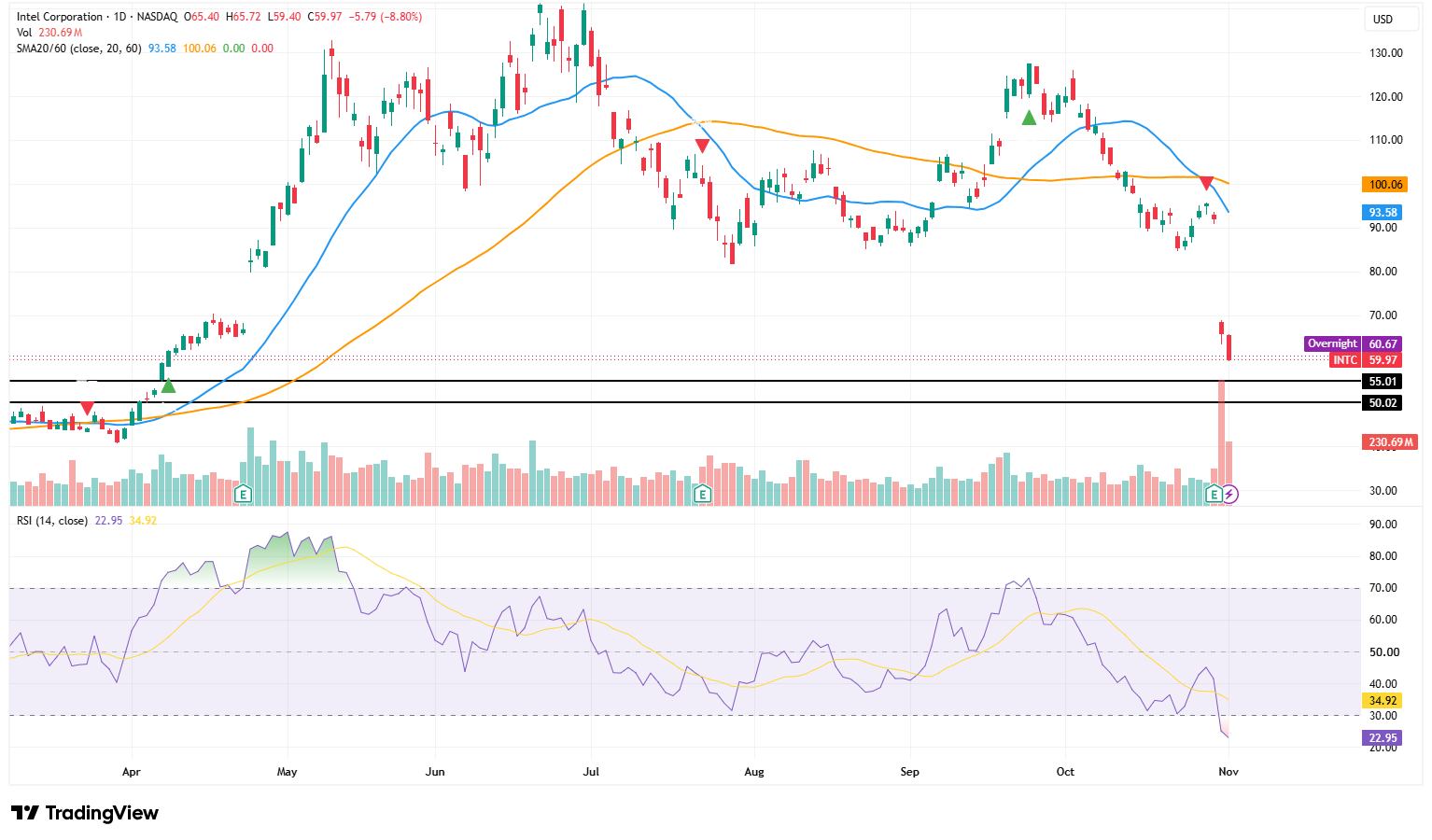
Intel has dropped sharply below its 20-day moving average of $93.58 and its 60-day moving average of $100.06, with both moving averages weakening simultaneously and no sign of a trend reversal in the overall decline. The RSI has fallen further to 22.95, below the oversold threshold of 30 and its signal line of 34.92, suggesting a potential short-term technical bounce; however, being oversold does not inherently mean the stock has bottomed out.
From a price action perspective, after consecutive historic declines, Intel may experience a short-term technical bounce driven by oversold conditions and short covering, but this does not imply a trend reversal. Unstabilized PC demand, constrained server chip supply, and a foundry business still lacking large-scale external orders mean that valuation recovery will require more fundamental evidence. If the company fails to deliver on new customer commitments over the next two quarters, the stock could still break below its October low and prolong the bottoming process.
If the stock fails to regain the $60 level, the next support to watch is at $55, followed by the psychological level of $50. The $50 level also lies near a former breakout platform, representing roughly 17% downside from current prices; if lost, the stock could fall further into the $45–$47 region.
To the upside, initial resistance lies in the $60–$66 range, with $65–$66 representing the upper boundary of the recent gap down. Only a high-volume recovery above this zone can relieve short-term selling pressure; until then, even if the RSI triggers an oversold bounce, it is more likely to be viewed as a technical retracement within a downtrend.
This content was translated using AI and reviewed for clarity. It is for informational purposes only.
Recommended Articles











Comments (0)
Click the $ button, enter the symbol, and select to link a stock, ETF, or other ticker.