


Arm Q2 Earnings Preview: Can Data Center Royalties Continue Doubling Growth? Wall Street Highest Target at $480



AI Podcast


Arm Holdings will report its second-quarter fiscal 2027 financial results after the U.S. market close on November 4, Eastern Time, with Wall Street expecting revenue of $1.37 billion to $1.38 billion and adjusted EPS of $0.48. While AI infrastructure expansion drives robust demand for Armv9 and Compute Subsystems, investors will closely scrutinize data center royalty growth, licensing performance, and revenue realization from the newly launched AGI CPU. Achieving the ambitious 2031 revenue target of $25 billion depends heavily on scaling these new processor businesses amid an elevated valuation and market execution uncertainties.
TradingKey - Arm Holdings (ARM) will report its second-quarter fiscal 2027 financial results after the U.S. market close on November 4, Eastern Time. As AI data centers continue to expand, market demand for Arm processor architecture is extending from smartphones to cloud computing, servers, and AI infrastructure, bringing new growth opportunities for the company. However, against the backdrop of recent stock price pullbacks and a still-elevated valuation, investors will focus not only on whether revenue meets expectations, but will also closely examine data center royalty growth, licensing business performance, and whether the newly launched AGI CPU can generate actual revenue.
Currently, Wall Street expects Arm's second-quarter revenue to be approximately $1.37 billion to $1.38 billion, up about 21% year-over-year, with adjusted earnings per share expected to be around $0.48, up about 23% from the same period last year. Arm's previous guidance called for revenue of $1.38 billion, plus or minus $50 million, and non-GAAP earnings per share of $0.47, plus or minus $0.04.
Can Data Center Royalties Continue Rapid Growth?
To understand Arm's performance, one must first distinguish between its two traditional revenue sources: license revenue and royalty revenue. The former primarily stems from fees paid by customers to acquire rights to use Arm's processor architectures and related intellectual property, with revenue recognition typically depending on contract values, delivery schedules, and agreement arrangements. The latter is linked to chip shipments based on Arm technology, where Arm receives royalties at an agreed rate for every batch of relevant chips sold by customers.
The two businesses reflect market cycles that are not entirely identical. License revenue better reflects customers' current chip design investments and future product planning, while royalty revenue is more closely tied to chips that have entered the production and sales stages. Therefore, the licensing business helps gauge customers' future design requirements, whereas the royalty business more directly reflects the actual scale of Arm technology adoption in end products.
In the previous quarter, Arm generated revenue of $1.289 billion, up 22% year-over-year, setting a record high for a first fiscal quarter. Among this, royalty revenue grew 22% to $715 million, while license and other revenue rose 23% to $574 million. Data center royalty revenue more than doubled year-over-year, becoming the most outstanding highlight of its performance.
Unlike AMD or Intel, which sell chips directly, Arm relies primarily on license fees and royalties for revenue. This model means that Arm's data center growth depends not only on chip shipments but is also influenced by the royalty rate per chip. As customers upgrade from older architectures to Armv9 and further adopt Compute Subsystems (CSS), Arm can increase revenue generated per chip without a corresponding doubling of chip shipments.
The company disclosed that Armv9 currently accounts for about one-third of royalty revenue, meaning the majority of existing products still run on older architectures with lower royalty rates. The royalty rate for Compute Subsystems is roughly twice that of standalone Armv9 processor licensing, and subsequent products could even reach three times. As long as architecture upgrades continue to progress, product mix improvements are expected to serve as a major driver of royalty growth in the coming years.
However, Arm has projected that royalty revenue growth in fiscal 2027 will be in the high range of 15% to 20%, slightly below the company's long-term compound growth target of approximately 20% toward fiscal 2031.
Arm AGI CPU Opens New Growth Areas
Beyond its traditional IP licensing and royalty business, Arm is attempting to expand further into chip products. In March 2026, the company launched its first Arm AGI CPU for agentic AI workloads, signaling that its business model is no longer limited to architecture licensing and collecting chip royalties from customers, but is also starting to generate more direct chip revenue by selling its own processor products.
This shift is of significant importance. Although the traditional licensing and royalty model offers higher gross margins, Arm can only capture a portion of the value in the chip value chain. By selling processors directly, the company has the opportunity to earn higher revenue per chip, while also assuming additional responsibilities such as product development, supply chain coordination, and market expansion.
Currently, initial shipments of the Arm AGI CPU have been delivered to multiple customers. The company disclosed in the first quarter of fiscal 2027 that combined customer demand for the product in fiscal years 2027 and 2028 has exceeded $2 billion, an increase from the previously estimated $1 billion opportunity size. Arm also stated that it is expanding production capacity with manufacturing and supply chain partners to support subsequent customer deployments. However, customer demand and potential orders are not equivalent to recognized sales revenue, and the actual contribution remains contingent on product delivery, customer deployment, and capacity ramp-up progress.
2031 Revenue Target Still Needs New Businesses to Deliver
Arm's long-term plan targets approximately $25 billion in revenue by fiscal year 2031, but this goal cannot be achieved through its existing royalty business alone. Based on the previous quarter's annualized revenue, the company's current scale is approximately $5.2 billion; reaching $25 billion will require maintaining an expansion rate over the coming years that is far higher than the growth rate of its traditional IP business.
The company expects that IP licensing and compute subsystems could contribute approximately $10 billion in future revenue, with a growth path primarily built on rising Armv9 penetration, expanding CSS adoption, and market share gains in data centers. The remaining approximately $15 billion would need to be provided by new businesses such as Arm AGI processors.
Arm previously disclosed that potential customer demand for AGI processors in fiscal years 2027 and 2028 has exceeded $2 billion, though product shipments, supply capacity, and business models have yet to be validated. Therefore, during this earnings call, management's commentary on processor business orders, capacity readiness, and revenue recognition timing may hold greater long-term significance than whether this quarter's earnings modestly beat expectations.
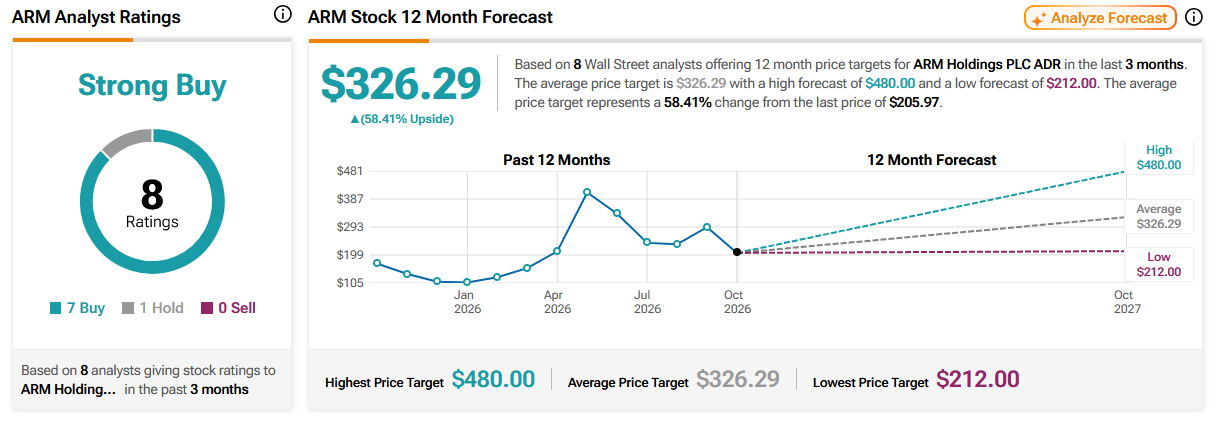
According to TipRanks, eight Wall Street analysts covering Arm over the past three months have set an average 12-month price target of $326.29, with a high forecast of $480 and a low of $212. The wide dispersion in target prices reflects that while the market recognizes Arm's architectural advantages in AI servers, mobile devices, and edge computing, it remains cautious about its high valuation and the execution speed of its new processor business.
Source: TipRanks
This content was translated using AI and reviewed for clarity. It is for informational purposes only.
Recommended Articles










Comments (0)
Click the $ button, enter the symbol, and select to link a stock, ETF, or other ticker.