


WTI Crude Plunges 6% Below $100: What Caused the Sharp Drop in Oil Prices?



AI Podcast


On Eastern Time November 2, international oil prices dropped significantly, with Brent crude falling 6.3% to $106.2 per barrel and WTI crude down 6.4% to $97.4 per barrel. This decline was driven by easing geopolitical tensions after reports indicated the U.S. prefers diplomatic resolution with Iran and favors extending negotiations over immediate military action following discussions between Donald Trump and Benjamin Netanyahu. Concurrently, Iran signaled a willingness to engage in indirect talks based on a proposed "Seven-Day Plan." Despite these diplomatic efforts, persistent Middle Eastern attacks and stringent military directives leave market confidence fragile regarding a durable near-term ceasefire.
TradingKey - On November 2, Eastern Time, international oil prices fell sharply. As of press time, Brent crude futures (UKOIL) fell 6.3% to $106.2 per barrel; U.S. WTI crude futures (USOIL) fell 6.4% to $97.4 per barrel.
U.S. Secretary of State Marco Rubio said over the weekend that Trump has not yet decided whether to take military action against Iran, and that the U.S. prefers a peaceful resolution to the conflict. Previously, the market had priced into oil prices the risk of military escalation following the U.S. midterm elections, and this diplomatic signal eased related concerns.
According to Axios, Trump favors giving diplomatic mediation with Iran more time and holding off on launching a new round of military action. It is reported that on October 31, Trump held a "direct and sharp" phone call with Israeli Prime Minister Benjamin Netanyahu. Netanyahu urged the U.S. side to resume war against Iran immediately after the midterm elections on November 3, but Trump wants to allow negotiations to fully unfold.
Sources said that Trump currently does not want Israel to interfere with the negotiation process. However, if negotiations fail, his stance could change significantly.
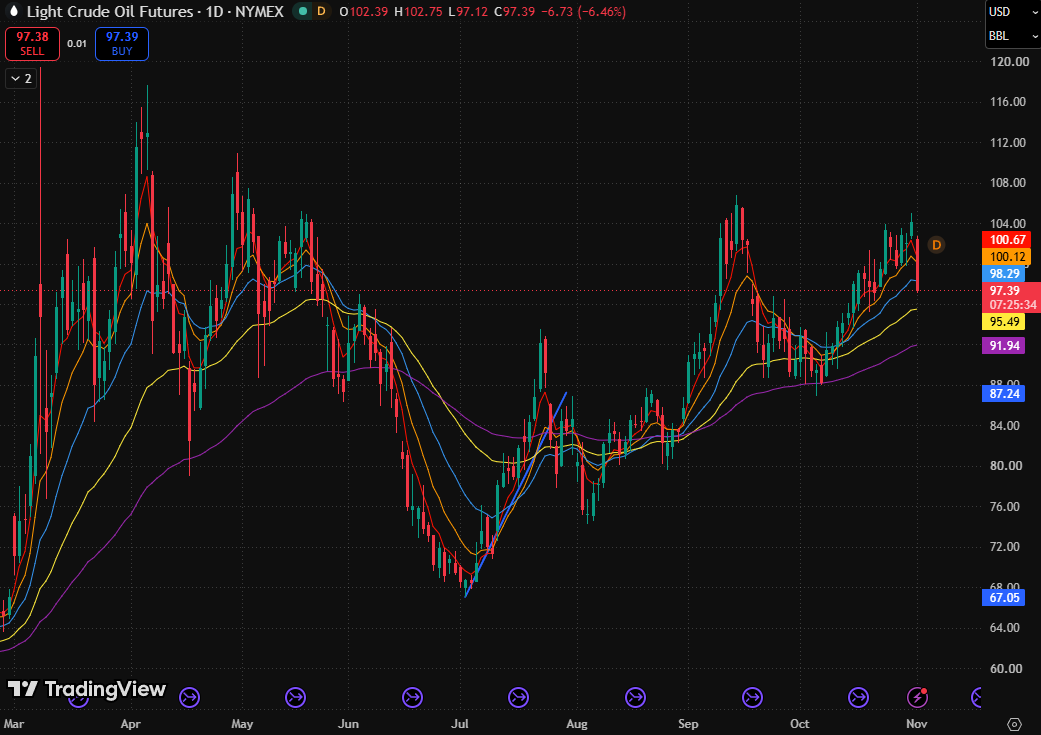
WTI crude oil price daily chart, Source: TradingView
In addition, Iran simultaneously signaled a willingness to negotiate. Iranian Foreign Ministry spokesperson Baghaei stated on November 2 that indirect talks between the U.S. and Iran are based on a "Seven-Day Plan" proposed by Iran, which has been streamlined and can be fully implemented within two days. However, the implementation of the plan, the initiation of negotiations, and the restoration of security in the Strait of Hormuz depend entirely on U.S. decisions and concrete actions.
On the same day, Iranian President Pezeshkian stated that the government is working to resolve issues through dialogue and that the Supreme Leader has granted the government certain authority. He also emphasized that war cannot force Iran to surrender.
Beyond diplomatic statements, military risks have not receded. Iranian Supreme Leader Mojtaba Khamenei required the armed forces on Saturday to deliver an "immediate, forceful, and geographically unrestricted response" to threats of any degree or type.
Tamas Varga, an analyst at PVM Oil Associates, pointed out that ongoing attacks on vessels and refineries in the Middle East, as well as strikes on civilians in Ukraine, make it difficult to bolster market confidence in achieving a durable ceasefire in the near term.
This content was translated using AI and reviewed for clarity. It is for informational purposes only.
Recommended Articles












Comments (0)
Click the $ button, enter the symbol, and select to link a stock, ETF, or other ticker.