


Taoyuan Union Launches 24-Hour Strike as Scheduled Despite Micron Reaching Deal With Taichung Union



AI Podcast


Micron Technology’s labor disputes in Taiwan have diverged. While the Taichung plant reached an agreement on October 21 local time, negotiations at the Taoyuan plant failed, leading to a 24-hour strike starting October 22. The core dispute centers on employee profit-sharing mechanisms, specifically demands for a long-term system rather than a one-time cash bonus. Taiwan is a critical production hub for Micron’s DRAM and advanced packaging operations. Although current evidence shows no production disruptions, prolonged escalation could impact supply capacity, financial performance, and stock prices, warranting close monitoring of ongoing negotiations and operational impacts.

TradingKey - Micron Technology (MU) labor disputes in Taiwan have diverged. On October 21 local time, the labor union at Micron's Taichung plant reached a consensus with the company on multiple issues and signed a labor-management agreement, with both parties agreeing to withdraw the mediation proceedings originally scheduled for October 22.
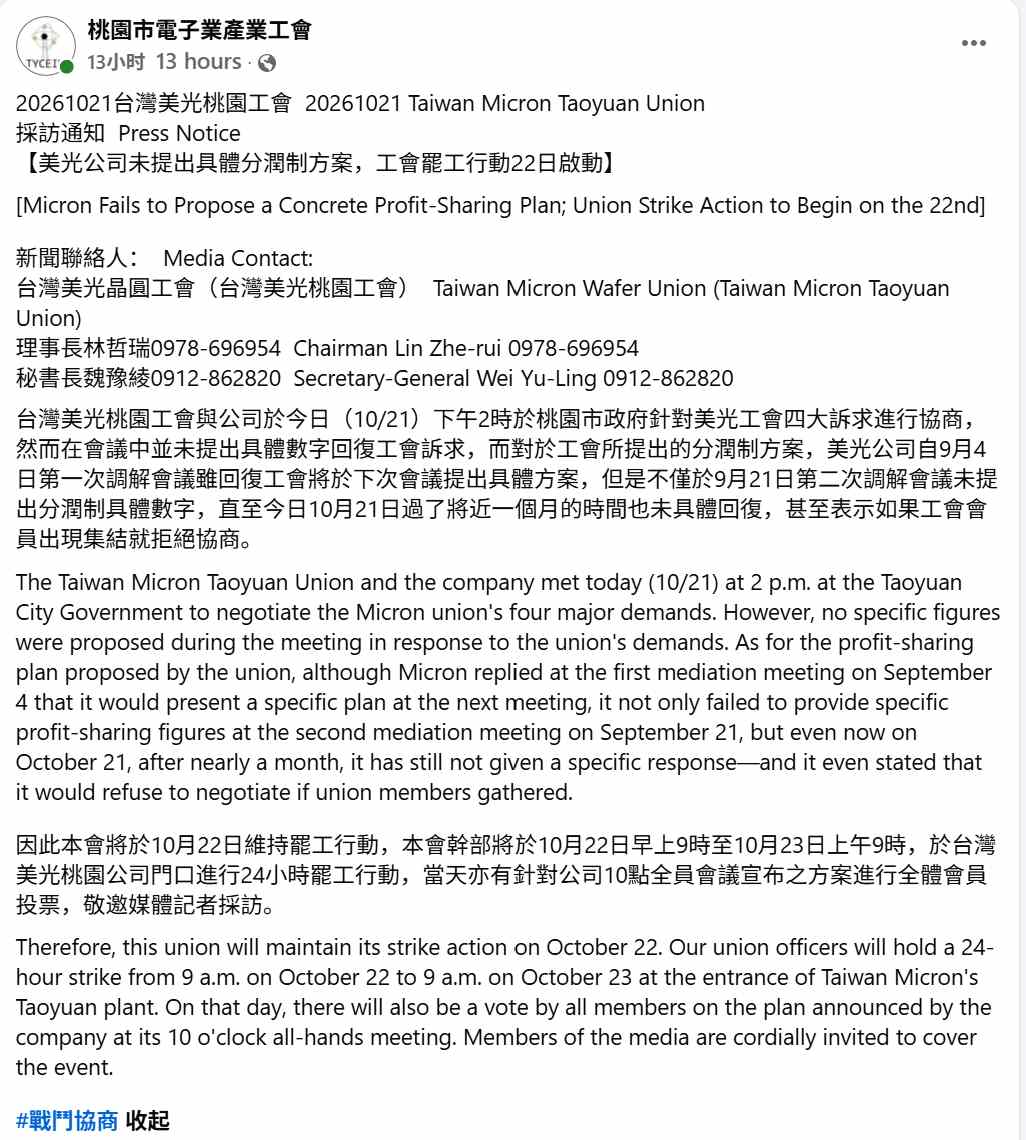
However, negotiations between the labor union at Micron's Taoyuan plant and the company failed to reach a consensus. The union launched a 24-hour strike at 9:00 a.m. on October 22, which is expected to last until 9:00 a.m. on October 23.
According to a report by Taiwan's Central News Agency on October 22, the Taoyuan union stated that 11 union cadres participated in the strike. The union also called on members for support and will conduct an intention poll on the plan proposed by the company to determine its next steps.
Currently, the actual scale of participation in the strike and its impact on the plant's production and operations remain to be further confirmed.
[Source: Facebook]
Employee Profit-Sharing Mechanism Remains Core of Dispute
On October 21, Micron management met with the Taoyuan union at the Taoyuan City Government for negotiations, but the two sides failed to reach a consensus on four key demands. The union requested allocating 15% of the company's operating profit to employees and establishing an open and transparent long-term profit-sharing mechanism.
On September 11, Micron announced an employee incentive plan for fiscal year 2026, which included a one-time cash bonus of NT$1 million for each eligible employee in Taiwan, along with annual performance bonuses and stock awards. However, the union contended that a one-time bonus cannot replace a long-term profit-sharing system, leaving the two sides still at odds over the distribution mechanism and specific proposals.
Earlier, a total of 2,012 members participated in the Taoyuan union's strike authorization vote, with 1,994 voting in favor of the strike. The Taoyuan plant employs about 3,000 workers, around 2,400 of whom are union members.
Whether progress can be made in subsequent negotiations critically depends on whether Micron presents a concrete profit-sharing proposal and how union members react to it.
Impact on Micron Production and Memory Chip Supply Remains to Be Seen
Micron has approximately 15,000 employees in Taiwan, including about 12,300 at its Taichung plant and around 3,000 at its Taoyuan plant. Taiwan is a key production hub for Micron, with operations spanning DRAM production as well as advanced HBM packaging and testing. The Taichung plant, located in the Houli Science Park in Taichung City, is Micron's largest facility in Taiwan; the Taoyuan plant, situated in the Hwaya Technology Park in Guishan District, Taoyuan City, focuses on DRAM wafer fabrication.
As demand for high-performance memory chips from AI servers grows, if labor disputes continue to escalate and affect key production processes, it could heighten market concerns over Micron's supply capacity and overall memory chip supply.
However, there is currently no sufficient evidence indicating that the strike has led to production disruptions or reduced supply.
Going forward, attention should be paid to the actual scale of strike participation, the progress of labor negotiations, and whether production operations are affected. For Micron, the actual impact of the strike on its financial performance and stock price will depend on its duration, the production processes involved, and the final resolution.
This content was translated using AI and reviewed for clarity. It is for informational purposes only.
Recommended Articles










Comments (0)
Click the $ button, enter the symbol, and select to link a stock, ETF, or other ticker.