


Meta Q3 Earnings Preview: Muse Commercialization Faces Test, Wall Street High Target Price Hits $1,000



AI Podcast


Meta will report its third-quarter 2026 financial results after the U.S. market close on October 21, Eastern Time. Analysts expect revenue of approximately $63.34 billion and earnings per share of $6.54. Core advertising remains the profit foundation supporting heavy AI infrastructure investments, though surging capital expenditures may cause a free cash flow net outflow of $8.52 billion. Investors will closely monitor advertising demand, the commercialization and inference costs of the Muse AI assistant, Reality Labs' operating losses, and management guidance on capital expenditures and depreciation for 2027.

TradingKey - Meta (META) will report its third-quarter 2026 financial results after the U.S. market close on October 21, Eastern Time, and host an earnings conference call at 16:30 on the same day.
According to FactSet data, the market expects the company's revenue for the quarter to be approximately $63.34 billion, up about 23.6% from $51.24 billion in the same period last year; earnings per share are expected to be $6.54.
Ad Business Remains the Cash Flow Foundation for AI Investment
Although Meta continues to emphasize Muse, enterprise AI services, and smart glasses, its primary revenue and profits still stem from the advertising ecosystem composed of Facebook, Instagram, and WhatsApp. Therefore, what needs to be verified first this quarter is whether advertising demand can continue to support double-digit growth.
In the second quarter, Meta's revenue reached $60.8 billion, up 28% year-over-year. Ad impressions grew 14% and the average price per ad rose 12%, demonstrating that its AI recommendation system is improving content distribution and ad matching efficiency. Compared with building an independent AI business from scratch, embedding model capabilities into a mature advertising system can be reflected more quickly in operational metrics such as click-through rates, conversion rates, and ad prices.
A survey by Bank of America showed that advertising demand remained solid in the third quarter. If ad impressions, prices, and conversion efficiency continue to grow in tandem, it indicates that Meta can rely on its core business to fund AI infrastructure.
Meanwhile, Reality Labs remains a drag on profitability, with the market expecting the division's third-quarter operating loss to be around $5.2 billion. Investors will focus on whether smart glasses and virtual reality hardware achieve further commercial progress, and whether management will adjust the future pace of investment in this business.
Capex Doubles as Free Cash Flow Faces Test
In the second quarter, Meta narrowed its full-year 2026 capital expenditure guidance to $130 billion to $145 billion, higher than the lower bound of its previous range. The funds are primarily used to procure AI chips, construct data centers, expand networks, and train next-generation models.
According to Visible Alpha data, Meta's third-quarter capital expenditures are expected to reach $41.68 billion, more than doubling year-over-year. As expenditure growth is significantly faster than operating cash flow, the market expects the company's free cash flow for the quarter may see a net outflow of $8.52 billion.
Infrastructure investments typically require upfront capital, as data centers must be built in advance, with equipment depreciation and operating expenses subsequently hitting the income statement, while related revenue may only materialize at a later stage. Therefore, what truly matters in this earnings report is not only the size of third-quarter expenditures, but also management's guidance on capital expenditures, depreciation expenses, and operating costs for 2027.
If Meta continues to increase investment without providing a clear path to utilization rates and revenue returns, market concerns over the overexpansion of AI capital expenditures may heighten.
Muse Commercialization Becomes New Valuation Variable
The launch of the Muse personal assistant and the Muse Wonder model has improved market perception of Meta's AI execution capabilities. Following its launch, Muse gained rapid user growth, and the company also plans to explore revenue streams beyond advertising through subscriptions, enterprise tools, and commercial services. Meta's vast app ecosystem and enterprise customer base help lower distribution costs for new products while providing favorable conditions for the AI assistant to enter shopping, customer service, and business communication scenarios.
However, user growth does not equate to profitability. Rising usage of Muse will also increase inference costs, so the market needs to see that revenue from paid subscriptions, enterprise services, or commercial traffic generation can cover the additional computing expenditure. During the earnings call, Muse's active users, paid conversion rates, cost per inference, and enterprise adoption could all influence investors' judgment of its long-term value.
Meanwhile, according to TipRanks, the 12-month average price target from 44 Wall Street analysts covering Meta over the past 12 months is $828.28, with a high forecast of $1,000 and a low of $580; among them, 38 give a Buy rating, and 6 recommend a Hold.
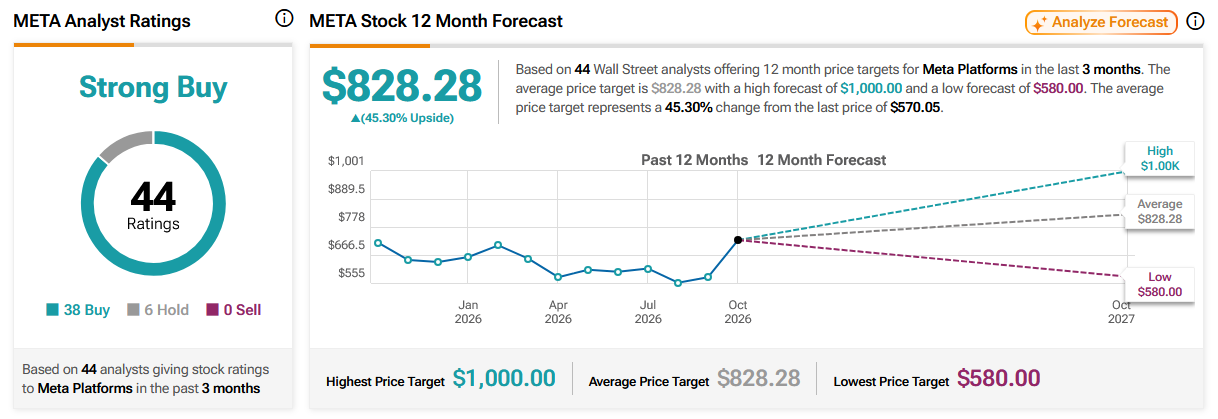
Source: TipRanks
This content was translated using AI and reviewed for clarity. It is for informational purposes only.
Recommended Articles












Comments (0)
Click the $ button, enter the symbol, and select to link a stock, ETF, or other ticker.