


Tesla Q3 Operating Profit Plunges 56% YoY, Dragged Down by Higher Operating Expenses Including R&D



AI Podcast


Tesla reported Q3 2026 revenue of $28.046 billion, slightly beating expectations, while non-GAAP EPS reached $0.48. Automotive gross margin improved to 18.5%, driven by efficiency gains despite a 3% drop in segment revenue. However, a 39% surge in operating expenses, led by higher R&D, caused operating profit to decline 56% year-over-year to $718 million. Free cash flow dropped 62% to $1.531 billion. Strategic progress featured Cybercab entering the Austin Robotaxi fleet, Optimus starting production, and record energy storage deployments. Battery supply constraints remain a key risk affecting production growth.

TradingKey - Tesla (TSLA) reported its Q3 2026 financial results, with revenue slightly beating market expectations and automotive gross margin improving, but rising operating expenses such as R&D weighed on profits. Meanwhile, the company disclosed that Cybercab has joined the Austin Robotaxi fleet and Optimus has started production.
Following the results release, Tesla's stock rose as much as 2% in after-hours trading; as of press time, the gain narrowed to 1.32% to trade at $391.57.
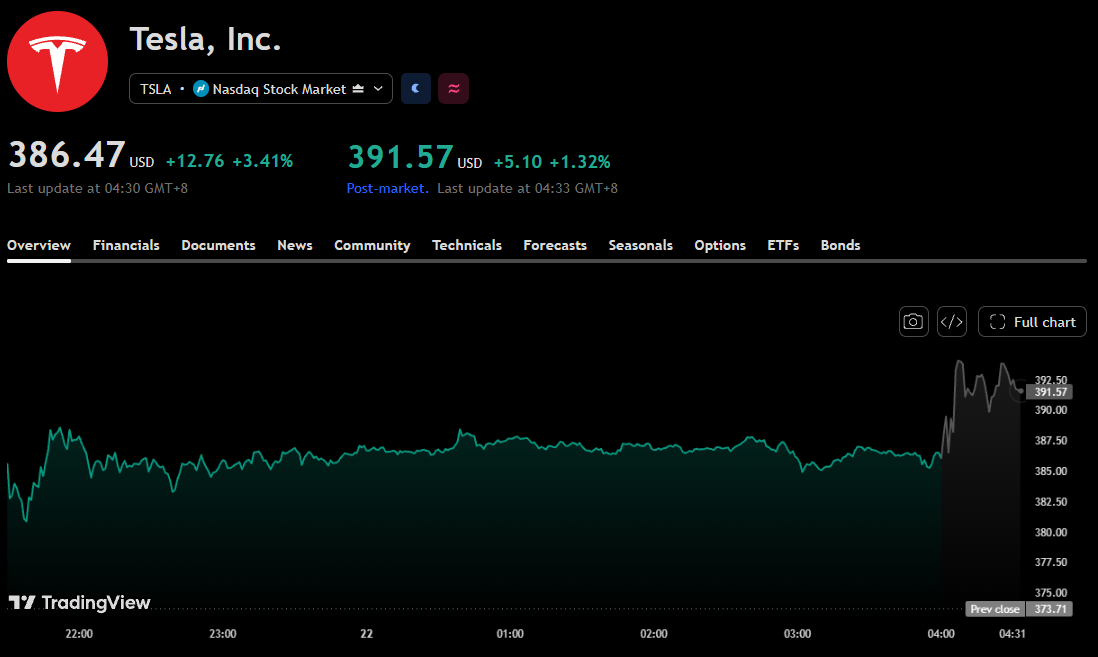
[Tesla Stock Price Chart, Source: TradingView]
Specifically, Tesla's third-quarter revenue came in at $28.046 billion, flat year-over-year, exceeding market expectations of $27.9 billion by $146 million. Non-GAAP diluted EPS was $0.48, down 4% year-over-year, but above the market consensus of $0.43. GAAP diluted EPS was $0.22, down 44% year-over-year.
By segment, automotive revenue reached $20.560 billion, down 3% year-over-year. Deliveries for the quarter totaled 486,532 vehicles, down 2% year-over-year, while production reached 464,391 units, up 4% year-over-year. Automotive regulatory credit revenue fell to $113 million from $417 million in the same period last year.
Despite revenue pressure, automotive GAAP gross margin rose to 18.5%; automotive gross margin excluding regulatory credits was 18.1%, up from 15.4% in the year-ago period and 16.3% in the prior quarter.
Energy generation and storage revenue was $2.881 billion, down 16% year-over-year, while energy storage deployments grew 10% to 13.7 GWh. The company stated that order intake speed and backlog for the energy storage business both hit record highs, and the Texas Megafactory has entered production, with a planned annual capacity of 50 GWh. Services and other revenue reached $4.605 billion, up 33% year-over-year; gross profit hit a record $734 million with a gross margin of 15.9%, driven by growth in supercharging, insurance, and parts sales.
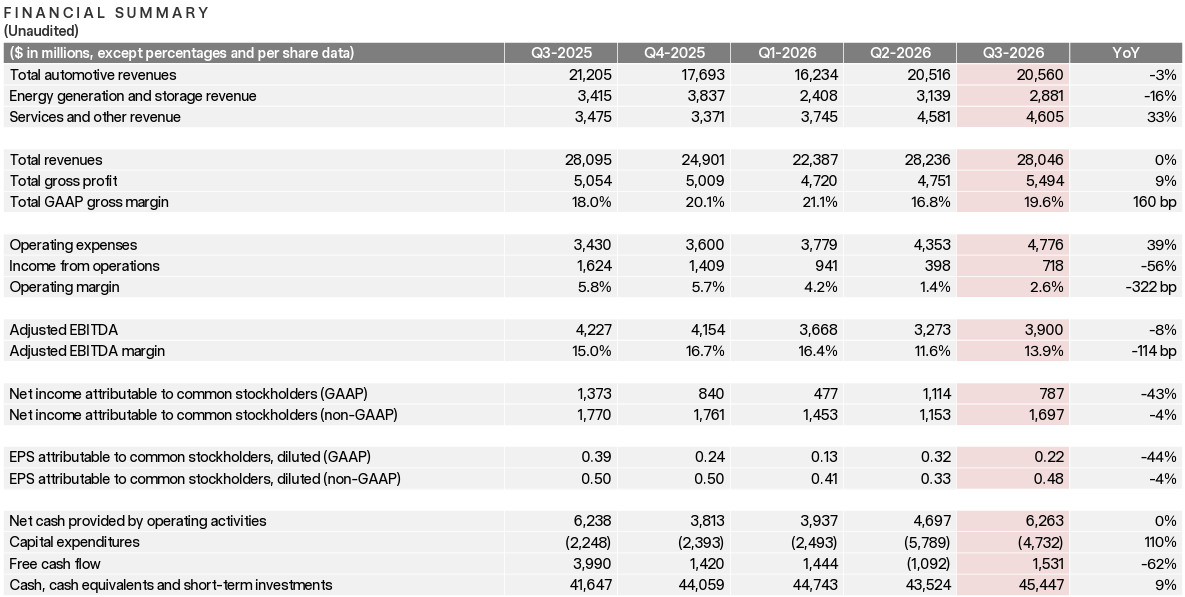
[Tesla Q3 Financial Results]
Notably, the improvement in gross profit has not yet translated into operating profit growth. Total gross profit in the third quarter was $5.494 billion, up 9% year-over-year, with the overall GAAP gross margin rising to 19.6%, up 160 basis points year-over-year. However, operating expenses jumped 39% to $4.776 billion, with R&D expenses increasing from $1.630 billion to $2.761 billion. The increase in expenses surpassed the gain in gross profit, driving operating profit down 56% year-over-year to $718 million and reducing the operating margin to 2.6%.
In terms of cash flow, operating cash flow for the third quarter was $6.263 billion, while capital expenditures reached $4.732 billion, up 110% year-over-year; free cash flow was $1.531 billion, down 62% year-over-year, but turned positive from negative $1.092 billion in the previous quarter. Cash, cash equivalents, and short-term investments totaled $45.447 billion at quarter-end, up 9% year-over-year.
Regarding business progress, Tesla stated that it has been offering Robotaxi services in Austin using Cybercab since September 3, with cumulative unsupervised driving miles approaching 2 million by the end of the quarter. Active FSD subscriptions reached 1.74 million, up 67% year-over-year; the take rate for FSD subscriptions among new vehicle deliveries in North America exceeded 75%.
The company also disclosed that volume production of the Tesla Semi has begun in Nevada, and the production line for Optimus in Fremont has commenced production. Management stated that passenger vehicle order backlogs reached their highest level in four years at quarter-end, though battery supply continues to constrain automotive production growth.
This content was translated using AI and reviewed for clarity. It is for informational purposes only.
Recommended Articles






Comments (0)
Click the $ button, enter the symbol, and select to link a stock, ETF, or other ticker.