


Jabil Stock Forecast: AI Infrastructure Growth Faces a Major Q4 Earnings Test



AI Podcast


Jabil is reporting its fiscal Q4 results, with investor focus centering on AI infrastructure demand, cash flow, and management’s 2027 outlook. The company benefits from rising AI-related components demand and a strategic $1.7 billion memory authorization from Akamai, which minimizes working capital burdens. While Q3 performance exceeded expectations and valuation is supported by cloud and AI exposure, heavy working capital needs remain a key risk. Technically, the stock tests resistance near $321.44; a close above $324.84 confirms a bullish breakout toward $334.84, whereas a drop below $310 signals near-term bearishness.

TradingKey - Jabil (JBL) reports fiscal Q4 results on September 30, before the U.S. market opens. The stock has almost fully recovered from its mid-month lows. JBL closed yesterday, September 29, at $318.84, -0.03% for the day. Jabil’s components business is benefiting from rising demand of infrastructure for artificial intelligence. The biggest question regarding the company is how long will this uptrend last? Management’s 2027 outlook is more important than 2026 results.
Earnings Are Still Ahead
Jabil makes electronic components and provides related services. It manufactures electronic and electromechanical products for a wide range of companies. According to TipRanks, Jabil’s trailing-twelve-month gross profit margin is 9.23%. Jabil has released positive results for the past five quarters. The consensus EPS estimate for the fiscal year 2026 is $12.77. For Q4, Jabil expects revenue in the range of $9.2 billion to $10 billion. Jabil expectsts GAAP operating income in the range of $526 million to $586 million, and core operating income in the range of $589 million to $649 million. Core diluted EPS is expected in the range of $3.80 to $4.20, while GAAP diluted EPS is expected in the range of $3.24 to $3.64.
The Akamai Authorization Is a Strong AI Demand Signal
Akamai recently increased its AI cloud commitments and authorized Jabil to purchase approximately $1.7 billion of memory components. Akamai will support Anthropic’s AI efforts with its $11.6 billion contract. Considering Jabil’s authorization, it’s likely that Jabil is part of a large AI infrastructure project, and Akamai’s announcement provides evidence to that effect. The $1.7 billion authorization should not be treated as $1.7 billion of Jabil revenue or profit.
Akamai will pay Jabil all corresponding supplier invoice amounts when Jabil receives the memory components. Jabil will hold the components on consignment for Akamai and repurchase them at cost as they are utilized. Jabil will realize the benefits of this authorization should it lower the barriers for Akamai to source and build AI infrastructure. This structure should limit Jabil’s working-capital burden for the authorized memory components. Jabil’s shareholders’ interests will be aligned with Jabil’s profit interests when it implements the authorization.
Q3 Gave the Recovery Story a Stronger Base
Jabil reported revenues of $8.75 billion for fiscal Q3 with GAAP operating income of $445 million and core operating income of $504 million. GAAP diluted EPS was $2.59, and core EPS was $3.16, compared to $2.55 in the prior year. Management indicated that core EPS and free cash flow were above expectations.
Jabil has mentioned AI infrastructure and demand, as well as better than expected results for Automotive and Connected Living.
AI has a cyclical nature, and reliance on a single AI customer could be risky. Diversification across several industries increases the robustness of a recovery. Core results exclude stock-based compensation, amortization and restructuring costs, and management focus should be on core results. The gap between GAAP and core results is material.
AI Growth Is Expanding Across the Portfolio
Jabil has multiple opportunities within AI, and it isn't just relying on one customer to drive its AI business. The company has made investments in several areas including server and rack systems, storage and edge infrastructure, and has announced an intent to form a strategic alliance with Adani Enterprises to build an AI and data-center infrastructure manufacturing platform in India.
Jabil’s partnership with Adani is still an intended strategic alliance, with the parties working on definitive operational frameworks and formal documentation, and therefore, there are very little hard numbers to work with. Traditionally, investors look for hardware (like production equipment) to evaluate if a company’s business is growing. The equipment also has to be profitable in order to justify the investment. If the equipment is extremely large and bulky, that may also pose a challenge.
Cash Flow Is the Main Quality Test
Jabil expects its fiscal year 2026 revenue to be about $35 billion. It expects its core operating margin to be about 5.8%. Its core EPS is expected to be about $12.70. Adjusted free cash flow is expected to be about $1.4 billion. The expected free cash flow gives Jabil the flexibility to make large investments. However, a manufacturer can increase revenue while building and stocking up on inventory. If inventory and receivables increase, cash may become constrained.
Jabil’s working capital needs are already large. As of Q3, Jabil’s inventory and receivables were about $5.93 billion and $5.47 billion respectively. For inventory to increase, cash investment also needs to increase. Jabil needs cash to invest in working capital. Increasing working capital isn't the best use of cash if the cash isn't quickly converted to other forms. Jabil also has large contracts to build AI edge systems. The Akamai memory authorization is structured to reduce the cash burden on Jabil for those memory purchases because Akamai reimburses Jabil when the components are received.
Fiscal 2027 Guidance May Decide the Reaction
Jabil said after its Q3 that it feels good about its FY2027 outlook. With that, investor focus will be on Jabil’s FY2027 guidance, and beyond. Core elements of that guidance should include revenue growth, core operating margin and earnings, as well as free cash flow. Prior commentary indicated Jabil expected FY2027 AI-related revenue growth at a similar percentage rate to FY2026, when AI-related revenue was expected to grow about 50%. It will be interesting to see if Jabil updates that guidance.
Valuation Still Requires Execution
Prior to its Q4 report, management noted that the company expected continued strong demand for its services. This strong demand likely stems from a shift to cloud computing and artificial intelligence. The Company’s valuation is likely most supported by its earnings multiple. The company’s forward earnings multiple is approximately 20, and using management’s prior guidance of $12.70, the company trades at approximately 25.1 times its fiscal 2026 guided core earnings. These multiple bases will likely diverge based on Jabil’s performance. I view Jabil’s valuation as somewhat supportive of its earnings potential given its exposure to the AI and cloud computing markets.
Jabil Technical Analysis: JBL Tests $321.44 as Triangle Breakout Nears
JBL is currently trading at $318.84 after a recent bounce from the September lows at $292.45. The price action shows the stock bouncing off of rising trendline support and testing falling resistance. The stock is currently trading above both the 50-day and 200-day moving averages and currently testing the $318.82 - $321.44 zone. Relative Strength Index (RSI) is at 60 and just above its signal line at 59.8.
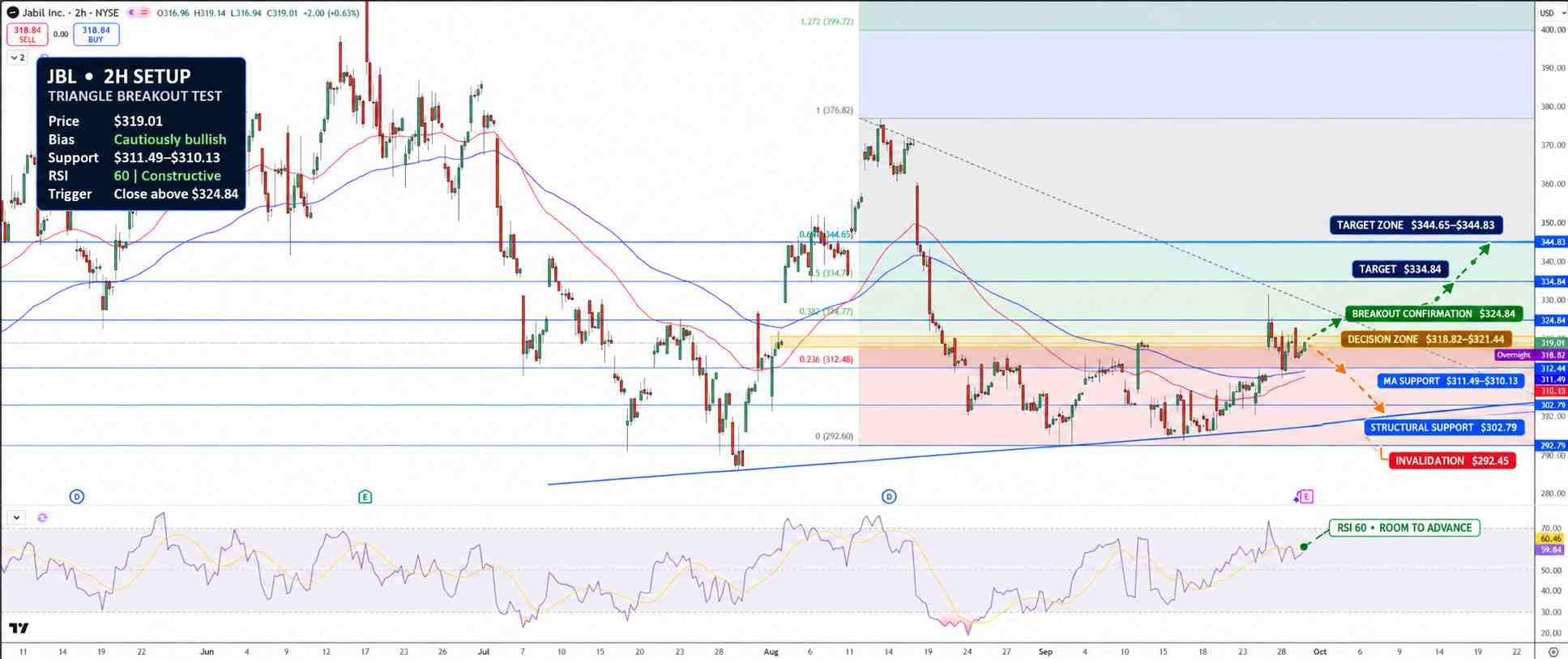
Jabil Stock Price Chart - Source: Tradingview
I am in the bear camp at the moment and would look for a close below $318.82 to confirm a larger move lower and test the $311.49 - $310.13 area for support. Below there, the rising trendline comes into play at $302.79 before more supportive levels at $292.45.
I am looking for an end of the month close above the $324.84 level to confirm a breakout and have upside targets at $334.84 and higher at $344.83. Above there, I would look for resistance in the $350 area.
Why is Jabil stock in focus now?
Jabil will report its fiscal fourth quarter and full year 2026 results on September 30, before the market open. Management will likely provide color on its outlook for AI infrastructure. Jabil may also offer a cash and debt conversion outlook as well as a preliminary fiscal 2027 outlook.
What level confirms a stronger JBL breakout?
Sustaining a close above $324.84 for 2 hours would strengthen the breakout pattern for JBL and have a bullish bias for a move to $334.84. A move below $310 would invalidate the bullish bias and have a more bearish bias and be targeting the level at $302.79.
Bottom Line
Jabil, prior to earnings, had improved operating conditions for Q3. Additionally, there is continuing demand for AI infrastructure. Also, the recent Akamai authorization alludes to large customer engagements. It is important to see improvements in operating conditions and margin and free cash flow expansion for JBL.
Looking at the chart, the overall trend is bullish as long as the stock trades above $310. A break above $324.84 would have a bullish bias and target $334.84. A break below $310 would be bearish for the short term.
Recommended Articles









Comments (0)
Click the $ button, enter the symbol, and select to link a stock, ETF, or other ticker.