


US Stocks Edge Down as Philadelphia Semiconductor Index Bucks Trend to Gain 1.3%; Some Tech Stocks Rebound With Optical Communication Stocks Leading Gains; Meta Rises Over 3%



AI Podcast


U.S. stocks edged lower as Treasury yields rose to multi-year highs. Major indices declined, while optical communications stocks outperformed and tech performance remained mixed. Meta advanced following bullish analyst commentary, and SpaceX successfully achieved its first Starship orbital flight. In corporate developments, OpenAI is reportedly seeking funding at a $1.4 trillion valuation and launched GPT-6.1 Sol alongside the Dot agent. Samsung projected HBM to near 30% of DRAM capacity next year. Meanwhile, Morgan Stanley anticipates a potential S&P 500 pullback may precede a year-end rally, and Fed's Williams left room for another rate hike.

TradingKey - U.S. stocks fell slightly as U.S. Treasury yields rose back to multi-year highs. Some tech stocks rebounded, with optical communications stocks leading the gains and bank stocks leading the losses.
At the close, the Dow Jones Industrial Average fell 0.26% to 51,349.92; the Nasdaq Composite Index fell 0.09% to 26,797.54; and the S&P 500 Index fell 0.17% to 7,670.84.
Tech Stock Performance
Meta (META) rose 3.24% to $738.79.
Jefferies stated in a research report that following Meta Platforms' AI Summit, the firm turned even more optimistic about the company, considering Muse a surprisingly good killer product and noting that personal AI agents represent immense consumer and enterprise opportunities. Trading at roughly 19 times estimated 2028 earnings per share, the risk-reward profile is attractive with room for further valuation upside. The firm noted that as usage increased, its team encountered several issues during testing (such as crashes, latency, or delayed responses), indicating that capacity is beginning to come under pressure, which may lead to further upward revisions in capital expenditure forecasts. The firm maintained its "Buy" rating and $875 price target.
SpaceX (SPCX) rose 2.59% to $149.24.
SpaceX's flagship rocket, Starship, successfully entered Earth orbit for the first time, completing the commercial space company's most ambitious mission to date. According to Reuters, Starship lifted off on Monday local time. Despite an early engine shutdown during flight, the spacecraft continued to execute critical burn maneuvers following real-time evaluations by engineers and successfully entered its intended orbit.
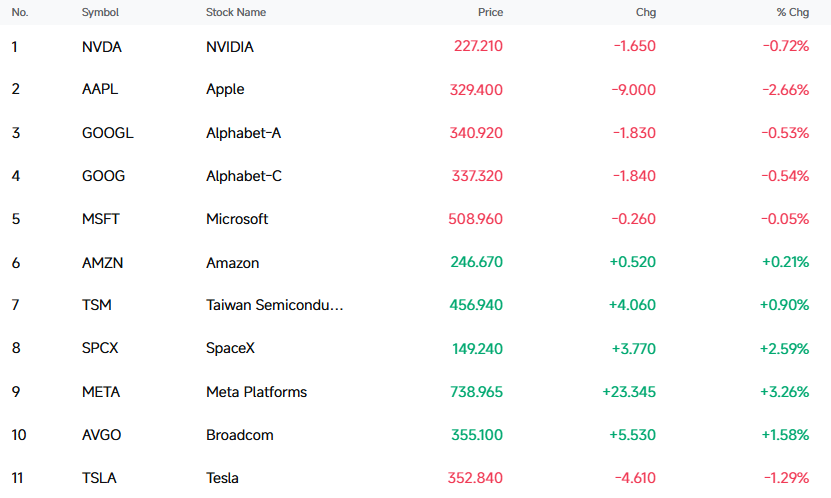
Among mega-cap tech stocks, Meta Platforms (META) rose 3.26%, SpaceX (SPCX) gained 2.59%, Broadcom (AVGO) climbed 1.58%, TSMC (TSM) advanced 0.90%, and Amazon (AMZN) edged up 0.21%. On the downside (ranked by decline): Apple (AAPL) fell 2.66%, Tesla (TSLA) slipped 1.29%, Nvidia (NVDA) dropped 0.72%, Google (GOOGL) declined 0.53%, and Microsoft (MSFT) dipped 0.05%.
[Source: FutuBull]
The Philadelphia Semiconductor Index rose 1.32% to 12,629.16. Among its 30 constituents, 26 advanced and 4 declined.
Among optical communications stocks, Lumentum (LITE) rose 5.66%, Corning (GLW) gained 4.68%, Marvell Technology (MRVL) climbed 4.51%, and Applied Optoelectronics (AAOI) advanced 3.98%.
Company News
OpenAI Reportedly Seeking to Raise at Least $30 Billion at Target Valuation of $1.4 Trillion
OpenAI is seeking to complete a new funding round of at least $30 billion at a valuation of approximately $1.4 trillion, using a bridge round to replenish its capital reserves after delaying its IPO plans. The financing discussions remain in early stages and the final terms could change, Bloomberg reported, citing people familiar with the matter. One of the people said that demand for this round is primarily investor-driven. If successfully completed, OpenAI's valuation will surpass the latest private market valuation of rival Anthropic, reclaiming its industry leadership position.
OpenAI Launches GPT-6.1 Sol and Dot Agent
OpenAI announced the launch of GPT-6.1 Sol, an upgraded version of GPT-6 Sol that focuses on enhancing agent coding, computer usage, and professional workflow capabilities. OpenAI stated that GPT-6.1 Sol approaches the performance of GPT-6 Astra across multiple benchmarks, but its standard input and output token pricing is about one-fifth that of Astra. Debuting alongside Sol is the agent Dot. According to the announcement, Dot is powered by GPT-6 Astra, features an independent cloud computer, learns from feedback over long-term usage, works toward user goals 24/7, and can connect to over 4,000 applications through a plugin ecosystem. Users can contact Dot at any time via ChatGPT, text messages, Slack, and Teams, or engage in voice calls with it, while Dot syncs context across all channels.
Samsung Executive: HBM Expected to Account for Nearly 30% of Global DRAM Capacity Next Year
Kim Taewoo, Executive Vice President of Samsung Electronics, stated that HBM is expected to account for nearly 30% of DRAM makers' total wafer capacity next year, up from approximately 20% currently. He stated that HBM is expected to account for nearly 30% of DRAM makers' total wafer capacity next year, up from approximately 20% currently. Kim Taewoo said that HBM competes with conventional DRAM for the same wafer capacity, and expanding HBM output could squeeze the supply of conventional DRAM.
Industry & Macro News
Morgan Stanley: A moderate pullback in the S&P 500 Index could actually set the stage for a stronger year-end rally
Mike Wilson, Chief US Equity Strategist and Chief Investment Officer at Morgan Stanley, believes that a moderate pullback in the S&P 500 Index could actually set the stage for a stronger year-end rally. Wilson stated that if bond market stress cannot be relieved, US stocks could face greater volatility, with the S&P 500 potentially experiencing a 5% to 10% correction. However, he believes such a pullback does not necessarily mean a long-term trend reversal, but rather a restart for the market after completing an internal adjustment.
Fed's Williams: One more rate hike possible this year if economy meets expectations
John Williams, President of the Federal Reserve Bank of New York, stated that after raising interest rates at its September meeting, the Fed sees no need to rush to act again and can wait for more economic data to determine its next policy direction. Williams stated that if economic developments broadly align with his expectations, a further increase in the target range for the federal funds rate may be needed before the end of the year to help push inflation back to the 2% target in a more timely manner. However, he emphasized that this is merely a personal forecast, and the final decision will depend on future data. Williams noted that with economic growth remaining solid and the labor market performing well, inflationary pressures will continue to be a focus of monetary policy. He stated that the Fed must ensure inflation does not stay persistently high due to shocks and avoid second-round effects of inflation.
This content was translated using AI and reviewed for clarity. It is for informational purposes only.
Recommended Articles





Comments (0)
Click the $ button, enter the symbol, and select to link a stock, ETF, or other ticker.