


US September Nonfarm Payrolls Preview: Job Growth May Cool, How Will US Stocks, Dollar and Gold React?



AI Podcast


On Friday, October 2 (EDT), the U.S. will release the September nonfarm payrolls report. Markets project job additions of approximately 90,000 to 100,000, with the unemployment rate edging up to 4.2%. This data will heavily influence Federal Reserve rate-hike expectations and drive short-term asset volatility. A moderate cooling will likely benefit equities and gold, whereas significantly stronger-than-expected figures would boost the dollar and Treasury yields while suppressing gold prices. Conversely, a sharp deterioration could trigger economic slowdown concerns, altering policy stances and prompting broad market repricing across asset classes.

TradingKey - On Friday, October 2 (EDT), the U.S. will release its September nonfarm payrolls report, with markets focusing on whether job growth can sustain August's rebound and whether the data will alter expectations for subsequent Federal Reserve rate hikes.
Markets generally expect U.S. job growth to slow noticeably from August. According to a Reuters survey, nonfarm payrolls are projected to add about 100,000 jobs in September, with the unemployment rate potentially rising from 4.1% in August to 4.2%; forecasts from some institutions are clustered near 90,000. By comparison, U.S. nonfarm payrolls increased by 162,000 in August, marking the largest gain in five months.
Jobs May Cool Modestly, Fed Policy Expectations Face Repricing
Looking at recent labor market indicators, August JOLTS job openings fell by 256,000 to 7.079 million, reflecting a cooling in corporate labor demand, though layoffs remained low at 1.641 million. Meanwhile, US initial jobless claims fell to 197,000 in the week ended September 19, near multi-decade lows, indicating that companies have not yet engaged in significant large-scale layoffs.
Therefore, the key to this non-farm payrolls report is not whether job gains slow from August's 162,000, but whether the magnitude of the decline exceeds market expectations. If September job additions can still stay around 90,000 to 100,000 while the unemployment rate remains at 4.1% to 4.2%, the market is more likely to view it as a normal cooling of the labor market rather than a clear deterioration of the US economy.
Institutional forecasts also diverge significantly. Bank of America estimates that September job gains may be only around 60,000, while most market forecasts remain close to 100,000. This means that if actual job growth reaches above 150,000 again, it will be significantly stronger than current expectations; conversely, if job growth drops below 50,000 while the unemployment rate rises further, it could reinforce market concerns over a slowdown in economic growth.
Employment data is also a crucial factor determining the Fed's next policy move. Inflation currently remains well above the long-term target of 2%; if employment continues to show resilience, the Fed will have greater policy space when controlling inflation. If September non-farm payroll gains are significantly higher than 100,000, the unemployment rate stays low, and wage growth remains solid, the market may further raise expectations for subsequent Fed rate hikes.
Conversely, if job growth falls significantly below expectations alongside an unemployment rate rising to 4.2% or even higher, the need for the Fed to continue raising rates may decline. New York Fed President Williams also recently stated that following previous policy tightening, there is no need for the Fed to rush into taking further action and it can wait for more economic data.
How September Non-Farm Payrolls Will Impact Short-Term Movements of US Stocks, Dollar, and Gold
As for US equities, a 'moderate cooling' in employment may be a relatively favorable outcome for the current market. If job growth hovers around 80,000 to 100,000, it would neither signal a significant economic deterioration nor necessitate further Fed rate hikes. Consequently, US Treasury yields could pull back, offering support to high-valuation sectors such as the Nasdaq, AI, and semiconductors. If nonfarm payroll additions rebound to over 150,000, the market may raise rate-hike expectations, driving US Treasury yields further up and placing valuation pressure on high-valuation tech stocks. However, if employment falls significantly below expectations, while the market might initially trade on falling interest rates, it will subsequently need to reassess corporate earnings and consumer growth prospects.
Regarding the US dollar, if September nonfarm payrolls come in significantly stronger than expected, the dollar may continue to find support. Robust employment figures would indicate that the US economy remains resilient, while bolstering market expectations that the Fed will maintain high interest rates or even hike further. Additionally, the interest rate differential between the US and other major economies could continue to support the dollar. If job additions drop to around 50,000 or even lower, accompanied by a rise in the unemployment rate, US Treasury yields and rate-hike expectations could fall in tandem, leaving room for a tactical correction in the US dollar.
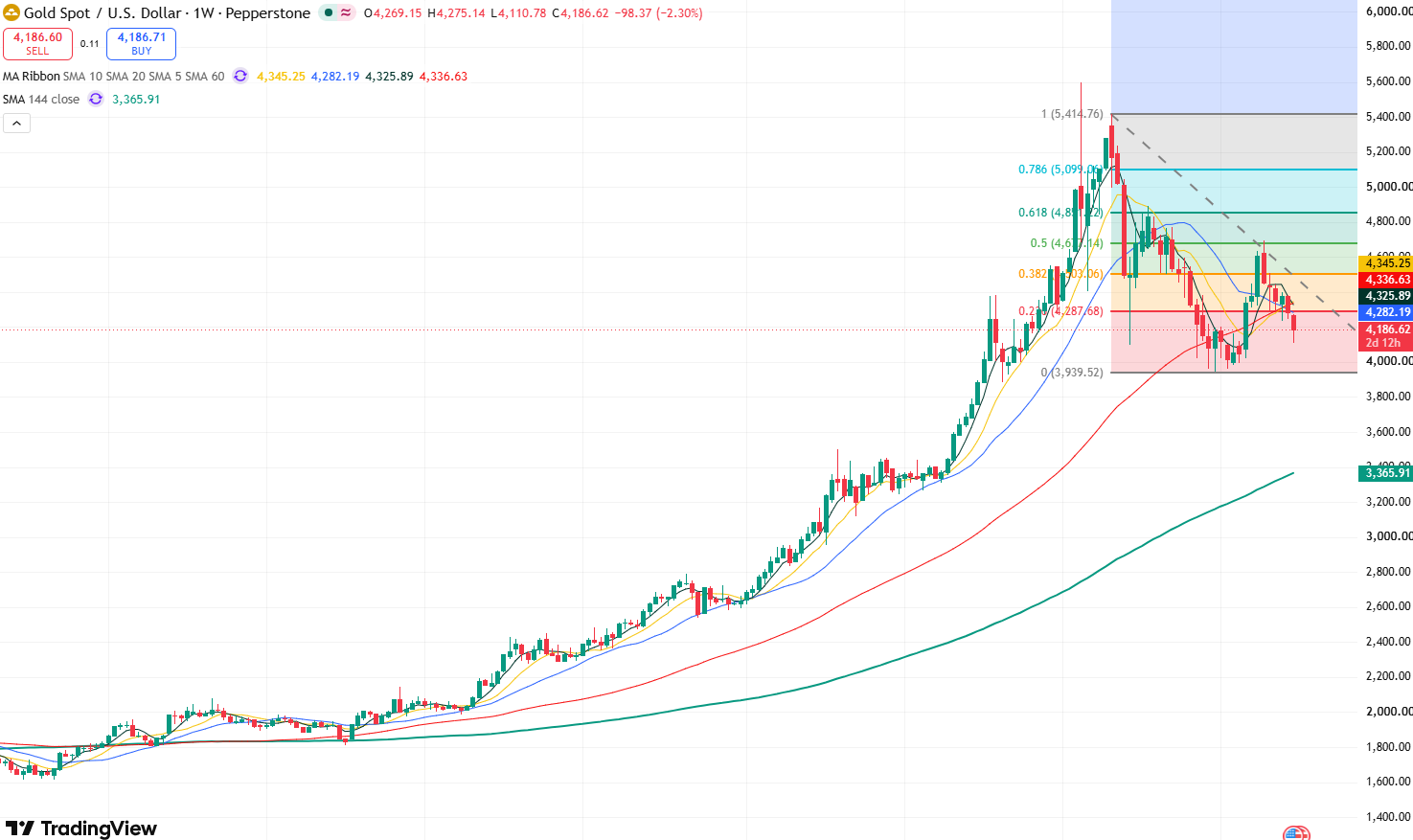
Gold price weekly chart, Source: TradingView
As for gold (XAUUSD), if employment is significantly stronger than expected, rising Fed rate-hike expectations could push the US dollar and Treasury yields higher, continuing to suppress gold's performance. Gold prices could test downward toward $4,100 or even further toward the $4,000 mark. If job growth slows significantly and the market dials back rate-hike expectations, causing Treasury yields and the US dollar to pull back in tandem, it would favor a recovery in gold prices, potentially opening up upside room toward $4,400. If the data falls roughly within the expected range of 90,000 to 100,000, gold's further trajectory will need to be judged in combination with wage growth, the unemployment rate, and the market's repricing of the Fed's next meeting.
This content was translated using AI and reviewed for clarity. It is for informational purposes only.
Recommended Articles












Comments (0)
Click the $ button, enter the symbol, and select to link a stock, ETF, or other ticker.