


AMD vs. Broadcom: Which AI Chip Stock Is Better for Long-Term Investment? Comprehensive Comparison of AMD and AVGO



AI Podcast


AMD and Broadcom represent distinct AI investment profiles alongside Nvidia. AMD targets general-purpose AI computing via Instinct GPUs and EPYC CPUs, with data center revenue up 50% to 107% year-over-year. Conversely, Broadcom focuses on custom AI accelerators (ASICs) and networking chips for hyperscale clients, posting a 221% surge in AI semiconductor revenue. Broadcom offers superior profitability, cash flow, and a lower forward P/E of roughly 21x versus AMD’s 50x. While Broadcom provides mature earnings visibility, AMD presents higher growth upside contingent on executing market share gains in the AI accelerator sector.
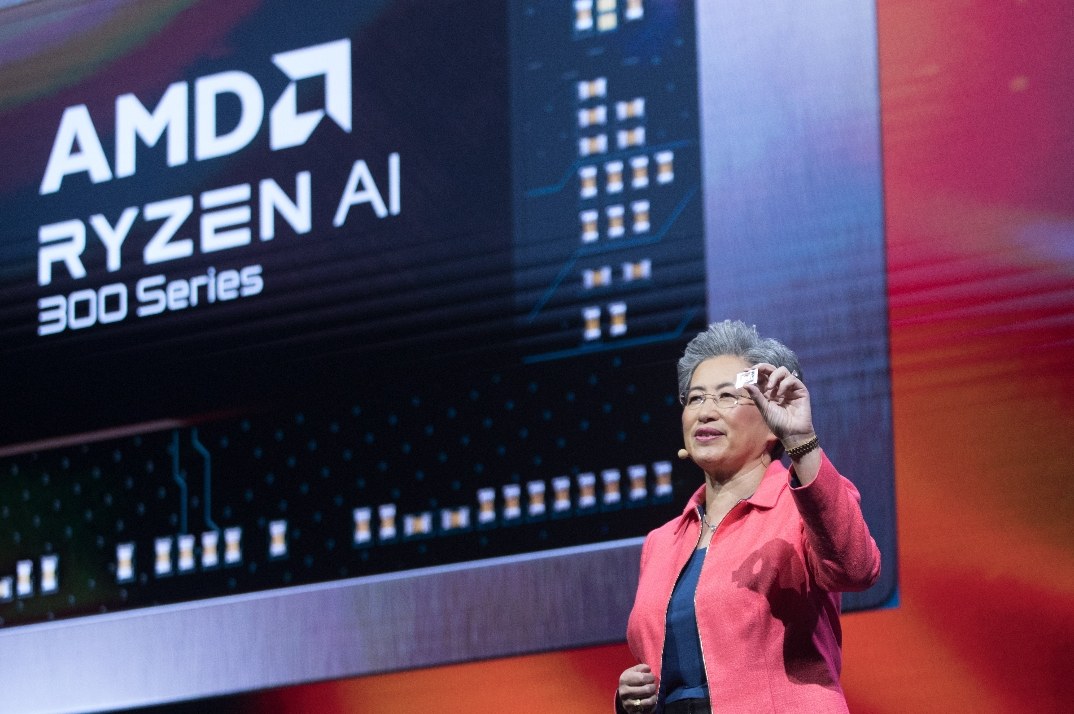
TradingKey - As AI data center investments continue to grow, AMD (AMD) and Broadcom (AVGO) have both become key AI chip targets alongside Nvidia (NVDA), but there are distinct differences in their business models. AMD primarily competes in the general-purpose AI computing market through its Instinct GPUs, EPYC server CPUs, and Helios rack systems, while Broadcom focuses on developing custom AI accelerators (ASIC/XPU) for major clients such as Google (GOOGL), OpenAI, and Anthropic, while also providing high-speed networking chips. So, which of these two companies is more worthy of long-term investment?
AMD vs. Broadcom: Which AI Business Is Growing Faster?
AMD's revenue for the second quarter of 2026 reached $11.54 billion, up 50% year-over-year, with Data Center revenue reaching $6.7 billion, up 107% year-over-year, mainly driven by growing demand for EPYC server processors and Instinct GPUs. Data Center now accounts for approximately 58% of AMD's total revenue.
Broadcom posted an even faster growth rate in its latest earnings report. Revenue for the third quarter of fiscal 2026 reached $29.59 billion, up 86% year-over-year, with Semiconductor Solutions revenue coming in at $20.84 billion, up 127% year-over-year.
More notably, Broadcom's AI semiconductor revenue for the quarter reached $16.7 billion, up 221% year-over-year. The company expects AI semiconductor revenue to rise further to $21.7 billion in the fourth quarter, up 236% year-over-year.
It should be noted that the reporting metrics of the two companies differ: AMD's Data Center segment includes CPUs and GPUs, while Broadcom's AI revenue primarily consists of custom AI accelerators and AI networking chips. Therefore, market share cannot be judged simply based on revenue figures.
AMD: Betting on General-Purpose AI GPUs, Growth Depends on Market Share Gains
AMD's core investment thesis is to become a major general-purpose AI computing platform besides Nvidia.
The company has introduced the MI400 series Instinct GPUs and the Helios rack-scale AI system, integrating GPUs, EPYC CPUs, Pensando networking, and ROCm software to further expand from individual chips to complete AI systems.
Currently, major AI clients such as OpenAI, Anthropic, Meta, Microsoft, and Oracle are deploying or testing AMD platforms. OpenAI's partnership with AMD involves deploying up to 6GW of GPUs, while Anthropic plans to deploy up to 2GW of MI450 series GPUs.
For AMD, the core variable driving the company's future growth lies in whether its Instinct GPUs can continuously expand their market share in AI accelerators.If Helios and the MI400 can achieve large-scale deployment among major cloud computing companies and AI labs, AMD's data center revenue still has substantial room for growth.
Broadcom: Custom AI Chips Are Growing Rapidly
Broadcom, on the other hand, is taking a different route.
Google, Meta (META), OpenAI, Anthropic, and other major AI companies have massive computing demands, making them increasingly eager to develop custom AI chips optimized for their own models to reduce unit compute costs and power consumption. Broadcom helps these customers design and produce custom AI accelerators, while also providing data center infrastructure such as switching chips, high-speed networking, and optical communications.
For example, Broadcom and OpenAI announced this year the Jalapeño AI processor co-developed by both parties, with plans for gigawatt-scale deployment and continued development across multiple product generations.
The advantage of this model lies in the fact that once a major customer finalizes a chip architecture, projects typically span multiple product cycles, while the expansion of AI clusters simultaneously drives demand for networking chips. According to the latest financial report, Broadcom's third-quarter AI semiconductor revenue surged 221% year-over-year, demonstrating that custom AI chips are becoming one of the company's most important sources of growth.
AMD vs Broadcom: Which Is the Better Long-Term Investment?
Comparison Metric | AMD | Broadcom (AVGO) |
Core AI Business | General-purpose GPUs, CPUs, rack systems | Custom AI ASICs/XPUs, networking chips |
Key Products | Instinct, EPYC, Helios | Custom AI accelerators, networking chips |
Latest AI/Data Center Growth Rate | Data center +107% | AI semiconductors +221% |
Key Customers | OpenAI, Meta, Microsoft, Anthropic | Google, Meta, OpenAI, Anthropic, etc. |
Software/Other Business | ROCm | VMware infrastructure software |
Profitability | Rapidly improving | Higher |
Core Growth Thesis | Gaining GPU market share | Expanding demand for custom AI chips |
Forward P/E | Around 50x | Around 21x |
Key Risks | GPU market share execution, ROCm ecosystem, valuation | Customer concentration, custom chip cycle, AI capex |
Overall, Broadcom holds a relative advantage across metrics such as AI revenue growth, profitability, free cash flow, and valuation; AMD's larger potential growth upside, on the other hand, is built on the foundation of continuously increasing its AI GPU market share in the future.
Therefore, for long-term investors who place greater value on cash flow and earnings visibility, Broadcom's fundamentals are relatively mature; whereas for investors who are willing to bear higher valuation and market share execution risks and are bullish on AMD further challenging Nvidia, AMD exhibits more distinct growth investment characteristics.
This content was translated using AI and reviewed for clarity. It is for informational purposes only.
Recommended Articles










Comments (0)
Click the $ button, enter the symbol, and select to link a stock, ETF, or other ticker.