


Microsoft Falls Over 2% Premarket as Massive Global Outage Hits Outlook and Teams, Raising Concerns Over Enterprise Service Stability



AI Podcast


As of Eastern Time November 13, Microsoft fell 2.8% pre-market to $508.33 following a 12-hour widespread outage on November 12 affecting Microsoft 365 services like Outlook, Teams, and Copilot. Caused by server health check failures and overloaded secure connection processes, the disruption impacted global enterprise operations and third-party connectors. Microsoft deployed authentication patches, expanded virtual machine resources, and extended email timeout windows to 48 hours. While no malicious activity is suspected and no immediate customer churn or revenue impact is observed, recurring outages risk undermining enterprise confidence in service reliability and long-term cloud adoption.

TradingKey - As of press time on November 13, Eastern Time, Microsoft (MSFT) fell about 2.8% in pre-market trading to $508.33.
On November 12, multiple Microsoft services suffered a widespread outage, affecting certain features of Outlook, Teams, Copilot, and other Microsoft 365 applications. The outage lasted about 12 hours and extended into Friday business hours in the Asia-Pacific region.
As this marks the second major outage for Microsoft's Microsoft 365 services this year, enterprise customer concerns over service reliability have intensified once again.
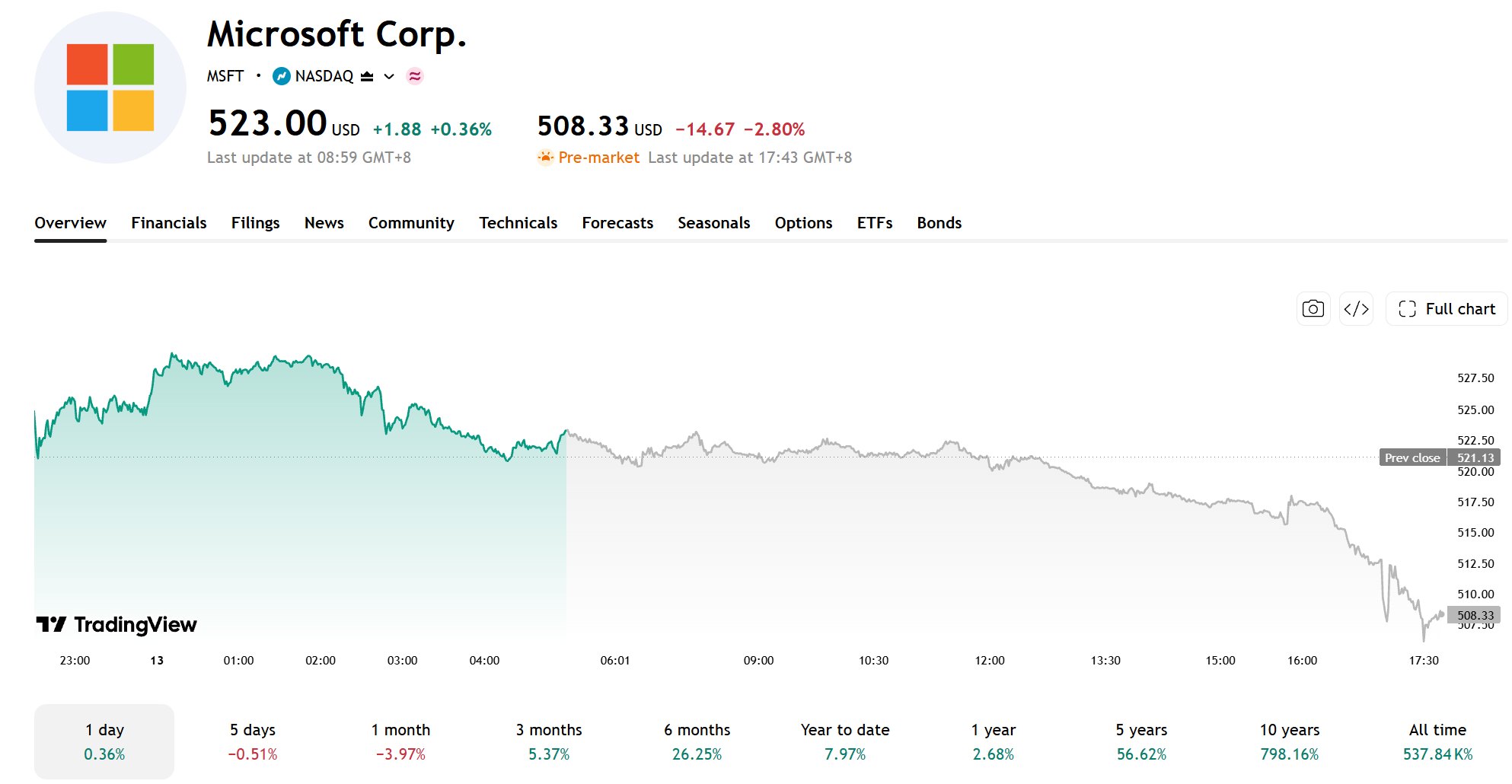
[Source: TradingView]
Multiple Microsoft Services Suffer Outage Lasting Over 12 Hours
The outage primarily affected Exchange Online, Microsoft's cloud-based email and calendar service, and spilled over into other Microsoft 365 features that rely on it. Some users were unable to access Outlook mailboxes normally, with sending and receiving emails as well as inbox loading also impacted.
Certain Teams features were also affected, particularly calendar and meeting scheduling functions that depend on Exchange Online, while features independent of the service remained largely operational.
Downdetector data showed that Outlook outage reports peaked at approximately 138,000 around 1:00 p.m. Eastern Time on November 12. The disruption subsequently spread across multiple countries and regions, with service anomalies also emerging in markets such as India, Australia, and Japan.
The disruption also affected some third-party services. OpenAI stated that its Microsoft connector experienced issues, leaving certain new connections and related tools unavailable; Anthropic also reported that its Microsoft 365 connector was affected by the upstream service outage.
Microsoft stated that some servers failed automated health checks and were taken out of service, reducing the number of available servers and driving up the load on the remaining infrastructure. The investigation also revealed that processes responsible for establishing secure connections on affected servers became overloaded, preventing them from properly handling requests.
To restore service, Microsoft took measures including restarting affected servers, rerouting traffic, and throttling connection traffic in certain regions, while also testing configuration adjustments.
As of press time, Microsoft was still advancing its remediation efforts. Earlier, some servers returned to service became unresponsive again after traffic resumed, resulting in unstable recovery progress.
The latest update indicates that server stability has improved after Microsoft deployed upstream authentication and routing configuration patches, and the company is gradually expanding their rollout. Meanwhile, the company is boosting infrastructure capacity by adding virtual machine resources.
To mitigate the impact of delayed email delivery during the outage, Microsoft extended the email timeout window to 48 hours to protect messages pending processing.
Microsoft stated that there is currently no indication the outage was caused by malicious activity, and the specific cause remains under investigation.
Enterprise Service Stability Impacts Customer Confidence
Outlook and Teams are essential tools for daily operations across many enterprises. The outage disrupted email transmission, meeting scheduling, and certain collaboration features, highlighting how deeply Microsoft's productivity services are integrated into everyday enterprise operations.
Enterprise customers focus not only on software features and pricing, but also place significant value on service availability and fault recovery capabilities. If similar disruptions recur, they could undermine customer confidence in Microsoft's service reliability and prompt some businesses to consider backup communication and collaboration solutions.
There is currently no evidence to suggest that this outage has led to enterprise customer churn, nor can it be concluded that Microsoft's enterprise services revenue will be materially affected.
Investors will need to monitor Microsoft's explanation regarding the cause of the outage going forward, as well as whether the company further enhances its server health checks, fault isolation, and service recovery mechanisms.
In the near term, the market will focus on whether Microsoft can fully restore services and identify the cause of the failure. Over the long term, service stability and customer retention will influence how enterprises evaluate Microsoft's productivity and cloud services.
This content was translated using AI and reviewed for clarity. It is for informational purposes only.
Recommended Articles











Comments (0)
Click the $ button, enter the symbol, and select to link a stock, ETF, or other ticker.