


McDonald's Shares Plunge 6% as $8.5 Billion Franchisee Support Plan Sparks Cash Flow Concerns



AI Podcast


On September 23 US Eastern Time, McDonald’s shares suffered their largest single-day drop since March 2020, nearing a four-year low. Investors remain concerned over an $8.5 billion franchisee support plan through 2036, which pressures short-term cash flow despite aiming for long-term modernization and a 50% operating margin by 2030. Management anticipates persistent inflation, particularly in beef costs, and flat industry traffic. Consequently, McDonald’s postponed its 50,000 global store target to 2028, prioritizing market share expansion in chicken and beverages and emphasizing value and efficiency over menu price hikes to navigate consumer price sensitivity.
TradingKey - On September 23 US Eastern Time, McDonald's (MCD) shares came under a new round of downward pressure, falling over 6% intraday to mark its largest single-day drop since March 2020 and nearing a four-year low; the stock has fallen in 9 of the past 11 trading days. Investors are assessing the impact of a large-scale franchisee support plan on the company's short-term cash flow and whether it can support long-term growth.
According to company plans, McDonald's will provide approximately $8.5 billion in support to franchisees through rent reductions and capital investments by 2036, with about $5 billion to be invested before 2030. The funds will be used for restaurant modernization, technology deployment, and operational improvements, as part of the company's "McDonald's NEXT" strategy.
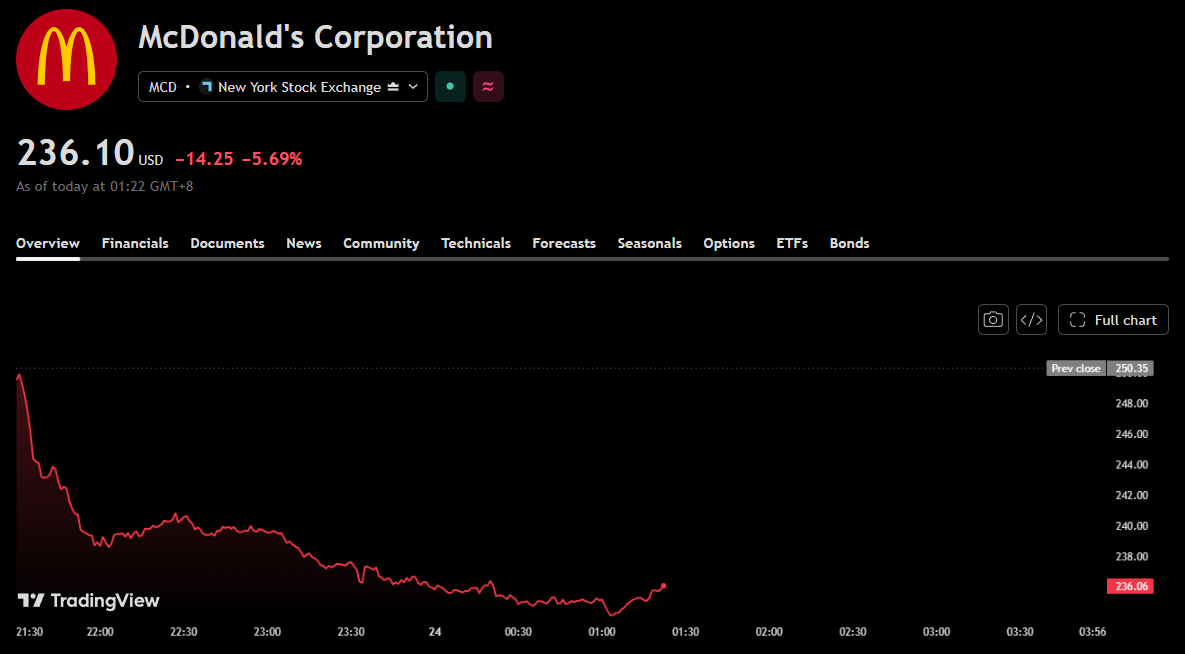
McDonald's stock chart, Source: TradingView
McDonald's expects the plan to raise its operating margin to around 50% by 2030, equivalent to an annual cash flow benefit of about $100,000 per average US restaurant. The company stated that after accounting for the support funds, franchisees are expected to recover their related investments in about four years.
However, investors worry that the returns on modernization and technology investments will take years to materialize gradually, while large cash expenditures will occur upfront, potentially weakening the company's cash generation capacity in the short term.
In addition, McDonald's postponed its target of reaching 50,000 global stores from 2027 to 2028, citing reasons including more cautious consumer spending and cumulative increases in construction and development costs. The company plans to boost its operating margin to the low-to-mid 50% range by 2030, up from an adjusted operating margin of 46.9% in fiscal year 2025, while striving to gain 1.5 percentage points of market share each in chicken and beverages, and maintaining its leadership in the beef market.
McDonald's Chief Executive Officer Chris Kempczinski said in an interview with CNBC on Wednesday that the company is preparing for persistent high inflation and weak industry traffic. He said McDonald's no longer views the current inflationary environment as a transitory phenomenon, and industry traffic is not expected to see a sudden strong surge, likely remaining flat overall, while high inflation will persist for years to come.
Kempczinski stated that global inflation remains "sticky," with beef price increases being particularly pronounced. In McDonald's largest market, beef prices rose by about 14% last year and have nearly doubled over the past five years. He believes that in such an environment, winning market share is key to the company's future growth.
McDonald's believes that chicken and beverages offer the main room for expanding market share. The global chicken market is worth approximately $130 billion and the beef market about $50 billion, with McDonald's holding a market share of about 20% in chicken and about 40% in beef. The beverage market is worth roughly $230 billion, but McDonald's holds a share of only about 10%.
The NEXT strategy also treats efficiency gains as an important means to cope with cost pressures, reducing the company's reliance on menu price hikes. Kempczinski acknowledged that McDonald's needs to be more cautious when setting prices, noting that previous price increases had exceeded what some consumers could afford. He stated that the company could try to pass on some costs, but must ensure it delivers better value to consumers than its competitors.
Currently, the core concern for the market is whether franchisee support and store upgrades can translate into higher operational efficiency and market share while short-term cash flow is under pressure. McDonald's needs to deliver the long-term returns of its NEXT strategy in an environment marked by weak guest traffic, persistently rising costs, and heightened consumer price sensitivity.
This content was translated using AI and reviewed for clarity. It is for informational purposes only.
Recommended Articles








Comments (0)
Click the $ button, enter the symbol, and select to link a stock, ETF, or other ticker.