


Nasdaq Rebounds 1% After Yesterday's 5% Slump Led by Tech, SpaceX Shares Jump Over 8%



AI Podcast


On Eastern Time November 6, U.S. stocks diverged as strong nonfarm payrolls of 165,000 for October fueled December rate hike bets, pushing the Nasdaq up 1.09% and S&P 500 up 0.31%, while the Dow fell 0.46%. Semiconductor stocks rebounded strongly. In corporate news, Microsoft reportedly declined to renew an older-generation GPU contract with Oracle; OpenAI reaffirmed its infrastructure investment plans regardless of election results; and TSMC evaluated 3D DRAM manufacturing at Nvidia's request. Meanwhile, Musk projected robust long-term revenue growth for SpaceX.

TradingKey - On Friday, November 6, Eastern Time, U.S. stocks diverged. After a sharp decline the previous day, chip stocks attracted some investors to buy the dip, driving a rebound in the Nasdaq and the S&P 500, while the Dow remained under pressure. Meanwhile, stronger-than-expected employment data prompted the market to raise bets on a Federal Reserve rate hike in December.
At the close, the Dow Jones Industrial Average fell 0.46% to 51,285.73 points; the Nasdaq Composite Index rose 1.09% to 24,579.42 points; and the S&P 500 Index rose 0.31% to 7,376.86 points.
Tech Stock Performance
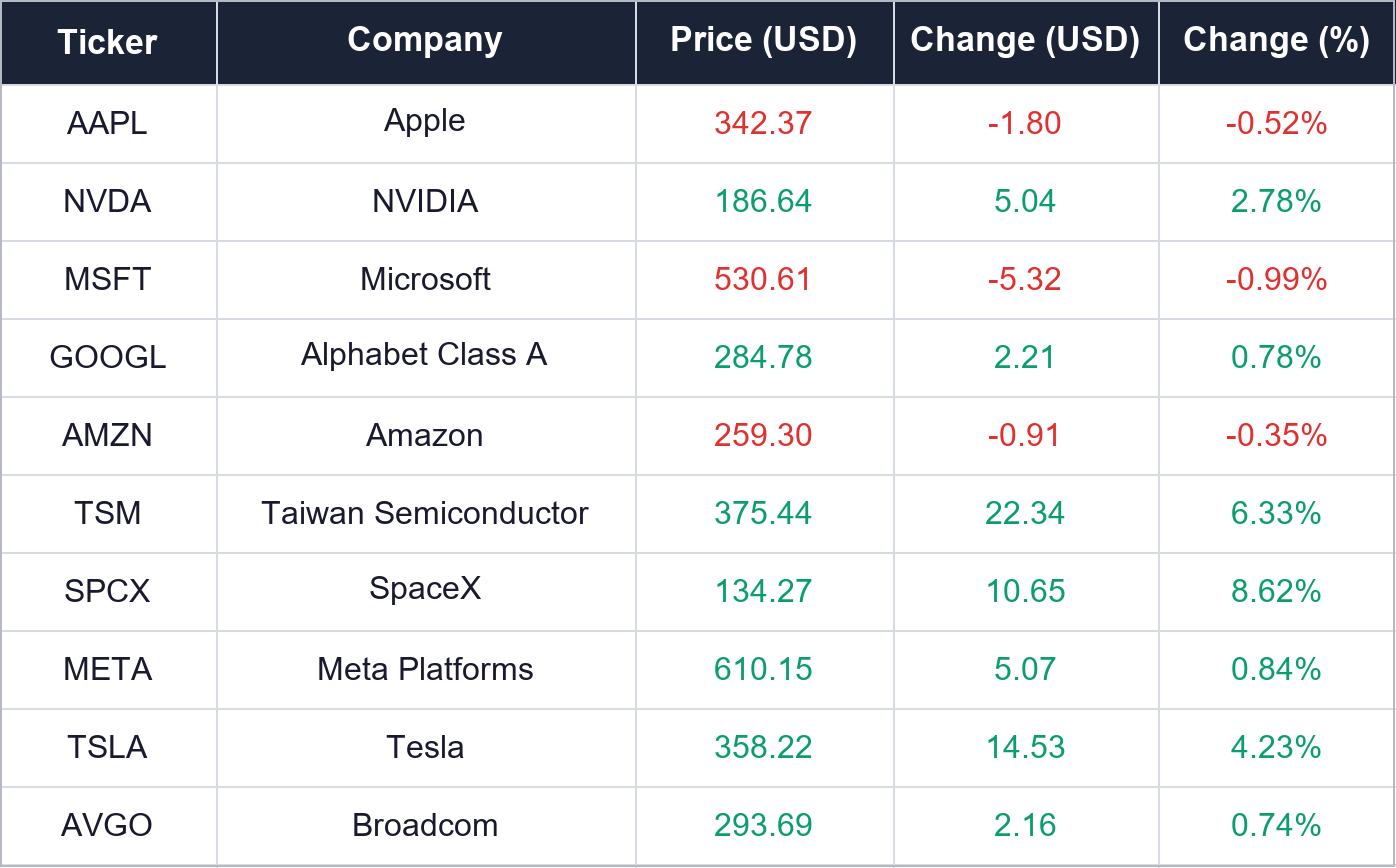
SpaceX (SPCX) rose 8.62% to $134.27.
In an interview on Friday, Musk said he still expects SpaceX's annualized revenue to exceed $500 billion by the end of 2027, calling it the most reasonable forecast. He noted that reaching $1 trillion is not entirely impossible, but personally estimated the probability at only about 2%. He also projected that annualized revenue in the fourth quarter of 2026 will exceed $100 billion, up about 70% from the third quarter; the share of revenue from the U.S. government will be below 10% this quarter and drop to under 5% a year later. Musk emphasized that these figures represent personal expectations, not commitments.
The performance of mega-cap tech stocks today is shown in the chart below:
The Philadelphia Semiconductor Index rose 4.21% to 9,390.25. Among its 30 constituents, 28 rose and 2 fell.
Company News
Microsoft Reportedly Opts Not to Renew Oracle AI Computing Contract Involving Older-Generation GPU Resources
According to Bloomberg citing people familiar with the matter, Microsoft (MSFT) has opted not to renew an AI computing power leasing contract with Oracle (ORCL) and has gradually phased out the related computing resources in recent months. The people said the servers provided by Oracle use older-generation Nvidia chips that no longer meet Microsoft's current technical specifications. The two companies reached the agreement in 2023 to provide computing power for the AI search engine Bing, with the contract value undisclosed. Oracle responded that demand for its AI infrastructure remains strong and older-generation GPUs still have a market. Meanwhile, Microsoft is also reassessing its external computing partnerships. Reportedly, the company has previously committed more than $80 billion in computing lease spending to emerging cloud providers such as CoreWeave, Nscale, and Nebius.
OpenAI CFO: Election Results Will Not Change AI Infrastructure Investment Plans
OpenAI Chief Financial Officer Sarah Friar said in an interview with CNBC on Friday that the company will not change its AI infrastructure investment plans due to the midterm election results, and will continue to partner with major cloud providers and raise capital to meet customer demand. Friar noted that AI demand is real and continues to grow. Facing increased scrutiny over data center construction, the company will strengthen communication with local communities to address concerns regarding electricity prices, the environment, and jobs, as well as build trust. OpenAI confidentially filed for an initial public offering with the U.S. SEC in June. Friar said the company is still considering going public in 2027, and negotiations for a new funding round are also underway, with a pre-money valuation of approximately $1.25 trillion.
TSMC Reportedly Evaluating 3D DRAM Manufacturing Plans at Nvidia's Request
According to The Information citing two people familiar with the matter, TSMC (TSM) is considering entering advanced memory manufacturing and, at Nvidia's request, has begun planning 3D DRAM production. The initiative remains in the evaluation stage, and a timeline for mass production has not yet been determined. 3D DRAM increases capacity density by vertically stacking memory cells. Currently, Samsung Electronics, SK Hynix, and Micron dominate memory chip manufacturing, and all three are also developing 3D DRAM technology. If TSMC moves forward with the plans, it will further expand its footprint in the AI hardware supply chain.
Industry & Macro News
US October Nonfarm Payrolls Rise by 165,000, Fueling Bets on December Rate Hike
Data released by the US Bureau of Labor Statistics on Friday showed that nonfarm payrolls increased by 165,000 in October, topping the 65,000 expected in a Reuters poll; the unemployment rate edged down to 4.1%, and job gains for the prior two months were both revised upward. Job growth was driven primarily by sectors including professional and business services and healthcare. Following the data release, US short-term interest rate futures fell as traders ramped up bets on a Federal Reserve rate hike in December. The labor market's resilience provides room for the Fed to remain focused on inflation, though officials will still receive another employment report and subsequent inflation data before their December policy meeting.
This content was translated using AI and reviewed for clarity. It is for informational purposes only.
Recommended Articles







Comments (0)
Click the $ button, enter the symbol, and select to link a stock, ETF, or other ticker.