


Marvell Stock Price Forecast: All-Stock Acquisition of Lumentum Drags Shares to Near Seven-Month Low as Key $110 Support Faces Test



AI Podcast


Marvell Technology’s proposed all-stock acquisition of Lumentum for an enterprise value of approximately $115 billion has triggered heavy selling, sending its shares down 16.43% to $133.55. While the merger strategically unites electrical and optical connectivity for AI data centers, the market has expressed concerns over substantial share dilution, a high valuation premium, and an extended timeline to the first half of 2028. Consequently, major financial institutions including TD Cowen and Bank of America have downgraded the stock and slashed price targets. Technically, the stock remains in a bearish trend, with critical downside support monitored near the $110 to $135 range.

TradingKey - Marvell Technology (MRVL) announced an all-stock acquisition of Lumentum (LITE), following which its shares came under continuous selling pressure. MRVL closed down 16.43% on Thursday at $133.55, touching an intraday low of $132.54 and falling back near a seven-month low.
The market is not questioning the long-term demand for AI optical communications; rather, it is concerned that Marvell paid too high a price to strengthen its related business. Under the agreement, Lumentum shareholders will receive 4.5 Marvell shares for each share of LITE held. The transaction implies an enterprise value of approximately $115 billion, representing a premium of about 23.9% over the stock price before the news emerged. Upon completion of the transaction, existing Marvell shareholders' ownership will drop to approximately 67%, while Lumentum shareholders will hold about 33% of the combined company.
Why All-Stock Acquisition Drags Down Both MRVL and LITE Shares
Unlike a fixed cash offer, the transaction employs a fixed exchange ratio, meaning Lumentum's actual acquisition value fluctuates in tandem with Marvell's stock price. When MRVL declines, the consideration LITE shareholders stand to receive also shrinks, resulting in both stocks dragging each other down.
For Marvell's existing shareholders, the primary concern is share dilution. Lumentum shareholders will hold approximately a one-third stake in the combined company, meaning Marvell must rely on faster revenue growth, margin expansion, and cost synergies to offset the impact of the newly issued equity on earnings per share.
The deal's sheer scale has also heightened market skepticism. Valuing Lumentum's equity at approximately $102.5 billion, the transaction not only exceeds any of Marvell's previous acquisitions, but also represents more than half of its market capitalization prior to the deal's announcement. Analysts note that the transaction values Lumentum at approximately 33 times its next-12-month core operating profit, significantly above the industry median of around 16 times.
Because the transaction is not expected to close until the first half of 2028, investors also face an extended period of uncertainty. During this time, both parties must secure shareholder and regulatory approvals, while guarding against risks such as customers seeking alternative suppliers and business integration progressing slower than anticipated.
Can AI Optical Communication Strategy Justify Costly Acquisition
From an industry logic perspective, Marvell's acquisition of Lumentum serves a clear strategic purpose. As computing scale in AI data centers expands, traditional copper connections are increasingly struggling to meet bandwidth, transmission distance, and power consumption requirements, and optical interconnects are gradually becoming critical infrastructure within server clusters and between data centers.
Marvell possesses networking chips, custom AI chips, and data center connectivity products, while Lumentum specializes in lasers, optical components, and high-speed communications technology. After the merger, the two companies can integrate electrical connectivity and optical technology into a unified platform, offering cloud computing customers complete solutions spanning chips, networking, and optical transmission.
Management projects that the combined company's addressable market will expand to $550 billion, with the potential to achieve over $1 billion in annual cost synergies. Marvell also expects the deal to be accretive to non-GAAP EPS in the first full year following the close of the transaction.
However, it will take considerable time for these advantages to translate into financial results. In the near term, Marvell will need to absorb integration costs, increased manufacturing complexity, and higher execution risks. If AI capex growth decelerates, or if major cloud service providers step up in-house optical communications solutions, the growth expectations underpinning the acquisition could also be revised downward.
Wall Street Cuts Ratings and Price Targets as Market Reassesses Deal Value
Following the M&A announcement, analyst sentiment on Marvell cooled. TD Cowen downgraded Marvell from "Buy" to "Hold" and sharply slashed its price target from $350 to $175. The firm believes that while the strategic direction of acquiring Lumentum is attractive, issues remain with the transaction structure and timing of execution, projecting that the deal could dilute Marvell's earnings per share by a mid-single-digit percentage in 2028 after completion.
Bank of America also downgraded Marvell from "Buy" to "Neutral" and lowered its price target from $400 to $225. While the firm acknowledged that the merger could build a comprehensive platform spanning electrical and optical connectivity, it noted that more than $1 billion in annual cost synergies may not necessarily offset the impact of equity dilution. In addition, an extended transaction timeline and potential customer conflicts increase uncertainty for future business integration.
Analysts' shift toward caution suggests that the market is not questioning Lumentum's technological value, but is instead recalculating the price Marvell is paying for these assets. For a semiconductor company still in the expansion phase of AI infrastructure, R&D investment, capacity building, and customer orders already require substantial capital. Adding a large-scale acquisition on top of that means management must prove that financial and equity resources can generate sufficiently high returns.
Meanwhile, the combined Marvell will also need to manage customer relationship challenges. The company not only partners with AI chipmakers such as Nvidia, but also serves major cloud service providers and custom chip customers. As its business scope expands from electrical connectivity to broader optical products, customers may re-evaluate competitive dynamics and technical information isolation arrangements among suppliers. If customers become concerned about sharing a supply chain with competitors, certain orders could be impacted.
Marvell Stock Technical Analysis: Can $110 Support Hold?
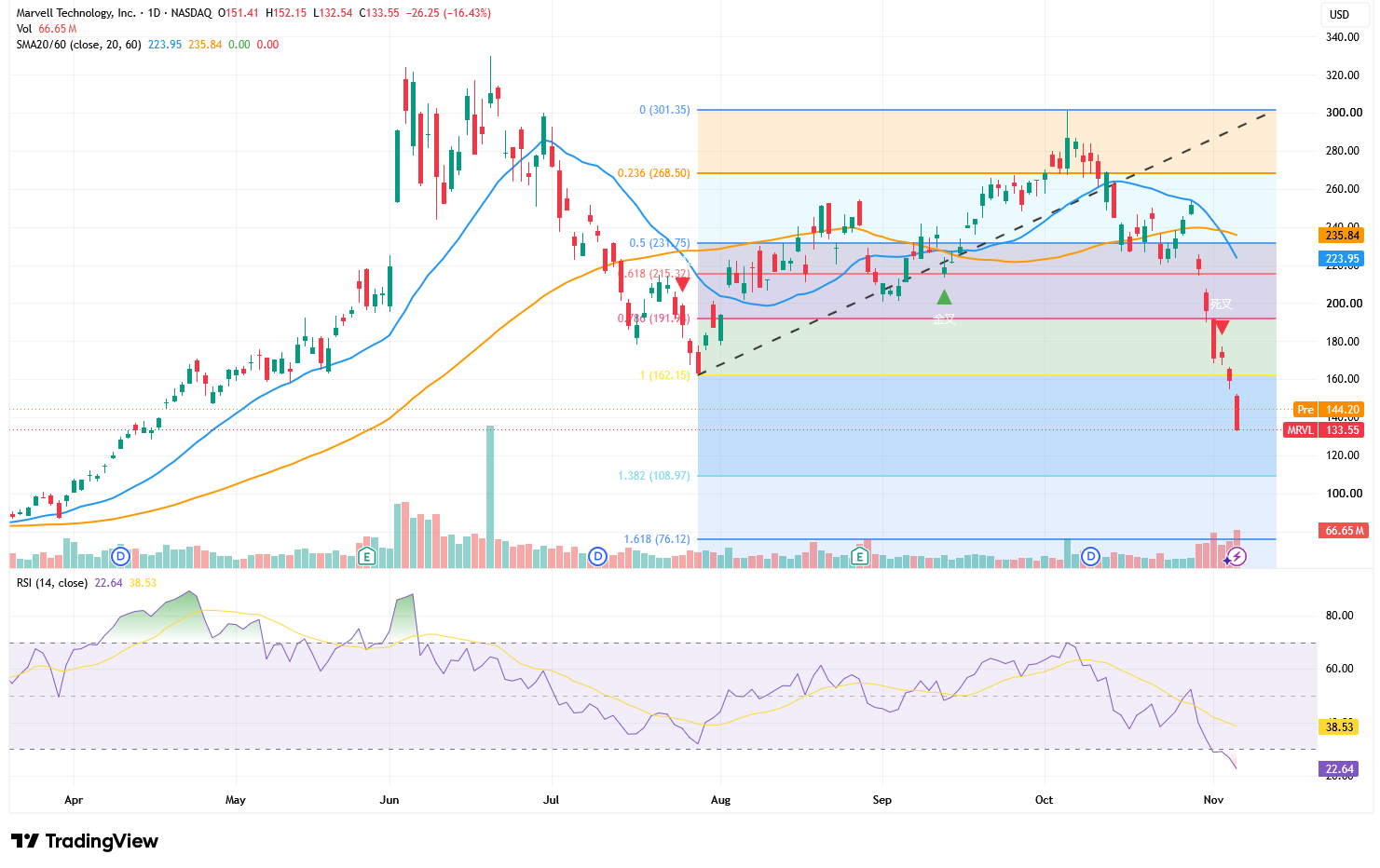
Source: TradingView
From a technical perspective, Marvell's share price has tumbled on heavy volume, closing at $133.55 on Thursday. The stock has consecutively broken below its prior low of $162.15, the $155 support, and the $150 psychological level, while sitting well below its 20-day moving average of $223.95 and 60-day moving average of $235.84, turning the medium- to short-term trends completely bearish. The previous upward trendline has also been decisively broken, largely invalidating the prior rebound structure.
The RSI has dropped to 22.64 into deeply oversold territory. Although a technical rebound may occur in the short term, oversold conditions do not mean a bottom has formed. To the upside, the initial focus is on the $144–$150 resistance zone, with further resistance at $160–$162; only a reclaim of $162 would provide preliminary relief from current downside risks.
Key downside support sits at $130–$135, corresponding to the consolidation platform from the early-April rally. If the stock closes below $130, it could fall further to test $120, followed by the 1.382 Fibonacci extension level at $108.97 (near $110), representing about 18% downside from current levels. At this stage, until the stock retakes $150, any rebound should still be viewed as an oversold bounce rather than a trend reversal.
This content was translated using AI and reviewed for clarity. It is for informational purposes only.
Recommended Articles











Comments (0)
Click the $ button, enter the symbol, and select to link a stock, ETF, or other ticker.